KEY INSIGHTS
- A pattern, not an anomaly: From Ukraine to Gaza to Venezuela, a cohort of ultra-nationalist states now openly employs coercion to acquire territory or strategic advantage, treating international law as optional.
- Personal power, not just national interest: Private ambitions — Netanyahu’s legal jeopardy, Trump’s pursuit of wealth and prestige — increasingly drive military decisions that are dressed up as matters of national security.
- Institutional collapse accelerating: The United Nations Security Council (UNSC), the World Trade Organization (WTO), and NATO are all declining in effectiveness; responsible governments should already be drawing up contingency plans.
- Reform is structurally possible: Article 109 of the UN Charter offers a route to institutional reform that bypasses the veto powers of the Security Council’s permanent five members; The Hague Group’s accountability work on Israel points toward the kind of enforcement mechanism the world needs.
- Moral clarity is irreducible: It is entirely consistent to condemn the Israeli-US attack on Iran as unlawful and reckless while also recognising the Iranian government as a brutal, repressive regime — double standards serve no one.
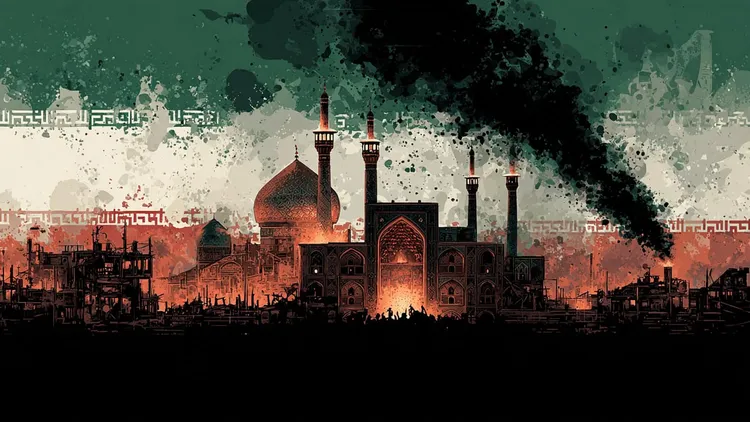
In one sense, the Israeli-American attack on Iran merely continues a well-worn trajectory: the Russian invasion of Ukraine in 2022; Azerbaijan’s takeover of Nagorno-Karabakh in 2023; Israel’s destruction of Gaza and its assaults on Syria and Lebanon between 2024 and 2025; the US abduction of President Nicolás Maduro in Venezuela and its threats to acquire Greenland by force, both in 2026. Each episode is an example of powerful states unapologetically threatening or using coercion to acquire territory or other strategic advantage. Private — even personal — interests and convictions of individual rulers play an important role alongside national security calculations and civilisational narratives. Consider Prime Minister Benjamin Netanyahu’s evident interest in staying out of court as one driver of Israeli military action, or President Donald Trump’s pursuit of wealth and glory in the case of the United States.
The ruling elites of these countries share a pronounced sense of superiority towards their neighbourhood and, in some cases, towards the rest of the world — while showing little accountability for, or even reflection on, the consequences of their military decisions. Those decisions are routinely disguised as serving essential national interests. The cases also represent flagrant violations of international law for which their perpetrators have, so far, faced no meaningful sanction. Most attacks have produced large-scale destruction, displacement, and killing. Nothing new here, one might shrug, pointing to countless historical precedents.
But something genuinely new is also afoot: the rise to greater prominence of righteous and ultra-nationalist states with imperial-style ambitions. The ruling elites of these states operate on the assumption that the uniqueness they claim for themselves, combined with the military strength they possess, simply entitles them to realise whatever future they aspire to. If doing so requires the subjugation of others, the instilling of permanent fear, or the spreading of death, so be it. In some cases, subjugation itself is the point.
The resulting military adventurism treats the lives of thousands of others as easily expendable — as well as those of their own citizens, who are naturally recast as “heroes” once they have been sacrificed. Russia, Israel, the United States, and, to a lesser extent, Azerbaijan all fit this logic. China is waiting in the wings, alongside a handful of other candidates. Most of these states maintain outsized territorial claims — from the “Russian world” to the Monroe/Trump doctrine, Greater Israel, the nine-dash line, and Taiwan — and view themselves as the leading lights of one civilisation or another.
At the same time, the capacity of other countries to come together and halt the destruction wrought by these ultra-nationalist states is weaker than it once was. This is the product of a convergence of division, competition, dependency, and multipolarity.
Division is especially pronounced in Latin America, where governments of the left and right remain deeply at odds; in the European Union (EU), where divergent political cultures, conflicting threat perceptions, and the narrow nationalist outlook of many member states fragment any collective response; and across Asia, where some countries seek to accommodate China while others seek to contain it. Competition is fierce in the Gulf — Saudi Arabia, the Emirates, and Qatar all jostling for position — and is equally evident in the rivalries between India and both Pakistan and China, or among the states of the Horn of Africa.
Dependencies, in turn, are typically a product of poor governance — the political economies of Egypt and Jordan, for instance, generate fiscal deficits that Gulf states or the International Monetary Fund (IMF) are called upon to plug — of historical trajectories, such as Europe’s reliance on the United States in security matters, and of geo-economic interests, as illustrated by the German chancellor’s proposal to exclude Iran from international law in order to preserve US deliveries of liquefied natural gas (LNG).
Multipolarity, finally, means that states hedge their bets and build overlapping alliances calibrated not to offend any major power. The United Arab Emirates offer a revealing example: simultaneously helping Russia evade sanctions, working with Israel and the United States on artificial intelligence, and serving as a “comprehensive strategic partner” of China while continuing to export oil to it.
The military onslaught pursued by American, Russian, and Israeli ultra-nationalists carries serious consequences, however — not just for the regions they are setting ablaze, but for the entire community of nations.
To begin with, these states are dismantling international law as a fragile but vital safety barrier governing the conduct of states, and in particular the use of force. If they succeed in doing so permanently, Thucydides’ Melian dialogue will be put on permanent repeat, and nuclear proliferation becomes practically inevitable. Countries can rationally conclude that only nuclear weapons offer a viable defence against conventional military superiority. It is an open question why Iran and Taiwan have not yet drawn that conclusion. Nuclear obliteration thus inches closer.
The ultra-nationalist-cum-imperialists are also putting key institutions on the road to irrelevance — institutions that once functioned reasonably well as guardrails against international misbehaviour, however imperfectly and unevenly. The UNSC has achieved little of consequence in any major geopolitical crisis since the Arab uprisings of 2011. The WTO is effectively defunct. NATO, as a defensive alliance, is in slow decline — a process accelerated by the US attempt to incorporate Greenland. These institutions will persist, but responsible governments will have already begun contingency planning.
Where does this leave us? The doomsday scenario is a gated world presided over by networks of privileged individuals who run militarily capable states and dominate poorer, voiceless populations as a matter of right and course. Conflict, climate change, and migration are likely, in the end, to overwhelm even such “gated communities” — generating still greater misery all around.
Alternatively, these ultra-nationalist-cum-imperialist networks may encounter growing resistance: from within their own coalitions, as the question of who is in and who is out sharpens; from the blowback effects of their own military adventurism; and from a global revulsion at the destruction they leave behind.
That resistance can open the way to a radical reconfiguration of global governance. In the medium term, this could be advanced by building on the cautious start that The Hague Group has made in holding Israel accountable, or by pursuing the route offered by Article 109 of the UN Charter, which enables institutional reform without the possibility of a veto by the permanent five members of the Security Council (P5). Such a process could make global decision-making more equitable and representative, while also strengthening enforcement through international courts operating on principles of primacy, direct and indirect effect — analogous to the architecture of EU law — along with greater sanctioning powers and an independent international military force. Such a force could be modelled on the standing troops originally envisaged in Articles 43–47 of the current UN Charter.
In the short term, however, there is no substitute for courageous states and leaders drawing a clear line against the human misery inflicted by ultra-nationalist, imperial-style military adventurism. At that level, our own moral commitments and actions matter more than process and policy.
It is entirely possible — and indeed necessary — to hold two things to be true simultaneously: that the Israeli-US attack on Iran is unlawful and reckless adventurism unlikely to produce anything good, and that the Iranian government is a highly repressive and brutal regime, on a par with Israel itself given its conduct in Gaza.
Either way, the US-Israeli attack on Iran makes it unequivocally clear that turning the tide of empire-style ultra-nationalism cannot wait.

Help Keep Social Europe Free for Everyone
We believe quality ideas should be accessible to all — no paywalls, no barriers. Your support keeps Social Europe free and independent, funding the thought leadership, opinion, and analysis that sparks real change.
— €4.75/month
Help sustain free, independent publishing for our global community.
Become a supporter— €9.50/month
Go further: fuel more ideas and more reach.
Become an advocate— €19/month
Make the biggest impact — help us grow, innovate, and amplify change.
Become a champion— €142.50/month
For organisations and professionals who rely on Social Europe in their daily work.
Become a member