Prime Minister Viktor Orbán famously boasted of turning Hungary into an “illiberal democracy.” In reality, Hungary has ceased to be a genuine democracy and is best understood as “a hybrid regime of electoral autocracy,” according to the European Parliament, or as a “post-communist mafia state” modelled on Putin’s Russia, in the view of Bálint Magyar, the sociologist and former government minister.
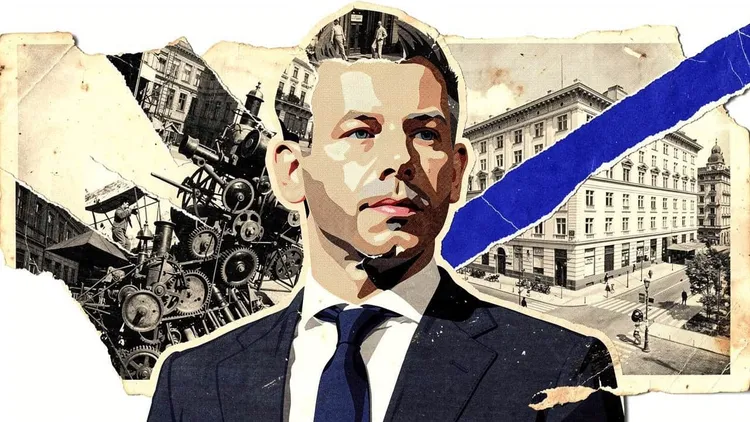
Yet, after 15 years of uninterrupted Fidesz rule, the party’s political ascendancy is no longer assured. With parliamentary elections scheduled for spring 2026, Fidesz has been trailing an opposition party, Tisza, for over a year, although recent polls suggest that Tisza’s lead has narrowed. Led by Péter Magyar—previously an obscure, if comparatively senior, figure within Fidesz and the ex-husband of Orbán’s former Minister of Justice, Judit Varga—Tisza has adopted much of the rhetoric and symbolism that brought Fidesz electoral success. A self-declared conservative with a commitment to Christian values, Magyar frequently appears at political rallies brandishing a large Hungarian flag. The symbolism is potent in a country with long, painful memories of foreign occupation—Ottoman, Habsburg, Nazi German, Soviet—and where nationalist sentiment runs deep.
Fidesz’s efforts to portray itself as the only genuinely patriotic political party have made little headway against Tisza and its flag-bearing leader. At the same time, Magyar has attracted enthusiastic support by promising to end Hungary’s isolation within the EU, and to halt the nepotism, corruption, and assaults on democracy that have characterised Fidesz’s decade and a half in power.
The odds are stacked against change
Despite Magyar’s success in mounting a credible challenge to Orbán and Fidesz within a remarkably short time—he only became leader of the previously obscure Tisza party in 2024—he faces an uphill struggle. Although Hungary’s economy remains stagnant, the government has promised a series of costly economic measures—increased pensions, lifetime relief from income tax for mothers with two or more children, generous government loans for prospective homeowners—that have helped to boost its flagging popularity.
Fidesz’s dominance of the country’s print and electronic media poses a further challenge for the opposition. The media landscape has been described as “the most sophisticated system of media capture and control yet seen within the European Union.” Even before the recent acquisition of Hungary’s most popular tabloid newspaper, Blikk, by a media company with close ties to Fidesz, Orbán and his associates controlled 80 per cent of the country’s media. Tisza is confronted by a media environment that is overwhelmingly hostile and that sees its overriding mission as providing the government with unstinting support. At the same time, the dwindling number of independent journalists still active in Hungary report “targeted harassment and smear campaigns.”
Orbán can also count on successive changes to Hungary’s electoral laws that severely disadvantage the opposition. These include the redrawing of constituency boundaries to favour Fidesz, and the extension of the franchise to ethnic Hungarians in neighbouring countries who have been systematically courted by the Orbán administration. Overwhelmingly loyal to Fidesz, ethnic Hungarians in countries bordering Hungary are permitted to cast a postal vote. By contrast, Hungarians working or studying in Western Europe or North America, whose political allegiances are more varied, can only vote at a Hungarian consulate or embassy, which may entail a lengthy and time-consuming journey.
There has even been speculation that, if polls indicate Fidesz has little or no prospect of winning an election next spring, it might resort to more draconian measures such as postponing the election or finding a legal pretext to prevent Péter Magyar from running. However, Orbán and his advisers will be aware that such blatant interference with the electoral process could be politically counterproductive. More realistically, like the populist Law and Justice party (PiS) in Poland, which lost power following elections to the Sejm in 2023 while retaining support from parts of the judiciary and from Poland’s president, Fidesz could use a period in opposition to try to undermine the incoming administration and prevent it from governing effectively. Given the sheer scale of Fidesz’s institutional capture within Hungary, its profound, mutually beneficial ties to prominent businessmen, and its undoubted ruthlessness, the challenges facing an incoming Magyar government are likely to be far more daunting than those experienced by the Tusk administration in Poland.
The enigma of Péter Magyar
For many people in Hungary, anxious for a return to constitutional democracy, Péter Magyar remains a worrying enigma. Although Magyar has been uniquely successful in mounting a serious challenge to Orbán and Fidesz, his democratic credentials remain suspect in the view of some observers. In contrast to the numerous politicians, journalists, and scholars who are longstanding critics of Fidesz, Magyar’s transition to the opposition ranks, in early spring 2023, was belated. It is conceivable that thwarted ambition and increasingly strained relations with senior figures within Fidesz, rather than ethical concerns or ideological conviction, prompted Magyar to quit the ruling party and form a rival political movement.
Even if such criticisms of Magyar’s motives are justified, there is reason to believe that, should Tisza convincingly win the elections in spring 2026—a two-thirds majority of the members of Hungary’s National Assembly is required to amend so-called “cardinal” laws—Magyar may succeed in undoing at least some of the harm that Orbán and Fidesz have wrought. Even if Magyar were tempted to emulate Orbán by acquiring semi-dictatorial powers and creating a kleptocracy, political self-interest would compel him to abandon such thoughts. Magyar’s appeal to Hungary’s electorate lies in his nationalist, conservative outlook and in his unequivocal rejection of the worst features of Fidesz’s rule. Replicating Fidesz’s authoritarian, anti-democratic policies or its systematic nepotism and corruption would be tantamount to political suicide for Magyar and for the party he leads.

Help Keep Social Europe Free for Everyone
We believe quality ideas should be accessible to all — no paywalls, no barriers. Your support keeps Social Europe free and independent, funding the thought leadership, opinion, and analysis that sparks real change.
— €4.75/month
Help sustain free, independent publishing for our global community.
Become a supporter— €9.50/month
Go further: fuel more ideas and more reach.
Become an advocate— €19/month
Make the biggest impact — help us grow, innovate, and amplify change.
Become a champion— €142.50/month
For organisations and professionals who rely on Social Europe in their daily work.
Become a member