KEY INSIGHTS
- A staggering queue: 174,922 candidates applied for just 1,500 EU civil service positions, nearly three times the expected number.
- Supply-side illusion: Europe built an education pipeline without ensuring the economy could absorb its graduates.
- Credentials as targets: Workers with graduate degrees are nearly four times more represented in high-exposure occupations than in unexposed ones.
- A state-led answer: Retraining alone is a treadmill; Europe needs job creation in care, education and green sectors, with the state acting as employer of last resort.
A month ago, the EU’s career office published statistics on applications for its prestigious civil service exam. Two data points stand out. First, a total of 174,922 applications have been filed for 1,500 positions — almost three times the expected number. Second, 45 per cent of them (79,450) came from Italy. The stakes are high, of course, for a comfortable position in the EU bureaucracy: one that comes with generous pay, no national taxes, excellent insurance and substantial side benefits. But this staggering number also suggests that European labour markets are increasingly saturated. University graduates struggle to find quality jobs at home, so they settle for less — or simply look elsewhere.
That nearly half of all applications for the recent European Personnel Selection Office (EPSO) round come from Italy is no surprise. The country has long been known for a paradox. On the one hand, it has the lowest share of university graduates aged 25 to 34 in the European Union, second only to Romania. On the other, Italy records the lowest employment rate for recent graduates: 77.3 per cent, against an EU average of 86.7 per cent. Simply put, Italy “produces” comparatively few high-skilled workers; still, it struggles to match them with a job — any job.
Technological change meets tight pockets
The Italian dilemma — with tens of thousands of graduates scrambling for a few hundred EU positions — speaks volumes about the transformations Europe is undergoing. First, the sectors that employ graduates with “general” soft skills such as writing, presenting and analysing (our own trade included) are no longer the priority of governments. Soon after the pandemic, EU members poured billions of euros into education, partly through the Recovery and Resilience Facility. Now the taps are gradually closing: many countries are cutting public education and university budgets, while billions are being redirected into rearmament programmes.
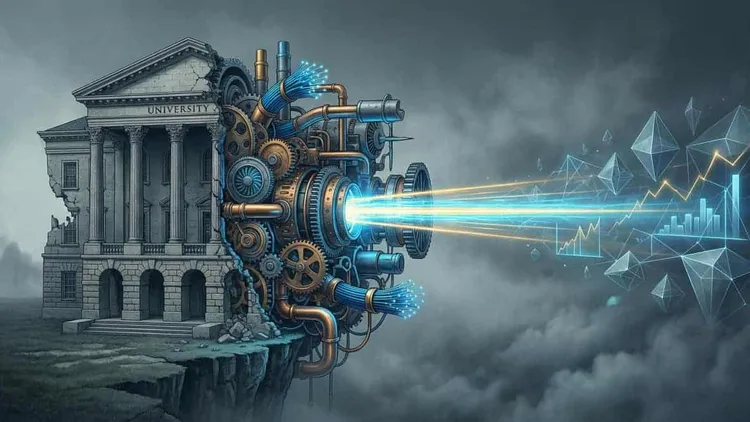
Second, artificial intelligence (AI) is reshaping the way we work, replacing many of the tasks for which the “highly educated” were paid. Europe promoted a supply-side illusion — build an education pipeline and assume, wishfully, that the economy will eventually generate the jobs to match. Countries such as Italy and Greece make the contradiction brutal and almost tragicomic: a highly educated diaspora thrives abroad, while those who stay struggle with precariousness and the rising cost of living. The pipeline leaks at both ends, and AI arrives at a critical juncture only to complicate matters further for workers and policymakers.
European labour markets are not ready for a technological revolution. The Single Market remains structurally incomplete: it may facilitate competition, but falls short in enabling coordinated industrial and labour market policies capable of generating new employment at scale. The business model chosen to drive growth rested on export competitiveness, lean public sectors and fiscal discipline. While this logic was seductive at first, it led to a gradual divergence across regions and a progressive weakening of state capacity. Governments surrendered the fiscal space needed to reshape their economies and create new jobs. Simultaneously, powerful agglomeration forces concentrated knowledge, capital and opportunity in urban centres such as Milan, Paris and Amsterdam, leaving behind regions that face chronic underinvestment, drained of their most educated young people and politically restless. Call them the geographies of content and discontent.
Whose skills is AI chasing?
We should approach AI not as a benign revolution but as an additional reason to rethink Europe’s socioeconomic model. The emerging research consensus is cautious — AI brings no jobs armageddon yet, and disruption is uneven and lagged. We are still, as one Brookings scholar put it this month, in the first inning. But the directional evidence is striking: it is precisely the high-skilled, high-salary, text-intensive occupations that face the greatest observed exposure to automation. Anthropic’s own labour market research finds that workers with graduate degrees are nearly four times as represented in high-exposure occupations as in occupations with no exposure at all. The credential that was supposed to insure you against economic disruption is increasingly the one that marks you as a target.
The consequences compound existing inequalities in ways that are almost mechanical. Early data from last year suggest a slowdown in hiring young workers into exposed roles — precisely the entry-level positions that ambitious graduates across Italy, Spain and Greece have long competed to secure, often after years of precarious internships and lateral moves. If this signal strengthens, brain drain from peripheral regions will accelerate, agglomeration pressures will intensify and the political geography of discontent will deepen further. A purely supply-side response — retrain, upskill, adapt — is necessary, but not sufficient. Retraining workers for jobs that are themselves being automated is a policy on a treadmill.
Nobody knows exactly what AI will do to advanced economies. What we do know is that the structural conditions under which the disruption is landing are already unfavourable: weak demand, exhausted states, fragmented markets and education systems designed for an economy that is quietly changing beneath them.
This calls for two parallel moves. The first is educational realism: curricula need gradual recalibration, with a serious integration of AI literacy across disciplines and levels, from primary school to universities, combined with a clearer-eyed conversation about which skills remain genuinely complementary to automation rather than replaceable by it. Judgment, care, relational intelligence, creativity and contextual knowledge are not soft consolations: they are the comparative advantage of human labour.
The second move is harder and more political: stop pretending that producing more graduates solves the problem if the economy cannot absorb them. Europe needs job-creation strategies in sectors where AI cannot easily bite and where social need is acute and growing — care work, public welfare services, early childhood education, green and digital infrastructure and security. Some of these will require the state to act not merely as a regulator or investor, but as an employer of last resort. That phrase still makes many economists flinch; it should not. The alternative — an over-educated generation without a credible economic future — is far more destabilising than a bold labour market experiment.


Help Keep Social Europe Free for Everyone
We believe quality ideas should be accessible to all — no paywalls, no barriers. Your support keeps Social Europe free and independent, funding the thought leadership, opinion, and analysis that sparks real change.
— €4.75/month
Help sustain free, independent publishing for our global community.
Become a supporter— €9.50/month
Go further: fuel more ideas and more reach.
Become an advocate— €19/month
Make the biggest impact — help us grow, innovate, and amplify change.
Become a champion— €142.50/month
For organisations and professionals who rely on Social Europe in their daily work.
Become a member