KEY INSIGHTS
- Grassroots leadership: From Shoah survivors to trade unions and academics, Belgian civil society is driving the campaign to make 8 May a national public holiday.
- Cross-party support: In April 2025 every Belgian party except the far-right Vlaams Belang backed a parliamentary resolution to elevate 8 May as an official day of remembrance.
- Parliament’s legacy: Two decades of European Parliament resolutions affirm that “there can be no reconciliation without truth and remembrance”; the institutions must now match the words with action.
- A precarious memory: Eyewitnesses are dwindling, public holidays remain rare, and far-right figures openly recast 8 May as a national defeat.
- The Auschwitz firewall: Auschwitz survivors’ call to refuse all cooperation with right-wing extremists is, in their own words, “an obligation for the future of democracy”.
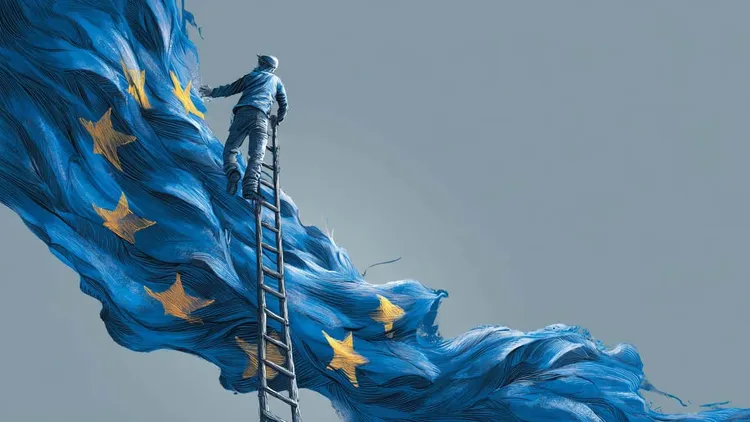
Around the 81st anniversary of the end of the Second World War in Europe on 8 May 1945, grassroots initiatives are flowering across the continent. The question is what the EU institutions will do this year.
Consider, for example, the breadth of initiatives organised across Belgium this year by Shoah victims, citizens of all ages, trade unions, social movements, artists, academics and NGOs. The diversity of actors and the geographic reach are striking. Together they argue that 8 May, the day of liberation from the horrors of the Nazi regime, should be a commemoration and a public holiday. Their joint declaration reads: “To commemorate, to warn, to defend. As a moment of social cohesion. As a jointly expressed will for peace and solidarity. As a call to action. So that young and old can see what hatred can lead to and what an ugly beast fascism is. Because only when you know the past and we remain vigilant about our constitutional freedoms, only then can we, now and in the future, make the right choices. So that this terrible history never, ever repeats itself! Because whoever remains silent now must fear everything. It is time for a May 8th coalition.“
In April 2025, the coalition and its allies persuaded the Belgian Parliament to “call on the federal government (…) to also highlight, on May 8, 2025, as part of the official commemorations and ceremonies (…); to emphasize, within the framework of these commemorations and other initiatives related to the duty to remember, the transnational aspects of European resistance movements and the links between resistance to Nazism and fascism and the idea of a democratic European integration, particularly in connection with Europe Day, which takes place on May 9 each year; (..) to designate May 8 as the official day of remembrance for the resistance and all victims of World War II, with a view to organizing an official commemorative ceremony each year, and to examine how to give the event public visibility“. Every Belgian party endorsed the resolution; only the far-right Vlaams Belang, affiliated with Patriots for Europe, abstained. A substantive response from the federal government remains outstanding.
What holds for Belgium holds for much of the continent: countless grassroots initiatives are unfolding across European countries. For social movements such as the trade union movement, May 8 and 9 are deeply intertwined. The defeat of fascism paved the way for the democratic reconstruction of Europe. The European project that followed was built not only on peace among nations, but also on the idea of societies founded on democracy, solidarity, social rights, and workers’ rights. Unions have played a central role in this process through collective bargaining, social protection systems, and workplace democracy. At a time when the far right is once again attacking unions, migrants, minorities, and democratic counter-powers, this memory also becomes a union and civil society responsibility.
From that vantage point, it is worth turning to the European institutions, and to the European Parliament in particular and initiatives linked to the liberation day. Over the past two decades, MEPs have adopted a series of resolutions whose substance and legacy still resonate. They concern, among other things, European historical consciousness, the importance of European remembrance for the future of Europe, the European Day of Remembrance for Victims of Stalinism and Nazism and, more specifically, the 60th anniversary of the end of the Second World War in Europe on 8 May 1945. Parliament has underlined “the importance of keeping the memories of the past alive, because there can be no reconciliation without truth and remembrance” and emphasised “at the same time that only a strong Europe can offer a means of overcoming the atrocities of the past“. It expressed “respect for, and pays tribute to, all who fought against tyranny, and particularly those who became its victims“.
Although 8 May stands as a symbol of liberation for most Europeans, remembrance has become precarious in at least three ways. First, the eyewitnesses to the Nazi and Holocaust horrors are dwindling, taking with them the testimony only they could give. Second, institutional remembrance varies sharply across Europe: there is general commemoration, but only a handful of public holidays, in countries such as France and Czechia. Third, remembrance is now under sustained attack from the far right and from Putin’s apologists. The AfD’s Alice Weidel has gone so far as to call 8 May the “defeat of one’s own country“, and Vlaams Belang’s Tom Van Grieken told an AfD audience: “Once you kneel, you kneel again and again, be proud“.
It is precisely in the spirit of those victims that we wish to echo the call of the International Auschwitz Committee: “For the survivors of Auschwitz, the “firewall” against cooperation with right-wing extremists is not only an obligation to them, but also an obligation for the future of democracy.”
How can we act decently in light of this past, to continue commemorating the liberation, in a way that builds bridges within our communities and stands unequivocally against policies that discriminate, that openly invoke the crimes of the Second World War, or that fail to condemn them?
We have taken part in and followed the commemorations of recent years. Today, we look towards the next institutional moments — European Parliament plenaries and Council meetings — and ask what kind of memory policy will rise to the height of the past and the demands of our times.

Help Keep Social Europe Free for Everyone
We believe quality ideas should be accessible to all — no paywalls, no barriers. Your support keeps Social Europe free and independent, funding the thought leadership, opinion, and analysis that sparks real change.
— €4.75/month
Help sustain free, independent publishing for our global community.
Become a supporter— €9.50/month
Go further: fuel more ideas and more reach.
Become an advocate— €19/month
Make the biggest impact — help us grow, innovate, and amplify change.
Become a champion— €142.50/month
For organisations and professionals who rely on Social Europe in their daily work.
Become a member