Social Europe

politics, economy and employment & labour

  • Projects
    • Corporate Taxation in a Globalised Era
    • US Election 2020
    • The Transformation of Work
    • The Coronavirus Crisis and the Welfare State
    • Just Transition
    • Artificial intelligence, work and society
    • What is inequality?
    • Europe 2025
    • The Crisis Of Globalisation
  • Audiovisual
    • Audio Podcast
    • Video Podcasts
    • Social Europe Talk Videos
  • Publications
    • Books
    • Dossiers
    • Occasional Papers
    • Research Essays
    • Brexit Paper Series
  • Shop
  • Membership
  • Ads
  • Newsletter

The Eurozone’s German Problem

by Philippe Legrain on 27th July 2015 @plegrain

TwitterFacebookLinkedIn
Philippe Legrain

Philippe Legrain

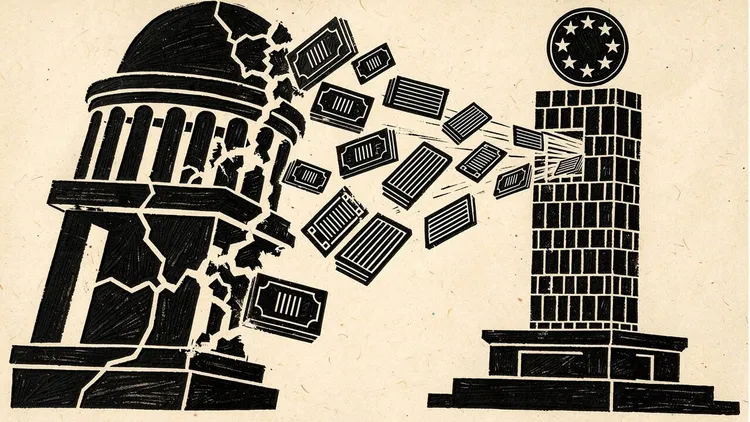
The eurozone has a German problem. Germany’s beggar-thy-neighbor policies and the broader crisis response that the country has led have proved disastrous. Seven years after the start of the crisis, the eurozone economy is faring worse than Europe did during the Great Depression of the 1930s. The German government’s efforts to crush Greece and force it to abandon the single currency have destabilized the monetary union. As long as German Chancellor Angela Merkel’s administration continues to abuse its dominant position as creditor-in-chief to advance its narrow interests, the eurozone cannot thrive – and may not survive.

Germany’s immense current-account surplus – the excess savings generated by suppressing wages to subsidize exports – has been both a cause of the eurozone crisis and an obstacle to resolving it. Before the crisis, it fueled German banks’ bad lending to southern Europe and Ireland. Now that Germany’s annual surplus – which has grown to €233 billion ($255 billion), approaching 8% of GDP – is no longer being recycled in southern Europe, the country’s depressed domestic demand is exporting deflation, deepening the eurozone’s debt woes.

Germany’s external surplus clearly falls afoul of eurozone rules on dangerous imbalances. But, by leaning on the European Commission, Merkel’s government has obtained a free pass. This makes a mockery of its claim to champion the eurozone as a rules-based club. In fact, Germany breaks rules with impunity, changes them to suit its needs, or even invents them at will.

Indeed, even as it pushes others to reform, Germany has ignored the Commission’s recommendations. As a condition of the new eurozone loan program, Germany is forcing Greece to raise its pension age – while it lowers its own. It is insisting that Greek shops open on Sundays, even though German ones do not. Corporatism, it seems, is to be stamped out elsewhere, but protected at home.

Beyond refusing to adjust its economy, Germany has pushed the costs of the crisis onto others. In order to rescue the country’s banks from their bad lending decisions, Merkel breached the Maastricht Treaty’s “no-bailout” rule, which bans member governments from financing their peers, and forced European taxpayers to lend to an insolvent Greece. Likewise, loans by eurozone governments to Ireland, Portugal, and Spain primarily bailed out insolvent local banks – and thus their German creditors.

To make matters worse, in exchange for these loans, Merkel obtained much greater control over all eurozone governments’ budgets through a demand-sapping, democracy-constraining fiscal straitjacket: tougher eurozone rules and a fiscal compact.

Germany’s clout has resulted in a eurozone banking union that is full of holes and applied asymmetrically. The country’s Sparkassen – savings banks with a collective balance sheet of some €1 trillion ($1.1 trillion) – are outside the European Central Bank’s supervisory control, while thinly capitalized mega-banks, such as Deutsche Bank, and the country’s rotten state-owned regional lenders have obtained an implausibly clean bill of health.

The one rule of the eurozone that is meant to be sacrosanct is the irrevocability of membership. There is no treaty provision for an exit, because the monetary union is conceived as a step toward a political union – and it would otherwise degenerate into a dangerously rigid and unstable fixed-exchange-rate regime. Germany has not only trampled on this rule; its finance minister, Wolfgang Schäuble, recently invented a new one – that debt relief is forbidden in the eurozone – to justify his outrageous behavior toward Greece.

As a result, Greece’s membership in the eurozone – and by extension that of all other members – is now contingent on submission to the German government. It is as if the United States unilaterally decided that NATO’s principle of collective defense was now conditional on doing whatever the American government dictated.

The eurozone desperately needs mainstream alternatives to this lopsided “Berlin Consensus,” in which creditors’ interests come first and Germany dominates everyone else. Merkelism is causing economic stagnation, political polarization, and nasty nationalism. France, Italy, and Europeans of all political stripes need to stand up for other visions of what the eurozone should be.

One option would be greater federalism. Common political institutions, accountable to voters across the eurozone, would provide a democratic fiscal counterpart to the ECB and help cage German power. But increasing animosity among eurozone member states, and the erosion of support for European integration in both creditor and debtor countries, means greater federalism is politically unfeasible – and potentially even dangerous.

A better option would be to move toward a more flexible eurozone, in which elected national representatives have a greater say. With the no-bailout rule restored, governments would have more space to pursue countercyclical policies and respond to voters’ changing priorities.

To make such a system credible, a mechanism for restructuring the debt of insolvent governments would be created. This, together with reform of the rules covering the capitalization of banks – which incorrectly treat all sovereign debt as risk-free and do not cap banks’ holdings of it – would enable markets, not Germany, to rein in truly excessive borrowing. Ideally, the ECB would also be given a mandate to act as a lender of last resort for illiquid but solvent governments. Such changes could garner broad support – and would serve Germany’s own interests.

The eurozone’s members are trapped in a miserable marriage, dominated by Germany. But fear is not enough to hold a relationship together forever. Unless Merkel comes to her senses, she will eventually destroy it.

© Project Syndicate

TwitterFacebookLinkedIn
Home ・ Politics ・ The Eurozone’s German Problem

Filed Under: Politics

About Philippe Legrain

Philippe Legrain is a Senior Visiting Fellow in the London School of Economics' European Institute. From February 2011 to February 2014, he was economic adviser to the President of the European Commission and head of the team that provides President Barroso with strategic policy advice in the Bureau of European Policy Advisers.

Partner Ads

Most Recent Posts

Thomas Piketty,capital Capital and ideology: interview with Thomas Piketty Thomas Piketty
pushbacks Border pushbacks: it’s time for impunity to end Hope Barker
gig workers Gig workers’ rights and their strategic litigation Aude Cefaliello and Nicola Countouris
European values,EU values,fundamental values European values: making reputational damage stick Michele Bellini and Francesco Saraceno
centre left,representation gap,dissatisfaction with democracy Closing the representation gap Sheri Berman

Most Popular Posts

sovereignty Brexit and the misunderstanding of sovereignty Peter Verovšek
globalisation of labour,deglobalisation The first global event in the history of humankind Branko Milanovic
centre-left, Democratic Party The Biden victory and the future of the centre-left EJ Dionne Jr
eurozone recovery, recovery package, Financial Stability Review, BEAST Light in the tunnel or oncoming train? Adam Tooze
Brexit deal, no deal Barrelling towards the ‘Brexit’ cliff edge Paul Mason

Other Social Europe Publications

Whither Social Rights in (Post-)Brexit Europe?
Year 30: Germany’s Second Chance
Artificial intelligence
Social Europe Volume Three
Social Europe – A Manifesto

Social Europe Publishing book

The Brexit endgame is upon us: deal or no deal, the transition period will end on January 1st. With a pandemic raging, for those countries most affected by Brexit the end of the transition could not come at a worse time. Yet, might the UK's withdrawal be a blessing in disguise? With its biggest veto player gone, might the European Pillar of Social Rights take centre stage? This book brings together leading experts in European politics and policy to examine social citizenship rights across the European continent in the wake of Brexit. Will member states see an enhanced social Europe or a race to the bottom?

'This book correctly emphasises the need to place the future of social rights in Europe front and centre in the post-Brexit debate, to move on from the economistic bias that has obscured our vision of a progressive social Europe.' Michael D Higgins, president of Ireland


MORE INFO

Hans Böckler Stiftung Advertisement

The macroeconomic effects of the EU recovery and resilience facility

This policy brief analyses the macroeconomic effects of the EU's Recovery and Resilience Facility (RRF). We present the basics of the RRF and then use the macroeconometric multi-country model NiGEM to analyse the facility's macroeconomic effects. The simulations show, first, that if the funds are in fact used to finance additional public investment (as intended), public capital stocks throughout the EU will increase markedly during the time of the RRF. Secondly, in some especially hard-hit southern European countries, the RRF would offset a significant share of the output lost during the pandemic. Thirdly, as gains in GDP due to the RRF will be much stronger in (poorer) southern and eastern European countries, the RRF has the potential to reduce economic divergence. Finally, and in direct consequence of the increased GDP, the RRF will lead to lower public debt ratios—between 2.0 and 4.4 percentage points below baseline for southern European countries in 2023.


FREE DOWNLOAD

ETUI advertisement

Benchmarking Working Europe 2020

A virus is haunting Europe. This year’s 20th anniversary issue of our flagship publication Benchmarking Working Europe brings to a growing audience of trade unionists, industrial relations specialists and policy-makers a warning: besides SARS-CoV-2, ‘austerity’ is the other nefarious agent from which workers, and Europe as a whole, need to be protected in the months and years ahead. Just as the scientific community appears on the verge of producing one or more effective and affordable vaccines that could generate widespread immunity against SARS-CoV-2, however, policy-makers, at both national and European levels, are now approaching this challenging juncture in a way that departs from the austerity-driven responses deployed a decade ago, in the aftermath of the previous crisis. It is particularly apt for the 20th anniversary issue of Benchmarking, a publication that has allowed the ETUI and the ETUC to contribute to key European debates, to set out our case for a socially responsive and ecologically sustainable road out of the Covid-19 crisis.


FREE DOWNLOAD

Eurofound advertisement

Industrial relations: developments 2015-2019

Eurofound has monitored and analysed developments in industrial relations systems at EU level and in EU member states for over 40 years. This new flagship report provides an overview of developments in industrial relations and social dialogue in the years immediately prior to the Covid-19 outbreak. Findings are placed in the context of the key developments in EU policy affecting employment, working conditions and social policy, and linked to the work done by social partners—as well as public authorities—at European and national levels.


CLICK FOR MORE INFO

Foundation for European Progressive Studies Advertisement

Read FEPS Covid Response Papers

In this moment, more than ever, policy-making requires support and ideas to design further responses that can meet the scale of the problem. FEPS contributes to this reflection with policy ideas, analysis of the different proposals and open reflections with the new FEPS Covid Response Papers series and the FEPS Covid Response Webinars. The latest FEPS Covid Response Paper by the Nobel laureate Joseph Stiglitz, 'Recovering from the pandemic: an appraisal of lessons learned', provides an overview of the failures and successes in dealing with Covid-19 and its economic aftermath. Among the authors: Lodewijk Asscher, László Andor, Estrella Durá, Daniela Gabor, Amandine Crespy, Alberto Botta, Francesco Corti, and many more.


CLICK HERE

About Social Europe

Our Mission

Article Submission

Legal Disclosure

Privacy Policy

Copyright

Social Europe ISSN 2628-7641

Find Social Europe Content

Search Social Europe

Project Archive

Politics Archive

Economy Archive

Society Archive

Ecology Archive

.EU Web Awards