KEY INSIGHTS
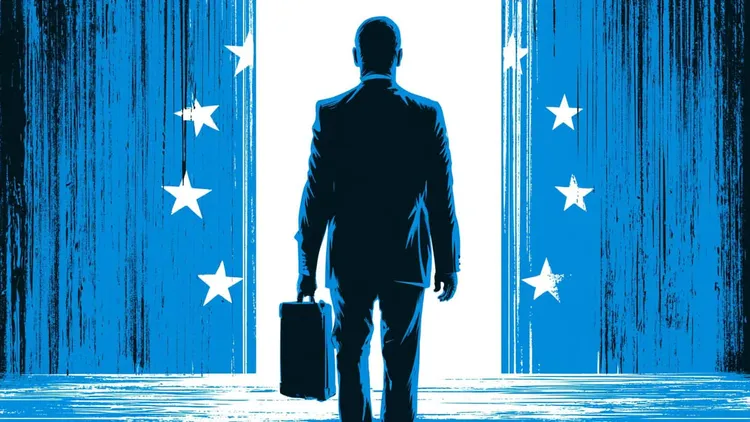
- A code word for deregulation: The Commission has repurposed “Omnibus” — once a tool for routine legislative housekeeping — into the lever for a sweeping, pro-business rewrite of EU law, with seven such directives planned for 2026 alone.
- A new Brussels consensus: Far-right governments, the centre-right EPP, European industry, the major US tech platforms, and the Trump administration have converged behind a single deregulatory agenda.
- A broken firewall: In November 2025, the EPP unpicked the Duty of Care directive with far-right votes, breaching the long-standing barrier against Parliament’s hard-right groups.
- Numbers without a formula: The promise to cut business red tape by 25 per cent and deliver €37.5 billion in savings rests on no demonstrated mechanism linking deregulation to growth.
- Europe reduced to a market: The drive risks stripping the EU of its capacity to act as a public authority, realising the old Eurosceptic dream of a Europe that is nothing more than a single market.
A recent announcement from the European Commission went almost unnoticed. On 16 April, it sent its legislative programme for the next two years to the 27 member states and the European Parliament. One keyword served as both watchword and rallying cry — “deregulation” — together with a code name: Omnibus. Behind it lies a long series of draft directives through which the Commission has been working, for more than a year now, to “deregulate”: that is, to rewrite European laws domain by domain — artificial intelligence, chemicals, agriculture, the digital sphere — always in a pro-business direction and in the name of the fight for European competitiveness.
Since the European Parliament’s historic vote of 13 November 2025 on “Omnibus 1” — the directive that unravelled the “Duty of Care” obligations of large companies, themselves adopted barely 10 months earlier — it has been clear that this deregulatory agenda can count on an unprecedented majority. The conservatives of the European People’s Party (EPP) seized that very occasion to break the cordon sanitaire against the far-right groups in the chamber. What is now equally clear is that the breach they opened has become a central preoccupation of the European institutions, with no fewer than seven “Omnibus” directives planned for 2026 and two more already in the pipeline for 2027.
The matter is anything but trivial. This rewriting of entire blocks of the European legislative acquis is unprecedented in scale, and amounts to nothing less than a sweeping recalibration of the balances that govern environmental protection standards, public health guarantees, the safeguarding of human rights — including personal data — and requirements for financial transparency.
It is the less trivial still because these laws were, for the most part, adopted only months ago, and could be enacted in the first place only after long deliberative processes that forged political and social compromises of considerable complexity. The deregulatory drive, by contrast, shows every sign of being conducted at a forced march: half of all European legislative work between now and the year’s end is devoted to it. It rests on the hijacking of a legal instrument that until now served only for straightforward technical “housekeeping,” with no change in substance, and it relies on accelerated procedures that let the work proceed in emergency mode — without consultation of “stakeholders” and without impact assessments.
In doing so — by reopening Pandora’s box on dozens of European laws — the Commission has set off an unprecedented campaign of economic and diplomatic lobbying. What is ultimately at stake is the capacity of the European Union (EU) to act as a public authority: its ability to serve as guarantor of the diffuse interests — social, health-related, environmental, human-rights-related — that form the bedrock of a democracy.
How, then, did a European Union that once prided itself on the “Brussels Effect” — its capacity to set high regulatory standards, underwritten by its control over access to the world’s largest single market — talk itself, in under three years, into the exact opposite? How did the institutions of the so-called “European triangle” of Parliament, Council, and Commission move, in the space of a few years, from the vast legislative ambition of the European Green Deal — designed to set Europe on the path to a decarbonised economy and willing to place at least modest constraints on the digital multinationals — to a sprawling deregulatory project that now consumes the bulk of their political and legal energy in dismantling what they had so patiently and incrementally built? Paralysed by the Trump administration’s assaults and power grabs against the EU, we were slow to register this new Brussels consensus as it consolidated before our eyes — and which now stands as the European normal.
What is most striking here is not the substance. The idea that Europe over-regulates, that it abuses norms, that it multiplies red tape, is as old as European law itself; the stock clichés peddled by the Eurosceptic camp, with the Brexiteers leading the charge (“cutting the red tape”), have long been worn threadbare.
The argument has merely been enriched by a new syllogism — one whose fragility, in both its premises and its conclusion, many economists have pointed out, including Gabriel Zucman as recently as last year: if regulation “stifles competitiveness,” and Europe has a competitiveness problem, then deregulation will, of itself, restore growth, sustainable or otherwise. It has been embellished, too, by an astonishing set of figures, which promise — in the Commission’s characteristically grandiloquent register — to reduce “the administrative burden on businesses by 25 per cent by the end of this mandate” and thereby deliver “€37.5 billion in savings for businesses,” without anyone quite knowing by what secret formula this sweeping deregulation would, on its own, generate such gains.
What is truly striking is that this fairly crude set of ideas has acquired, in a matter of months, such political respectability that it has become the very foundation of a new Brussels consensus — one that unites interests which, on the face of it, look most divergent. First come the far-right parties and governments which, from Giorgia Meloni to the now-fallen Viktor Orbán, saw in the “unpicking” agenda a unique chance to undermine the EU’s legitimacy to regulate. Then the EPP conservatives, who found in it an opportunity to test a right/far-right majority and so establish their political hegemony.
More troubling still, the consensus reaches well beyond the rapid rightward drift of European politics. It is carried, too, by a vast coalition of European industrial firms ranged against the mounting ecological obligations of the Green Deal, and by the major American digital platforms, which can thereby draw a line under a legislative chapter — from the Digital Services Act to the AI Act — that has run broadly against them. All these actors now enjoy, moreover, the backing of the Trump administration, whose ideology and commercial interests align fully with this project of weakening European public authority.
The full history of how this new Brussels consensus came to be formed remains to be written. But three milestones in this process of intellectual and institutional convergence can already be identified.
Consider, first, the fast tracks this deregulatory impulse found at the heart of the European power field. Its origins reach back to 2023 and early 2024 — well before the European elections of June 2024 — in the first parliamentary setbacks for the Green Deal, on deforestation and on the hasty reform of the Common Agricultural Policy, and in the first convergences between the right and the far right against the backdrop of Europe-wide farmer protests. The counter-mobilisation also unfolded beyond the parliamentary arena. In February 2024, 73 European business leaders, convened at the initiative of the chemical industry, met in the presence of the Commission President. The Antwerp Declaration “for a European industrial pact” that followed drew a direct, one-way line from the restoration of European competitiveness to deregulation, calling for an “omnibus proposal” — the word thereby enters the lexicon — that would “aim to take corrective action on all relevant existing European regulations, as the first legislative act to be presented in the next EU institutional cycle.”
Six months on, the road to the heart of European administrative power ran through the “Draghi” waypoint — named for Mario Draghi, the former president of the European Central Bank, whose September 2024 report on European competitiveness, drawn up after a consultation that involved employer-side stakeholders almost exclusively, swiftly became a reference point in European political debate and echoed the same diagnosis. In the end, it was Viktor Orbán who secured the new reform programme’s definitive anchoring at the centre of European institutional power, capitalising on the Hungarian presidency of the EU and the Budapest summit of heads of state and government in November 2024, at the close of which the Commission received a sweeping deregulatory mandate. He did so with the active support of a Giorgia Meloni long committed to rewriting the carbon-emissions rules for the car industry — and by conveniently setting aside, along the way, a quite different strand of the Draghi report, which had called for a massive increase in European public investment and raised the prospect of new joint borrowing.
The drama is all but sealed when deregulation becomes the first item in the “competitiveness compass” that Ursula von der Leyen presented in late January 2025, underlining that “the regulatory burden has become a brake on Europe’s competitiveness.” All that then remained was the characteristic ingenuity of the European administration’s legal experts, who put the finishing touches to the design by reinventing a technique to operationalise the deregulatory enthusiasm: the “Omnibus” directives, born in the early 2010s for the simple technical housekeeping of European legislation, here become the strategic lever for a pro-business rewriting of the legislative acquis.
A second milestone lies in the dysfunctions this great reversal and this fast track to the centre of power have laid bare — dysfunctions that amount to a profound crisis in the EU’s three regulatory equilibria.
The first is a diplomatic crisis within the Franco-German partnership, which, since Angela Merkel’s departure, has looked devoid of compass or project — when it has not joined, in disarray, the race to unpick. The second is a political crisis in the “Social Democrats and EPP conservatives” duopoly that long dominated the European institutions and is now coming apart, as the Socialists and Democrats (S&D) weaken ever more visibly in Parliament (the June 2024 elections), within the College of Commissioners (four S&D out of 27, against 12 for the EPP), and in the Council of the EU (a single social-democratic government). That decline, in turn, feeds the hegemonic temptation of an EPP that now looks to Parliament’s far-right groups to assert its centrality.
The third is a geopolitical crisis born of the Trump administration’s simultaneously ideological and commercial assaults on a European Union it is bent on destabilising — whether by aligning its policy with that of American corporations (in March 2025, Donald Trump barred American companies from applying the European duty of care directive) or by imposing its views on the Commission in the framework of trade “negotiations.” And it does so to effect: the opening of fresh “Omnibus” fronts throughout 2025 — beginning with the “Digital Omnibus” aimed at rewriting the digital rules barely adopted in 2024 — is inseparable from the massive mobilisation of the major American tech companies, long highly active in Brussels lobbying, whether directly or through employer bodies such as DigitalEurope. To that must be added the American administration’s direct interventions, through its diplomatic representatives in Brussels, calling for a suspension of the AI Act’s implementation.
A third milestone, finally, lies with the Brussels power brokers and other intermediaries who have built this convergence of interests, held it together, and translated it into rallying cries and concrete mobilisations. Here the investigative work of certain European non-governmental organisations (NGOs) and think tanks — Bloom, Corporate Europe Observatory, Somo — proves decisive, opening a window onto the intense political work under way across Europe and America, in public and private spheres alike, by the liberals, conservatives, and far-right actors who make up this deregulatory coalition.
The investigation conducted by the NGO Somo has shed light on the role of consultants and lobbyists, foremost among them the American firm Teneo, which set up a “Competitiveness Roundtable” gathering the American and European oil industry — Chevron, ExxonMobil, Koch Inc., and TotalEnergies — for an all-out offensive against the Duty of Care directive. Bloom, for its part, has illuminated the key role of transatlantic intermediaries such as the ultra-liberal Swedish Member of the European Parliament (MEP) Jörgen Warborn, chosen by the EPP as rapporteur for the Omnibus directive rewriting the Duty of Care. As the EPP’s spokesperson on trade, Warborn proves a genuine economic go-between operating on both sides of the Atlantic — heading the business interest group SME Global and Europe — and a political entrepreneur forging close ties with the world of American ultra-conservatives and Trump allies such as the Heritage Foundation. Such figures are the nodes of a transnational politico-economic network whose density has only grown with the access that Trump’s rise to power has opened up.
Every sign today suggests that these new alliances and balances of power, tested in 2025 around the Omnibus directive that unpicked the Duty of Care legislation, have since consolidated. Witness the employer mobilisation that has surged through the breach: through its interest group BusinessEurope, it now proposes to continue this movement of “reducing the regulatory burden” with 44 cuts across nine areas — environmental protection, employment and social policy, energy, and financial services — on top of comparable proposals tabled a year earlier. Witness, too, the profile of the MEP the EPP picked in February as rapporteur for the Digital Omnibus: the Finnish member Aura Salla, none other than Meta’s former chief lobbyist in Brussels, from 2020 to 2023.
What lies ahead is an unprecedented lobbying battle: over deadline extensions (“stop-the-clock” directives), the proliferation of exemptions, the raising of thresholds for the size of companies covered, and the dilution of legal obligation towards mere soft law. The direction is clear — to drain these complex directives of much of their binding force and practical effect. The risk, of course, is that once Pandora’s box is open it generates an endless regulatory instability, one that will inevitably weigh on the competitiveness of companies forced to adapt continually to a shifting framework — and that penalises the “good pupils” who had made the effort to bring their businesses into line with the movement set in motion in Paris around COP21.
And the deeper risk is that Europe loses, along the way, its entire capacity to act as a public authority — realising, far more probably, the old Eurosceptic dream of a Europe reduced to nothing more than a market.

Help Keep Social Europe Free for Everyone
We believe quality ideas should be accessible to all — no paywalls, no barriers. Your support keeps Social Europe free and independent, funding the thought leadership, opinion, and analysis that sparks real change.
— €4.75/month
Help sustain free, independent publishing for our global community.
Become a supporter— €9.50/month
Go further: fuel more ideas and more reach.
Become an advocate— €19/month
Make the biggest impact — help us grow, innovate, and amplify change.
Become a champion— €142.50/month
For organisations and professionals who rely on Social Europe in their daily work.
Become a member