KEY INSIGHTS
- The threat is internal: Israel retains overwhelming military superiority over states and militias alike; the greater danger, as Amos Oz warned, is that it destroys itself.
- A strained standing: Six in ten Americans now view Israel unfavourably, and the Gaza campaign has severely strained relations with previously friendly Western governments.
- Three rival visions fail: A single binational state invites chaos, “Greater Israel” breaches international law, and confederation is utopian without a minimum of mutual trust.
- Partition remains realistic: The two-state solution is “the least bloody scenario”, a practical horizon for coexistence rather than perfect justice.
- Leaders out of step: Both Gadi Eisenkot and Benjamin Netanyahu reject Palestinian statehood on security grounds, yet October 7 showed that security cannot be won at Palestinians’ expense.
On 7 October 2023, several thousand Hamas fighters and their associates breached Israel’s border with Gaza. During the short-lived incursion, over 1,200 people, mostly civilians, were killed, while 251 were abducted to Gaza. According to an independent commission, many of those killed in the Hamas-led attack had been tortured.
Despite the complacency and security lapses that enabled Hamas to carry out its unprecedented assault, Israel continues to enjoy overwhelming military superiority over its adversaries, both states and non-state actors. If countries such as Egypt and Syria, heavily armed by the Soviet Union, once posed an existential threat to the Jewish State, there is a growing consensus that the most serious threats now facing Israel, even allowing for the eliminationist rhetoric of Iran’s clerical leaders and Iran’s alleged nuclear ambitions, are internal in character. As the Israeli novelist and peace activist Amos Oz warned in a late essay, “Dreams Israel Should Let Go of Soon”, Israel is in danger of destroying itself.
A Prisoner of Its Own History?
For Israelis, as for many, perhaps most, Jews in the diaspora, October 7 was not “simply” a bloody and audacious act of terrorism. The massacre of several hundred defenceless Jews, including women, children, and the elderly, evoked memories of the Holocaust, which is almost certainly what Hamas had intended. This may explain, at least in part, the scale and ferocity of Israel’s military response.
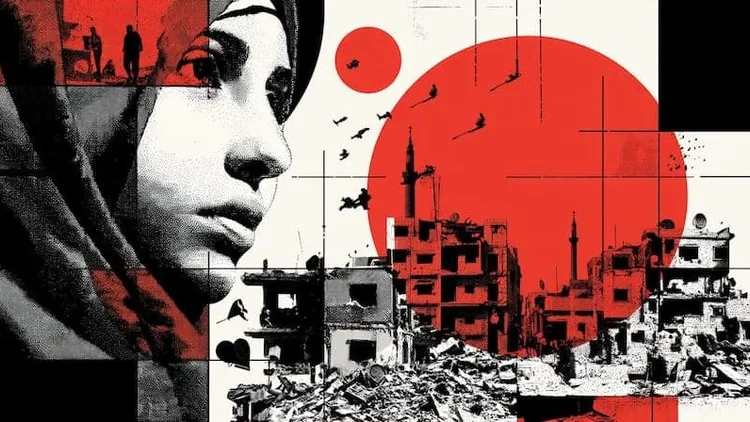
Israel has tried to justify its ongoing military campaign in Gaza, launched following October 7, as the only means of dismantling the “terror infrastructure and capabilities” of Hamas and of other militant Islamist groups that are active in the territory and that pose a continuing threat. However, the operation, which has inflicted immense suffering on Gaza’s civilian population while conspicuously failing to dislodge Hamas, has been widely condemned as unlawful, including by leading international lawyers in Israel itself. A report issued jointly by the World Bank, the European Union, and the United Nations in spring 2026 highlights the extent of the humanitarian crisis:
> Over 1.9 million Palestinians in the Gaza Strip have been internally displaced to locations inside of the Gaza Strip, many of them multiple times over; and over 1.2 million people —almost 60 percent of Gaza Strip’s population—have lost their homes. Extensive damage to water, sanitation, and waste management infrastructure, a lack of critical resources to operate and maintain the remaining infrastructure, and poor hygiene conditions and food insecurity have left the entire population of the Gaza Strip at risk of disease outbreaks.
Israel’s devastating military response to October 7 almost certainly represents a much greater threat to the Jewish State than Hamas’ fitful campaign of terror. The humanitarian toll of Israel’s military campaign has severely strained the country’s relations with previously friendly Western governments, while Israel’s image across much of the global south has been badly damaged. Even in Europe and North America, public opinion has gradually turned against Israel, due principally to the scale of civilian casualties, credible reports of an ongoing humanitarian crisis, and inflammatory statements by far-right Israeli ministers, including Itamar Ben-Gvir, calling for the wholesale resettlement of Gaza’s Palestinian population. Many younger Jews in North America are beginning to distance themselves from Israel.
An underlying shift in “progressive” political attitudes in the West, particularly apparent in universities and on the Left, has contributed to the gradual delegitimisation of Israel and the elevation of Palestine into the pre-eminent global symbol of thwarted justice. A preference for categorical moral judgements over nuance and complexity, and a somewhat selective reading of history, have played a part in this process. However, it would be absurd to discount the impact on public opinion around the world of the unconscionable scale of civilian suffering in Gaza and the plight of Palestinians in the West Bank, who face escalating violence and intimidation from “hilltop youths” aided and abetted by elements of the most right-wing government in Israel’s history.
Two Apartments in a Single House?
Amos Oz believed that justice and political pragmatism demand the creation of a sovereign Palestinian state alongside Israel. As Oz expressed it: “[t]here is no escape from dividing up this little house into two even smaller apartments”.
The so-called two-state solution, which was proposed by the UN General Assembly in November 1947 and which seemed on the brink of realisation more than 40 years later, with the conclusion of the Oslo Accords, has fallen out of favour. Although Simon Schama and other scholars emphatically reject such arguments, growing numbers on the Left and in the academy dismiss Israel as illegitimate and a settler colonial state. For this expanding constituency, a single democratic state comprising Palestinians and Jews, stretching “from the river to the sea”, is the only acceptable political outcome.
Like many on the Left, particularly in Europe and North America, influential voices on the far right of Israeli politics also condemn the partition of Palestine after the Second World War. Driven, variously, by religious or extreme nationalist sentiment, they envision a “Greater Israel” encompassing, at a minimum, the whole of what is now Israel-Palestine. A third and smaller constituency, which includes moderate Palestinians and Israelis, advocates some form of confederation between Israel and a future Palestinian state.
After more than a century of mutual fear and mistrust and intermittent violence, culminating in the slaughter of Jewish civilians on October 7 and Israel’s crushing military response, a single democratic state encompassing roughly equal numbers of Jews and Palestinians would almost certainly be a prescription for chaos and bloodshed on an unprecedented scale. On the other hand, the idea of “Greater Israel”, a hard-right fantasy of Jewish sovereignty over, at the very least, the whole of Israel-Palestine, is unethical, unfeasible, and contrary to established principles of international law, including the right of the Palestinian people to self-determination.
By contrast, the notion of a confederation of Jewish and Palestinian states, although liberal and progressive in spirit, is quite simply utopian in the present circumstances. Until Israelis and Palestinians have demonstrated at least a minimum level of mutual trust, an ability to work together in pursuit of common goals, and the willingness to act decisively against disruptive elements within their respective communities, it is hard to see how a confederation could work in practice.
For all its faults, the two-state solution remains the only realistic option, and the one that is likely to result in “the least bloody scenario”. The two-state solution may not satisfy every descendant of the Palestinians forced to flee their homes in what is now Israel during the fighting that erupted in 1948-49. At the same time, it may provoke outrage amongst Israeli Jews on the religious Right who believe that Scripture gives the Jewish people an absolute, God-given right to “Greater Israel”. However, as Professor Fania Oz-Salzberger, Amos Oz’s daughter, noted recently, the two-state solution offers “a practical horizon for coexistence, and a life raft for both nations”.
At the time of writing, the outcome of the elections held in Israel remains unclear. No single party commands a majority in the Knesset, Israel’s legislature. However, both leading contenders for the post of prime minister, Gadi Eisenkot and Benjamin Netanyahu, oppose the two-state solution, essentially on the grounds that a radicalised Palestinian state would threaten Israel’s security. Yet, as Amos Oz understood, long-term security for Israel cannot be achieved at the expense of the legitimate rights of Palestinians. That would be morally unacceptable and, as the carnage on October 7 demonstrated, almost impossible to achieve. “There must be compromise between Israel and Palestine”, Oz concluded, “There must be two states”.

Help Keep Social Europe Free for Everyone
We believe quality ideas should be accessible to all — no paywalls, no barriers. Your support keeps Social Europe free and independent, funding the thought leadership, opinion, and analysis that sparks real change.
— €4.75/month
Help sustain free, independent publishing for our global community.
Become a supporter— €9.50/month
Go further: fuel more ideas and more reach.
Become an advocate— €19/month
Make the biggest impact — help us grow, innovate, and amplify change.
Become a champion— €142.50/month
For organisations and professionals who rely on Social Europe in their daily work.
Become a member