KEY INSIGHTS
- Polity is not politics: Democracy is understood today as an institutional framework rather than a struggle over power, as if the battle for it were permanently won.
- Billionaires are rival orders: The wealthy and well-connected constitute competing ordering attempts that challenge the democratic polity’s claim to shape society and the state.
- America is the warning: Corporate dominance, private campaign finance, and media moguls mean elite power in the United States may already outweigh that of the population.
- Countervailing power must be built: Revitalised parties and unions, general strikes, limits on dynasties, and pluralistic media systems are indispensable to democratic politics.
- Post-democracy looms: Without reinstitutionalised collective power, formal structures remain intact while politics drains into small circles of elites.
Political science distinguishes between polity, politics, and policy. Polity refers to the institutional framework, the constitutional structure of a state; politics to the struggles over power and influence; and policy to the concrete actions and decisions that emerge from them. When we speak of democracy today, we tend to understand it primarily as a polity, an institutional arrangement, rather than as a mode of politics, a struggle over power.
We think of constitutions, elections, and procedures. Democracy thus appears as a settled system, something already accomplished, an order in which the people are in charge because the words on a document say so. The battle for it appears to have been permanently won.
The past few years should have given us reason to question this seemingly reasonable, all too liberal way of thinking. An excessive faith in constitutions and state institutions alone has proven, at the very least, somewhat naïve. The power of America’s new oligarchy, rampant inequality, the widening gap between wages and profits, the United States’ repeated willingness to wage wars despite a lack of public support, and the abysses of the American elite laid bare by the Epstein files all demonstrate that even the West, for all its sober, responsible, and democratic institutions, remains unjustly shaped by the interests of powerful, organised, and democratically unaccountable minorities, commonly referred to as elites.
States Are Only Ordering Attempts
States, whether democratic or autocratic, should not be understood as fixed and total orders. They are better understood as imperfect ordering attempts. The ordering attempt of a liberal constitutional democracy is neither total nor perfect. It exists alongside other ordering attempts.
On a small scale, these might take the form of tax evasion; on a larger one, the efforts of powerful actors to bend state decisions to their own interests, to paint the world in their image. The attempts of wealthy and well-connected individuals to shape the political order in their favour are a historical constant, one that has not vanished with the mere existence of constitutional documents.
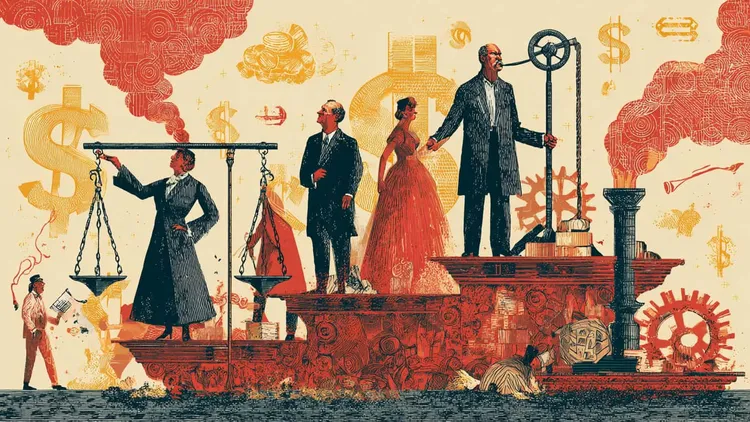
Their power rests on a historically familiar arsenal: above all capital, but also personal proximity to elected officials and to one another, control over or influence on the media, and the authority conferred by their own positions as captains of industry. The now rather ubiquitous figure of the billionaire, however overused the term may have become, is a useful way of putting a face to this phenomenon. A billionaire is someone whose power affords them more political influence than democratically legitimised representatives. A billionaire is a competing ordering attempt, one that challenges the democratic polity’s claim to shape society and the state.
The US offers a particularly striking example: the extraordinary dominance of a handful of corporations, the private financing of election campaigns, and the power over culture and media wielded by figures such as Rupert Murdoch and Elon Musk. In the US, elites are organised and heavily armed. As in the Gilded Age, they face a largely disorganised population.
While there may never be an order without organised minorities trying to capture it, democracies differ greatly in how successfully they keep elite power in check. The political scientist E. E. Schattschneider pointed to the “semi-sovereignty” of the public within an unbalanced system of pluralist interests: “The flaw in the pluralist heaven is that the heavenly chorus sings with a strong upper-class accent.”
Emancipation is not a mere question of having the right demands. It is a question of power. The liberal hope that the world will change if only we find the right words, whether in Davos or before a parliament, has proven insufficient.
Democracy Means Building Countervailing Power
Democracy is, alongside the separation of powers and the protection of minorities, an order in which the interests of the majority ultimately prevail. At the very least, it is a system in which the democratic state’s attempt to shape state and society outweighs that orchestrated by organised minorities. If a system such as that of the US cannot deliver on basic interests, a functioning healthcare system, for instance, or the avoidance of wars of aggression, then it would be naïve to call it a democracy solely on the strength of its constitutional documents.
The existence of American democracy itself can today be called into question. The power of the elites in the US may already outweigh that of the population. For European democracies, this must serve as a warning.
When Trump threatened to annihilate an entire civilisation, the response was neither a general strike nor mass demonstrations, but little more than a few indignant tweets: what Anton Jäger has called a postmodern rendition of a peasant uprising.
Democracy means the constant building of countervailing power, both within and beyond the formal polity. This requires functional counter-elites, as well as the revitalisation and repopulation of political parties, trade unions, and civic associations. Parties must not be allowed to degenerate into empty PR machines; they must once again be made to serve as vehicles for the representation of interests.
General strikes, limits on political dynasties and long tenures in office, and free and pluralistic media systems, combining public and private media, are equally indispensable. The media must be more than a playground for the Musks and Murdochs of this world. The US, in particular, demonstrates how the dominance of private media conglomerates narrows public discourse and turns politics into a spectacle that displaces rather than facilitates democratic deliberation. Private campaign financing and extreme concentrations of wealth must also be curbed.
All of this presupposes political education and an awareness of the conflicts of interest that run through society. Perhaps the dumbest of all liberal platitudes is the claim that classes no longer exist. The so-called new social movements are not enough. They are too fluid and too loosely organised to exercise power over the long term. More often than not, they amount to little more than temporary expressions of political feeling.
Sustainable democratic politics requires a process of reinstitutionalisation. What we need are institutions capable of organising collective power on a lasting basis, institutions that can build on the democratic achievements of the Trente Glorieuses. What is needed is an institutionalised democratic vitality.
Otherwise, the great danger is that we end up in what the British political scientist Colin Crouch calls post-democracy: a condition in which the formal structures of polity remain intact while politics itself gradually drains away. Elections continue to take place, now largely reduced to PR spectacles; governments can still be voted out of office; democratic institutions remain standing. But political energy increasingly shifts away from the broader population and into the hands of small circles of political and economic elites. It is not the de jure abolition of democracy but its de facto hollowing out.
The struggle for democracy begins with the recognition that constitutions and the rule of law, on their own, will not be enough. A liberal order is not necessarily a democratic one. What is required, rather, is a constant politics of democracy, a politics capable of sustaining, defending, and, most importantly, using its polity.

Help Keep Social Europe Free for Everyone
We believe quality ideas should be accessible to all — no paywalls, no barriers. Your support keeps Social Europe free and independent, funding the thought leadership, opinion, and analysis that sparks real change.
— €4.75/month
Help sustain free, independent publishing for our global community.
Become a supporter— €9.50/month
Go further: fuel more ideas and more reach.
Become an advocate— €19/month
Make the biggest impact — help us grow, innovate, and amplify change.
Become a champion— €142.50/month
For organisations and professionals who rely on Social Europe in their daily work.
Become a member