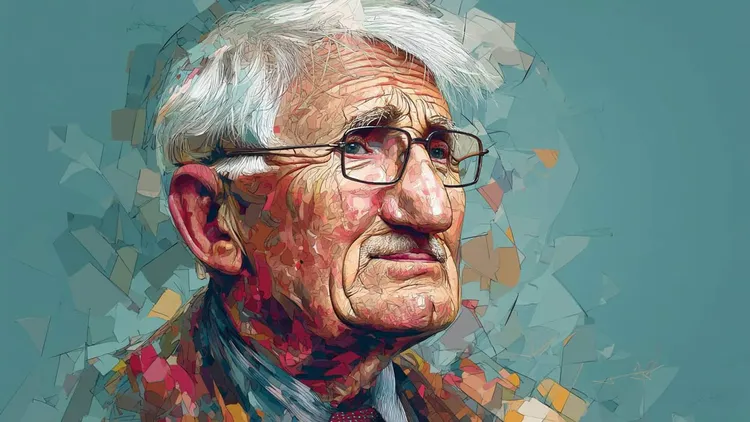
When a catastrophic situation occurs like the situation in Gaza, it is of course most important to try to rescue what can be rescued. It is, however, also important to think about whether it could have been avoided and if so, how. This often demands quite some imagination, and for Albert Einstein, imagination was more important than knowledge. He was not only the most celebrated genius of the twentieth century but also perhaps the most prominent and respected Jewish person of the previous century. So imagine that we could set his mind today on how the conflict between Israel and the Palestinians should have been solved. What would he have said? Where would his truly imaginative mind have led him?
This is certainly a speculative question, not least because since Einstein died in 1955, there have been more than a dozen wars in the region. However, considering the stalemate this conflict has reached, the horrible situation in Gaza and the West Bank, and how far away the parties are from anything approaching a stable peace, it does not seem unreasonable to try such an exercise. The thought experiment was in fact Einstein’s preferred scientific method. As a theoretical physicist, he spent hardly any time in the laboratory, and he was also not the sharpest of mathematicians. His genius was foremost his ability to think in unconventional ways “outside the box”, and for this he used thought experiments.
Einstein was not only the foremost theoretical physicist and natural scientist during the twentieth century. As is well known, he was also strongly engaged in political and ideological issues and became, during the last decades of his life, something of a moral world conscience. His outspoken criticism of all kinds of nationalism, chauvinism, oppression, racism and militarism made headlines and infuriated his opponents. However, contrary to what is often thought of him nowadays, he was neither aloof from the real world nor was he politically naïve. On the contrary, his political thinking was strongly characterised by an astute realism. This realism was, according to Isaiah Berlin, connected to his ontological ideas about science, which later became known as “scientific realism”.
According to Einstein, the theories and concepts used by scientists resulted from their inventive imaginations, or to use the language of today, they were “social constructions”. However, the purpose of human imagination was to discover the truth about an objective reality that existed independently of the concepts and theories that fallible humans were able to construct.
A result of this realism was that he, much earlier than most of his contemporaries, understood the barbaric nature of the Nazis. He warned his fellow Jewish scientists that their assimilationist strategy would be useless in a Germany that was more and more dominated by the Nazi type of virulent anti-Semitism. During March and April 1933, shortly after Hitler came to power, Einstein publicly criticised the repressive policies of the National Socialist government, resigned from the Prussian Academy of Sciences in Berlin, and applied for release from his Prussian (German) citizenship. He left Berlin, where he had been living since 1914. His conclusion that Nazism had to be fought also made him abandon the international pacifist movement that he had strongly supported and been engaged in until 1933. It is noteworthy that Einstein never compromised with the demand for respect for human rights.
Although he was something of a socialist, it is telling that contrary to many contemporary leftist intellectuals, he withstood all invitations to visit the Soviet Union or to collaborate with their cronies in the West, understanding that the Soviet leaders would use him in their political propaganda. Contrary to Jean-Paul Sartre and many other Western intellectuals, he harboured no illusions about Stalin or the Soviet leaders.
Einstein’s relationship with Zionism is, still today, under debate. Experiencing the virulent anti-Semitism in Germany after his move to Berlin, not least in the academic world, he came to support the Zionist movement in the early 1920s. He was, however, more of a cultural Zionist than a political one, and he expressed strong scepticism against the type of nationalistic militarism that occurred in parts of the Zionist movement. According to Einstein, it was especially three ideals that a Jewish state had to defend and protect, namely “the pursuit of knowledge for its own sake, an almost fanatical love of justice and the desire for personal independence.”
As early as in the 1920s, Einstein warned the leading Zionists that if they did not come to a fair agreement with the Arab population in Palestine, the central lessons of the Jewish people’s two thousand years of suffering would be betrayed. In what now seems like a truly prophetic warning, he argued that if the Zionists could not create a harmonious relationship with their Arab neighbours, the conflict would haunt them for many decades to come.
From this and many of his other statements about conflicts in general and human rights in particular, it is safe to conclude that Einstein would have been very troubled by much of Israel’s policies against the Palestinians as they have developed since the late 1960s. As a secular humanist, he would also have been troubled by the strongly increased religious character of the conflict on both sides. However, although he detested all kinds of nationalistic chauvinism, his realism led him to defend Israel’s right to defend its existence, if needed by military force.
Einstein’s point of departure was that problems in science as well as in politics should be dealt with by going to their root causes, that is, from “first principles”. Moreover, he also thought that conflicts could usually not be solved at the same level of perception as that which had created them. He would therefore have turned away from the “who-is-mostly-to-blame” problem that has long characterised most of the polemics and research about this conflict. Not because he would have thought that moral problems were unimportant, but because such a “book-keeping” idea of historical guilt and blame could not lead to a lasting solution, because this would make it more difficult for both sides to accept the concessions and painful compromises that would be necessary.
The Sacred Land Paradox
By going to the root of the problem, he is likely to have concluded that this is a conflict that has the form of an “absolute zero-sum game”. A zero-sum game is a conflict in which what one side wins is equivalent to what the other side loses. An absolute zero-sum game is when what the conflict is about cannot be divided—if one side wins, it wins “everything”, and then the other side loses “everything”. The reason why the conflict is “absolute”, its root cause, would according to Einstein be that both sides claim that they have a divine right to the same piece of land. If a people think they have divine right to a piece of land, giving up a part of that land would be against the will of their God.
Most importantly, Einstein would have questioned the epistemic foundations of the idea of “holy land”. Can vast areas of land really have sacred status, he would have asked? His answer would have been that neither Zionists nor Palestinians can make such a claim because both groups have been willing to buy and sell the land they claim is sacred. Before 1948, many Palestinians sold land to Jewish settlers, and still today, land in Israel, the West Bank and Gaza is being bought and sold. It is against the fundamental principles of logic, Einstein would have said, that something you are willing to sell for money can have a sacred status. If you can haggle about something, you cannot claim that it is a sacred thing to you. Both sides could of course claim that the sacred status of the land determines that it can only be sold and bought within their own group. For Einstein, this would have been equivalent to accepting ethnic discrimination and therefore unacceptable.
This de-sacralisation of the conflict would have been central to Einstein for the simple reason that it would change the basic character of the conflict so that it would no longer be an “absolute zero-sum game”. Something that can be converted into money cannot be sacred, and money has the additional advantage that it can be endlessly divided. Contrary to what Karl Marx thought, the conflict between capital and labour did not develop into a total conflict because unions and employers could negotiate endlessly, since the substance of the conflict was and still is endlessly divisible.
Einstein’s next question would have been to ask what have been the foremost reasons why all efforts to reach a stable peaceful solution have failed. We know the answer, namely the Israeli settlements on the West Bank and the Palestinian demand for the right of all refugees (today in reality their descendants) to return to the land from which their ancestors fled or were forced away in 1948. Both claims are based on the principle of “sacred land” that Einstein would have refuted. He is also likely to have argued that the settlements, because they are the result of a military conquest and occupation, are “un-Jewish” by their very nature.
However, it is unlikely that he would have supported the right for the Palestinian refugees to return, because Einstein would have seen it as completely unrealistic and very dangerous to place millions of Palestinians in central parts of today’s Israel. He would also have pointed at the fact that although the situation of the Palestinian refugees is and has been deplorable, what happened to them in 1948 is in principle no different from what happened to many other groups of people during that period. For example, the four hundred thousand Finns that in 1944 were forced out of Karelia, or the many millions in central and southern Europe (mostly Hungarians, Poles, Germans, Greeks, Italians and Slovaks) that through systematic ethnic cleansing were forced to leave their native lands. He would have remarked that none of these groups of people are today demanding a right to return to their “homeland”, probably because they do not believe that the soil their parents and grandparents had to leave some sixty years ago is sacred, and because they were granted citizenship in the states to which they had to flee.
From International Law to Civil Law
If we follow through on this thought experiment, what would then be a solution that would be in line with Einstein’s thinking based on the principles of justice, realism, respect for human rights and secular humanism? Einstein was, to put it mildly, not very fond of the combination of nationalist ideology and the state. His distaste for all kinds of “patriotic heroism” is well-known. It is therefore likely that he would have considered the type of two-state solution that “everyone” now argues for as unhealthy and a possible recipe for a future escalation of the conflict.
Einstein’s radical proposal for a solution would emerge from his thinking about the Palestinian refugee problem. Given that in his mind no such thing as “sacred land” can exist, it is easy to imagine that he would have reasoned as follows. Independently of why their ancestors left—whether they did so voluntarily and hoping to return with the victorious Arab armies, or whether they were forced away by Israeli military forces—the Palestinians have suffered a great injustice. Property that once was theirs (land, buildings, farms, businesses) has been taken away from them, and for this they as individuals have the right to first an official apology and secondly to be compensated economically. The property they left or had to leave had value, and the market value could be estimated, as well as the earnings the families have lost. Israel would have to compensate them or their heirs economically for what they have lost, and by this recognise the injustice that they have suffered. In return, the individual Palestinians would relinquish their demand to return. This would for sure have been costly, but the costs should be compared to the enormous military expenses and human suffering that the inability to solve the conflict has led to.
This may sound unrealistic seen from the current situation. However, empirical research about this specific conflict by Scott Atran and Robert Axelrod, published in 2008, indicated that a sincere recognition and apology by Israel of the injustices done to the Palestinians, together with economic compensation for losses, would have been acceptable to a majority of the Palestinians, including some radical Palestinian leaders. It should also be noted that in 2014, the European Union offered Israel to help finance precisely this type of solution, but Israel said no and would not engage in any serious discussion of the proposal.
Claims for compensations would have to be decided by impartial courts—Einstein would have preferred the Swiss courts—and paid out to individuals. Einstein would have said no to the idea that such compensation should be distributed by the Palestinian authorities because of their lack of respect for human rights and systemic corruption. This “Einstein solution” would thus have changed the situation from a conflict between states to a civil law conflict. The harm the Palestinians have suffered has not been done to a state, since no Palestinian state existed in 1948, but to individuals, and it is therefore individuals that have the right to be compensated. Since all efforts to solve the conflict through international law have failed, this thought experiment based on civil law as above could have been a possibility that would have prevented the horrors we see today. If nothing else, it can be seen as a lesson for the future about how to handle conflicts like this.
The result of such a solution would, among other things, be a large group of fairly or very wealthy ex-refugees—a Palestinian middle class that would be likely to use the money to invest in good future means of subsistence for themselves and their children. Such an offer from Israel, supported by the EU and probably the United States, would also create a real challenge for the Islamist fundamentalists in Gaza and Lebanon, considering what they can offer the refugees in any foreseeable future. Einstein was unique not only as a scientist but also in his ability to sway world public opinion, something that today’s leaders on both sides of the conflict would be well advised to learn from.
Notes
The literature about Einstein is enormous. For this essay mainly relied on the following:
Berlin, Isaiah. ”Einstein and Israel”, The New York Review of Books 26, nr 17, 1979.
Clark, Ronald W. Einstein: His Life and Times. London: 1971.
Isaacson, Walter. Einstein: His Life and Universe. London: 2007
Jerome, Fred & Taylor, Rodger. Einstein on Race and Racism. Newark: 2005.
Stern, Fritz. Einstein’s German World. Princeton 1999.
Scott Atran and Robert Axelrod’s research is published in an article titled ”Reframing Sacred Values” Negotion Journal July 2008
The offer from EU to support Israel for compensating the Palestinian refugees was published in Times of Israel March 24, 2014.
About the ethnic cleansing in Europe after World War II, see Tony Judt, Postwar. A History of Europe since 1945. New York: 2005.

Help Keep Social Europe Free for Everyone
We believe quality ideas should be accessible to all — no paywalls, no barriers. Your support keeps Social Europe free and independent, funding the thought leadership, opinion, and analysis that sparks real change.
— €4.75/month
Help sustain free, independent publishing for our global community.
Become a supporter— €9.50/month
Go further: fuel more ideas and more reach.
Become an advocate— €19/month
Make the biggest impact — help us grow, innovate, and amplify change.
Become a champion— €142.50/month
For organisations and professionals who rely on Social Europe in their daily work.
Become a member