The European Commission continues to talk about robust recovery, but with wages falling or stagnating, many people in Europe are worse off than they were a decade ago. The European Foundation for the Improvement of Living and Working Conditions has recently reported that more than half the population in 11 EU Member States has difficulty making ends meet. Households in seven EU countries – Croatia, France, Greece, Ireland, Italy, Slovakia and Spain – say their living conditions are still more difficult than before the 2007 crash. Some of those countries were subject to punishing austerity regimes following the crisis. And in Italy and Croatia the proportions of people reporting difficulties since 2011 have also risen – by +9 and +8 percentage points respectively.
Concern about growing inequalities in Europe is increasing – and not only among those who represent working people.
European Central Bank President Mario Draghi, for example, has called on governments to consider better income and wealth redistribution policies. The International Monetary Fund (IMF) has criticised wage stagnation despite falling unemployment in the EU. And the Organisation for Economic Cooperation and Development (OECD) found income inequality at “record-high levels” and stressed the need for “inclusive growth”, which it defines as: “economic growth that creates opportunity for all segments of the population and distributes the dividends of increased prosperity, both in monetary and non-monetary terms, fairly across society”.
Figure 1: Economic recovery has not reduced inequality
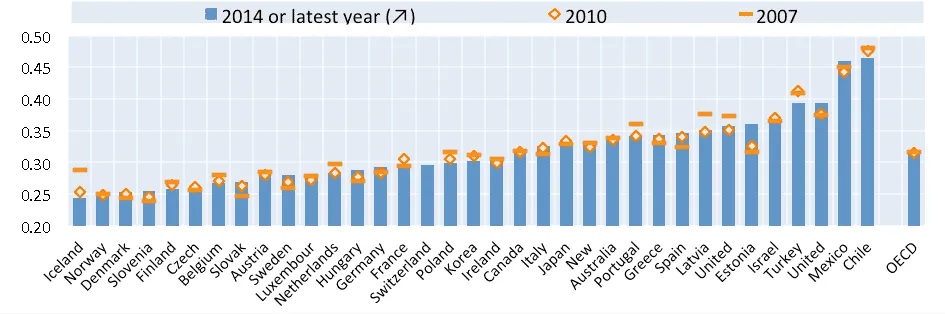
Gini coefficient of disposable income inequality in 2014 (or latest year), 2010 and 2007, total population. Source OECD 2016
Furthermore, the IMF has specifically identified the decline in trade union organisation as one of the main reasons for the growth in inequality (globally, just eight men own the same wealth as the poorest 50% of the population). The rise in inequality and wage stagnation are direct consequences of EU economic policies and we are still far from correcting this imbalance.
In the last three and a half decades, inequality has increased substantially and the share of national income that goes to wages has fallen dramatically. This was not always the case: from 1960 to 1990 wages increased slightly ahead of productivity, meaning workers’ lives improved. But from around 1990, wages started to fall behind, leaving a growing gap between productivity and pay. That gap is part of the reason why, despite the economy showing recovery, working people and their communities are not experiencing the benefits. The domino effect means that since increases in company profits are not making their way into workers’ wages, they are not reaching the real economy at local level either. This is a key driver behind the increase in populism.
Figure 2: Trends in growth in average real wages and labour productivity in developed economies, 1999-2015
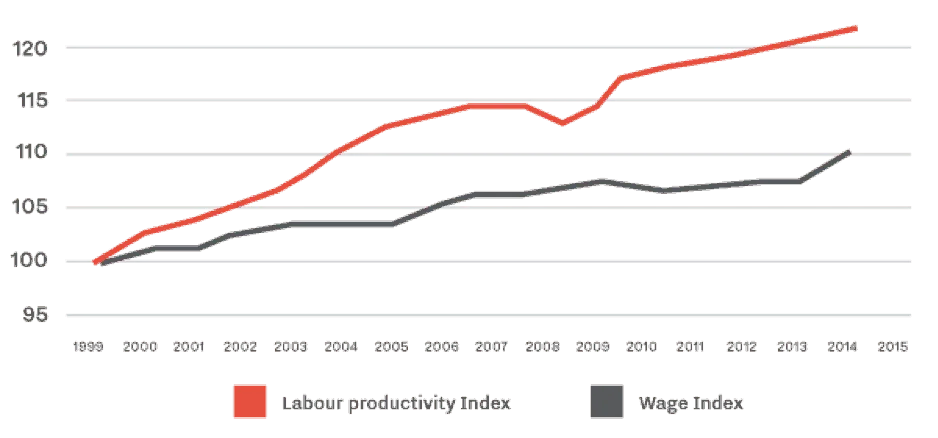
Source: ILO Global Wage Database; ILO Global Employment Trends (GET)
This problem is further exacerbated as companies redirect profits that should be going into workers’ wages towards financial speculation: the so-called financialisation of the economy. Deregulating financial and labour markets has led to an increase in the rate of financialisation and deepening inequalities. Financialisation means that profits go into shareholders’ pockets rather than investment in companies. Dividends in Europe since 2009 have increased at a faster pace than new private investments. Trade unions want tougher controls to rein in the galloping expansion of financial services and channel money back into wages and investment for real jobs.
Collective agreements
We also want a significant change to EU policies to better support trade unions, so that they can negotiate for a fair share for workers through collective bargaining. There are some immediate steps the EU could take to support this.
We want the guarantee of a collective bargaining social clause in European rules on public procurement, ensuring respect for labour law and collective agreements, which should not be judged as obstacles to the market.
Procurement contracts affect the livelihoods of thousands of workers in Europe. Contracting authorities should integrate quality, social and environmental criteria into their procurement processes, and contractors be held responsible for the performance of sub-contractors lower down the supply chain. We would like to see the presence of collective bargaining arrangements as a key award criterion. Awarding contracts on low price alone trickles down into lower wages and creates a race to the bottom.
Most important of all, the EU and Member States should invest in social dialogue and capacity building for trade unions. This entails action to establish or strengthen collective bargaining systems, particularly at national and sectoral level. Far more workers need to be covered by collective agreements, including workers in non-standard jobs, such as platform and agency workers. The ETUC has called for EU Member States to set out national action plans for delivering the European Pillar of Social Rights including its commitment to improved wages and collective bargaining. This means meeting with trade unions and employers in early 2018 and setting achievable targets to increase collective agreement coverage.
There is ample evidence of the success of trade union collective bargaining in improving living standards and eroding inequality. For example, in Czechia, trade unions secured an 11% increase in the minimum wage from 2018, and rises of up to 23% for low-paid workers in social services. In Italy, since 2016, the three Italian trade union confederations, CGIL, CISL and UIL have concluded 62 national sector deals offering 55% of Italian workers pay rises of up to 5.4% and signed more than 21,000 secondary level deals. Transport workers in Budapest, Hungary, obtained a 15% increase through negotiation, while Estonian health unions secured rises of 8% for doctors and 13% for nurses from 2018. In Slovakia, trade union members generally earn around 20% more than other workers.
Collective action and solidarity is the only way for workers to win fairer wages and working conditions. Just last week, for example, when Ryanair pilots threatened industrial action for better pay and decent employment terms, the company finally reversed decades of union-busting and agreed to talks on trade union recognition.
The examples are numerous, and demonstrate that where workers are unionised, they can act with employers and governments to tackle inequality. At Gothenburg in November, as EU leaders proclaimed the European Pillar of Social Rights, Commission President Jean-Claude Juncker called for Europe to be “a world-class place to live and work”. That should be for the many, not the few, and collective bargaining has a fundamental role to play. The challenge is to rebalance the share of profits in a way that provides broad gains for workers. It is high time for the EU institutions to start promoting collective bargaining as a key lever for fair economic growth.

Help Keep Social Europe Free for Everyone
We believe quality ideas should be accessible to all — no paywalls, no barriers. Your support keeps Social Europe free and independent, funding the thought leadership, opinion, and analysis that sparks real change.
— €4.75/month
Help sustain free, independent publishing for our global community.
Become a supporter— €9.50/month
Go further: fuel more ideas and more reach.
Become an advocate— €19/month
Make the biggest impact — help us grow, innovate, and amplify change.
Become a champion— €142.50/month
For organisations and professionals who rely on Social Europe in their daily work.
Become a member