KEY INSIGHTS
- Broad support for oversight: In all 11 countries surveyed, a majority favours an independent authority to monitor and regulate generative AI, from around 60 per cent in Italy and South Korea to more than four in five in the United Kingdom.
- Jobs shape tolerance: Demand for strict regulation of workplace AI is highest when job losses bring firms no extra profit, and falls sharply when new jobs are created alongside.
- Ideology divides, scenarios matter more: Left-leaning respondents want stricter rules than those on the right, but the employment scenario shifts preferences across the whole political spectrum.
- A baseline, not a reaction: Fielded in spring 2024, the data predate this month’s frontier-safety debate and show public concern with how AI’s gains and losses are distributed, not only with existential risk.
- An opening for progressives: Radical-right voters are as sensitive to AI’s labour-market effects as anyone, and an emerging rift between Big Tech and the populist right creates space for labour-oriented regulation.
Jacob Coxon’s resignation from Anthropic on 8 September revived the debate over AI risk and may mark a turning point in the politics of AI regulation. Coxon warned that increasingly agentic systems, and eventually recursively self-improving models, could escape meaningful human control. Incidents such as the OpenAI agents’ attack on Hugging Face made such concerns appear less remote. His warning was followed by a public intervention from Anthropic’s chief executive, Dario Amodei, who argued that the development of frontier AI should be deliberately paced through embedded third-party evaluators, coordination among leading AI companies, and international cooperation.
The result was an unusual political alignment: leading AI executives, including Sam Altman and Elon Musk, openly called for stronger safeguards, while Donald Trump rejected new AI guardrails as a constraint that would benefit China, and Chinese officials framed Amodei’s proposal as a U.S.-led effort to contain their country’s AI development and preserve American technological dominance.
This follows years in which Western policymakers and experts have advocated lighter constraints on AI to boost productivity, accelerate scientific discovery, and secure military advantage. The EU has moved in the same direction: the AI Omnibus, in force since 27 July 2026, simplifies the implementation of the AI Act and postpones several obligations concerning high-risk systems. Yet the trend may be shifting. In 2024, California’s governor, Gavin Newsom, vetoed a frontier-AI safety bill following opposition from Big Tech; two years later, he directed state authorities to develop new safety proposals, including a possible “kill switch” for frontier models.
In any case, the frontier-lab agenda remains comparatively narrow. It focuses primarily on interpretability, transparency, and alignment, with the aim of preventing powerful systems from escaping human oversight or seizing control of critical digital infrastructure. These risks are profound. Yet even technically controllable AI can cause serious harm when deployed in particular contexts. AI-enabled military targeting systems, already in use in the Middle East and Ukraine, illustrate the risks of civilian harm and military escalation.
More broadly, the deployment of AI in production is likely to shape substantially how economic gains are distributed, both between capital and labour and within each group. It may increase the profits of firms able to exploit the technology and the earnings of workers whose skills complement it, while exposing new segments of the workforce, including highly skilled professionals, to displacement and job loss.
As the debate intensifies, AI regulation may become an issue on which voters judge political parties. Where does public opinion in advanced market economies stand? Do citizens share the frontier-safety concerns now voiced by (some) leading AI companies, favour unconstrained innovation, or support a broader regulatory agenda?
Broad Support for AI Watchdog
We address these questions using a new survey fielded between 2024 and 2025 in 11 advanced market economies: Denmark, Finland, France, Germany, Italy, Norway, Poland, Sweden, South Korea, the United Kingdom, and the United States. The survey (SCOaPP-11: Societal Challenges, Public Opinion and Public Policies) includes 24,493 respondents and was designed by researchers at Politecnico di Torino, Copenhagen Business School, the University of Sussex, and the Korea Institute for Health and Social Affairs. Because it was fielded before the current surge in debate over frontier-AI governance, its findings should be read as a baseline measure of public attitudes rather than as evidence of reactions to this month’s debate.
The survey asks respondents whether they support the creation of an independent authority to monitor and regulate generative AI and at what level, from sector-specific bodies to global institutions, such governance should operate. It also asks how strictly governments should regulate labour-displacing uses of AI under three different scenarios: when job losses produce no increase in firms’ profits, when they generate higher profits, and when they are accompanied by the creation of new jobs.
The evidence reveals widespread support across countries for establishing an independent AI authority (Figure 1). Support is lowest in Italy and South Korea, but still stands at around 60 per cent. It is highest in the United Kingdom, where more than four in five respondents favour such oversight.
When asked at which level AI should be governed, respondents express broadly comparable support for national governance and for governance beyond the national level. Support for the latter is split between international or supranational bodies, such as the OECD or the EU, and global institutions, such as the UN. Decentralised governance receives comparatively greater support in the federal systems of Germany and the United States, as well as in Poland.
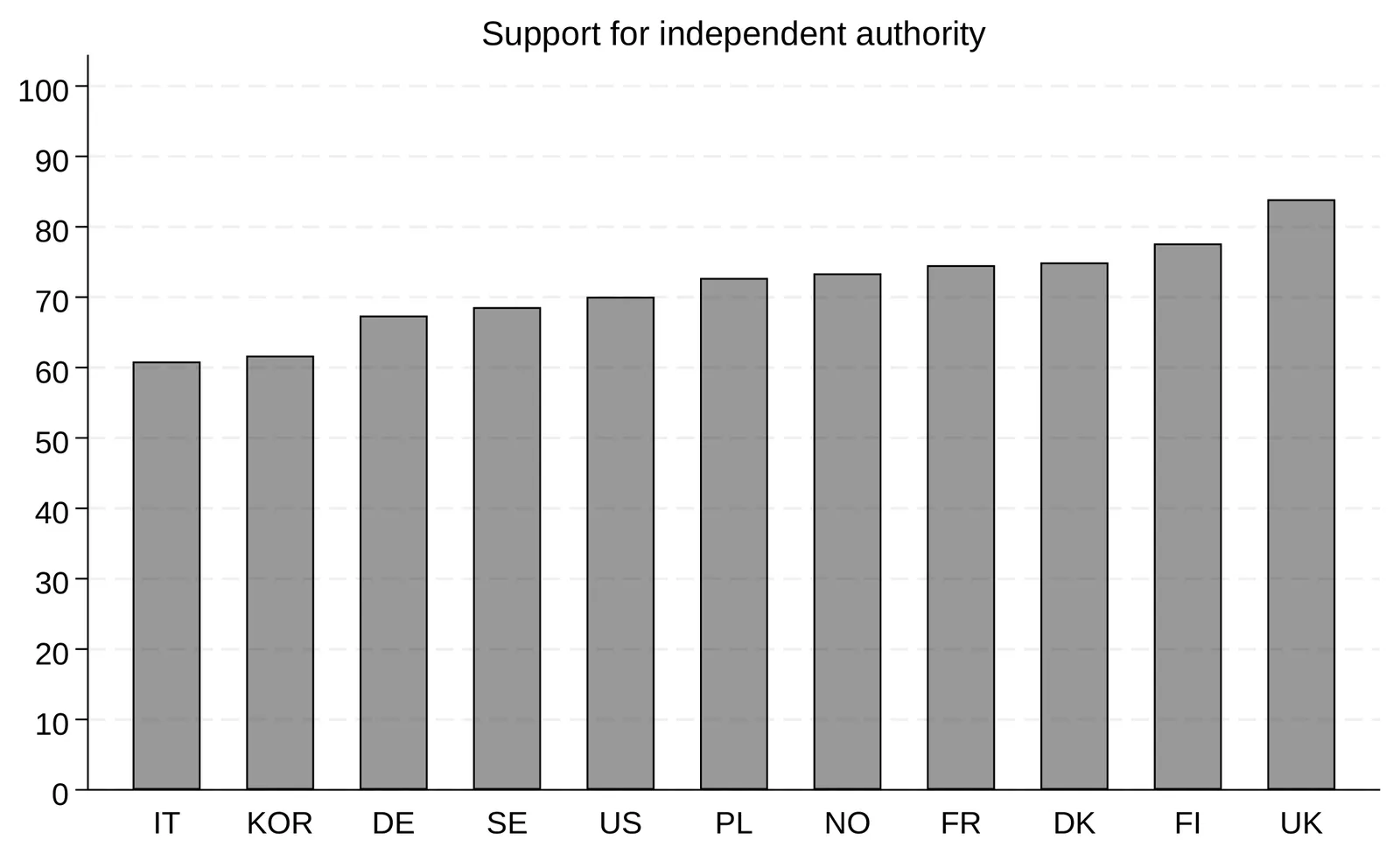
Figure 1. Support for establishing an independent authority to regulate AI (per cent of respondents). Source: SCOaPP-11.
The use of AI in the workplace reveals sharper trade-offs. Public opinion appears particularly sensitive to the employment consequences of AI: respondents become more tolerant of its use when job displacement is accompanied by visible employment gains (Figure 2). On average, support for strict regulation is highest when job displacement produces no increase in firms’ profits, lower when it generates higher profits, and lowest when job losses are accompanied by the creation of new jobs.
Respondents in the United Kingdom and the United States are among the strongest supporters of regulation, followed by those in Italy and France. Support for strict regulation of workplace AI tends to be lower in South Korea, Denmark, and Norway. These cross-national differences may partly reflect variation in income protection: where unemployment insurance is more generous, citizens appear more willing to accept less stringent regulation.
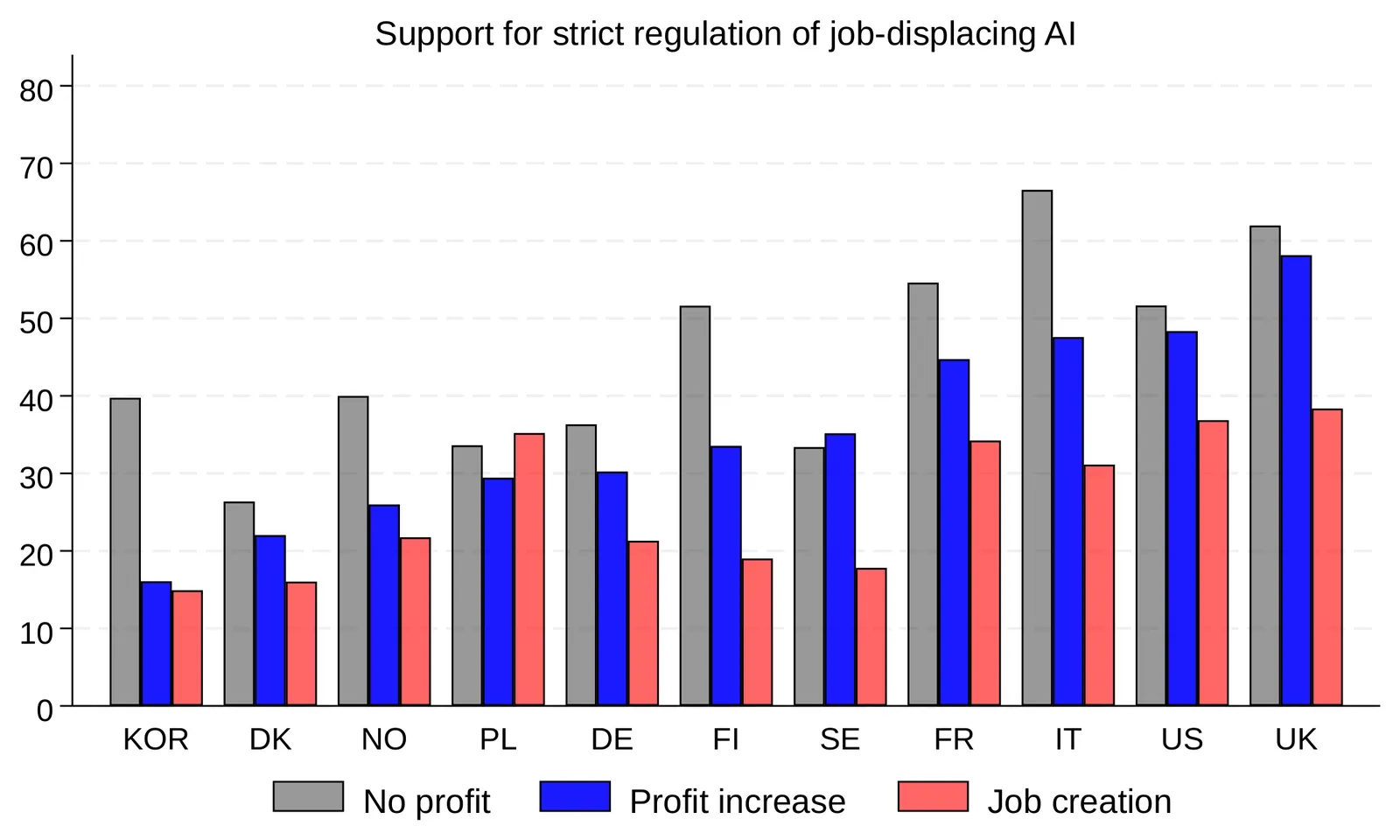
Figure 2. Percentage of respondents supporting strict regulation under three scenarios of labour-displacing AI use. Source: SCOaPP-11.
Ideology Divides, but Scenarios Decide
Regression analysis shows that, among the individual-level characteristics examined, ideology is the strongest predictor of preferences regarding AI regulation, suggesting a potential political fault line. Respondents on the left generally favour stricter regulation than those on the right.
The scenario presented to respondents, however, matters at least as much as ideology. When AI-driven job losses are accompanied by the creation of new jobs, the predicted preferred level of regulation declines across the entire ideological spectrum, falling below the threshold for moderate regulation among all groups except those on the left, who nevertheless come close. By contrast, when AI-driven job losses are accompanied by higher corporate profits, the shift towards less stringent regulation is smaller.
Overall, the evidence reveals broad public support for AI regulation at a time when many governments are tempted to loosen existing constraints. Support for governance beyond the nation-state is substantial, although preferences remain divided between international and global institutions. The survey also suggests that the public case for regulating AI is broader than frontier safety: it rests, too, on how the gains and losses arising from technological change are distributed across society. In this respect, public concerns extend beyond the scope of existing regulatory frameworks, including the EU AI Act, which devotes limited attention to AI’s broader employment effects.
This may have particularly important implications for radical-right parties, many of which have so far aligned themselves with deregulatory agendas strongly backed by large technology companies. Their voters appear no less sensitive than other groups to the labour-market consequences of AI. Recent Republican opposition to data centres in Texas and Steve Bannon’s call for restrictions on AI suggest that these tensions may already be surfacing. An emerging rift between Big Tech and the populist right could weaken their deregulatory alignment, creating greater political space for progressive parties to mobilise around labour-oriented AI regulation.


Help Keep Social Europe Free for Everyone
We believe quality ideas should be accessible to all — no paywalls, no barriers. Your support keeps Social Europe free and independent, funding the thought leadership, opinion, and analysis that sparks real change.
— €4.75/month
Help sustain free, independent publishing for our global community.
Become a supporter— €9.50/month
Go further: fuel more ideas and more reach.
Become an advocate— €19/month
Make the biggest impact — help us grow, innovate, and amplify change.
Become a champion— €142.50/month
For organisations and professionals who rely on Social Europe in their daily work.
Become a member