KEY INSIGHTS
- A workforce transformed: Representative survey data show Italian platform workers shifting from young side-earners in 2018 to older, increasingly income-dependent workers by 2021, after the Covid-19 pandemic.
- Four profiles, two axes: Sheltered youths, accumulationists, vulnerable jobseekers, and a precarious workforce differ by employment status and by dependence on platform earnings.
- Worse than other non-standard work: Platform workers face the most unstable contracts and the deepest economic vulnerability, with two-thirds postponing medical treatment in 2021.
- Caregiving and dependence go together: Workers who rely on platform income often carry childcare and care responsibilities that work-life policy should address instead.
- Monitor, protect, and stabilise: Policy should track platform work systematically, strengthen social protection for non-standard workers and jobseekers, and restore stable employment.
Digital platforms have been enthusiastically embraced for their purported ability to improve the matching of supply and demand across a wide range of online and offline services, while easing labour-market entry for those without ready access to standard full-time employment: students, migrants, people with disabilities, those engaged in caregiving, or even workers in the Global South. At first glance, this appeared to be a win-win situation. Customers could enjoy the convenience of home delivery or the speed of digitally mediated tasks through platforms such as Glovo or Amazon Mechanical Turk (AMT), while a PhD student or a person with reduced mobility could supplement their income without navigating lengthy recruitment processes to find employment.
It took only a modest expansion of the platform-services market, greatly accelerated by the Covid-19 pandemic, to reveal the other side of the coin. Rather than creating new employment opportunities for marginalised groups, platforms have pushed workers already in vulnerable situations into extreme forms of “digital precariousness”. One need only look around any major European city: ride-hailing and food-delivery platforms disproportionately attract workers from the most precarious segments of the labour market, such as migrants, people with low educational attainment, and those facing difficult socio-familial circumstances, trapping them in jobs characterised by low and unpredictable piece-rate pay, irregular working hours, little or no protection against social, health, and safety risks, pervasive digital monitoring, and an uncertain legal status.
The situation is even worse for workers carrying out microtasks for online platforms such as AMT, particularly those based in the Global South: paltry wages, endless working hours, a complete lack of social protection, and exposure to violent content, especially for those who moderate material posted online, all of which can have serious consequences for their physical and mental health. This trend is confirmed by the empirical literature, as well as by the growing body of case law condemning the degrading treatment experienced by platform workers.
We have recently analysed the working conditions of Italian platform workers using a unique micro-level dataset, the Participation, Labour, Unemployment Survey (PLUS) of the Italian National Institute for Public Policy Analysis (INAPP), which provides representative information and enables direct comparisons between this distinctive category of workers and the broader workforce. Drawing on machine learning and explainable artificial intelligence (AI) techniques, we show that platform work is a heterogeneous and stratified phenomenon that exacerbates long-standing labour-market, socio-demographic, and territorial inequalities. Young people who supplement their income by delivering meals or performing online tasks now represent only a marginal component of this workforce. Instead, platforms increasingly attract older individuals facing job instability, underemployment, or declining incomes from traditional occupations.
The Covid-19 pandemic further intensified these dynamics, acting as a catalyst for those experiencing economic and social insecurity. During this period, platform work became a fallback option for the unemployed, providing a precarious source of income amid shrinking employment opportunities and persistent economic insecurity.
Who Italy’s Platform Workers Really Are
A preliminary cluster analysis identifies four broad profiles of platform work: sheltered youths, accumulationists, vulnerable jobseekers, and precarious workforce. These profiles are differentiated by employment status (whether people are employed or not, and on what type of contract) and by their degree of dependence on platform earnings, which ranges from an essential income source to merely occasional or complementary income. These two axes intersect with broader dynamics of precarity (such as postponing medical expenditure for economic reasons), income conditions (monthly net income, household income, food and mortgage expenditure), and personal and family circumstances (marital status, number of children, caregiving), while also being strongly shaped by intersectional attributes such as gender, age, and geographical location.
The image of platform work as a temporary stopgap for young people, whether “accumulationists”, who combine platform earnings with stable full-time employment, or “sheltered youths”, who remain economically dependent on their families and are not actively seeking other employment, captures only one side of the story. The other, rapidly growing side concerns a segment of the Italian workforce for whom platform work is less a matter of choice than of constrained opportunity, and among whom the greatest vulnerability is concentrated. Those who consider platform income essential to meeting their basic needs fall into the “precarious workforce” cluster. They are mostly located in southern Italy and the islands, tend to be aged 40 to 49, work part-time with few hours and low pay (a monthly income below €1,000), bear caregiving responsibilities, and report very low household incomes, most of which go on food and mortgage payments.
The “vulnerable jobseekers”, largely concentrated in the north, share many characteristics of the precarious cluster while also being unemployed and younger, reporting an even lower household income (€1,001 to €1,500), and experiencing a significant degree of economic vulnerability, with €300 the largest unexpected expense they can afford. Both groups face material hardship that extends well beyond the workplace. For these workers, a platform such as Glovo or Uber appears less a freely chosen employment strategy than an inevitable path, shaped by difficult socio-familial circumstances and a lack of viable alternatives in the labour market.
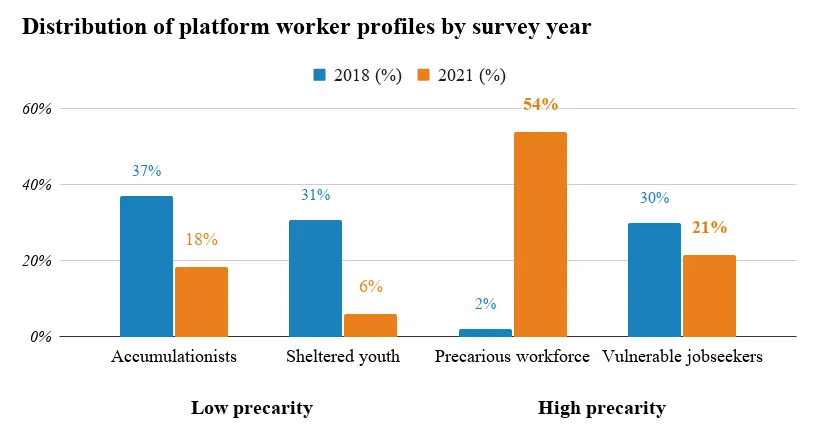
Figure 1. Distribution of platform worker profiles in 2018 and 2021. Relative shares are calculated among all platform workers assigned to one of the four clusters within each survey wave. The comparison illustrates changes in the profiles of platform workers following the Covid-19 shock, including a marked increase in the share of those characterised by high dependence on platform earnings and greater economic vulnerability. Source: Authors’ elaboration of INAPP PLUS 2018 and 2021 survey data, with sample weights applied. The four worker profiles were derived through cluster analysis.
Figure 1 shows a sharp compositional shift from relatively low-vulnerability profiles in 2018 to predominantly high-vulnerability profiles in 2021. This pattern is consistent with the broader evidence that platform work both reproduces and feeds on labour-market precarity: workers become more vulnerable when platform income is driven by economic necessity rather than used as supplementary earnings. This tendency appears to have intensified during the Covid-19 pandemic, as worsening labour-market conditions, limited social protection, and the shifting of risks onto workers pushed more individuals towards dependent forms of platform work. Indeed, in 2018 platform work was still largely concentrated among the relatively less vulnerable profiles, with “accumulationists” (37 per cent) and “sheltered youths” (31 per cent) together accounting for over two-thirds of platform workers. By 2021, however, these low-vulnerability profiles accounted for less than one-quarter, while the “precarious workforce” surged from two per cent to 54 per cent.
Do platform workers represent a new and more acute form of precarious employment? To address this question, we compare their working and socio-economic conditions with those of non-standard workers and of individuals actively seeking employment. Among workers in non-standard employment, engagement in platform work is associated with multiple and unstable sources of income, with many holding a secondary job alongside part-time or fixed-term employment. Other statistically significant drivers include indicators of financial and social pressure, such as high mortgage expenditure, low income, postponed medical treatment, and caregiving responsibilities.
Although the correlation is less pronounced, gender and education also play a role: men, and workers whose qualifications exceed those required by their jobs, are more likely to be associated with platform work. This pattern is consistent with reading platform work as a compensatory mechanism, whereby platform earnings supplement insufficient income from traditional employment rather than providing an autonomous and sustainable livelihood.
Platform workers’ profile becomes even clearer when compared with the broader pool of jobseekers. Those more likely to join platform work are young men not dependent on family support, residents of central and northern Italy, single individuals, and couples with children. Interestingly, the connection between age and platforms shifts here, with younger people more likely to seek platform work.
Occupational and economic vulnerabilities play a key role too. Jobseekers who had to postpone medical treatment for financial reasons, or who report a limited ability to cope with sudden expenses, show a positive association with platform work. Likewise, caring for relatives or acquaintances with a permanent reduction in autonomy acts as a strong positive predictor in the machine-learning models.
How the Pandemic Deepened the Trap
The link between job insecurity, economic vulnerability, and platform work was strengthened by the Covid-19 pandemic. We draw on two waves of the INAPP PLUS survey, conducted in 2018 and 2021, to examine whether and how the size and nature of platform work in Italy were affected by such a major structural shock. The most vulnerable groups, such as migrants and workers in non-standard employment, had limited access to social safety nets when the pandemic disrupted their jobs. Platform work therefore represented one of the few alternatives available for earning an income, leaving workers with little room to address the precarious conditions to which they were exposed, including significant health risks.
Among those in employment, platform work served as a coping mechanism in response to intensified financial pressure and weak public support systems. For jobseekers, in turn, platforms offered an easily accessible source of income at a time when the labour market was virtually at a standstill. Disaggregating the data by year reveals a marked shift in this relationship: in 2018, being a jobseeker was associated with a lower probability of being classified as a platform worker, whereas in 2021 the same condition became a strong positive predictor.
The pandemic not only boosted demand for platform work but also exacerbated the precarious nature of this form of employment. The share of Italian platform workers postponing medical treatment for financial reasons rose from 36 per cent in 2018 to 67 per cent in 2021 (Figure 2). Moreover, compared with 2018, a larger share of platform workers in 2021 reported severe financial hardship, job loss, or lasting income losses that had not been fully recovered by the time of the survey.
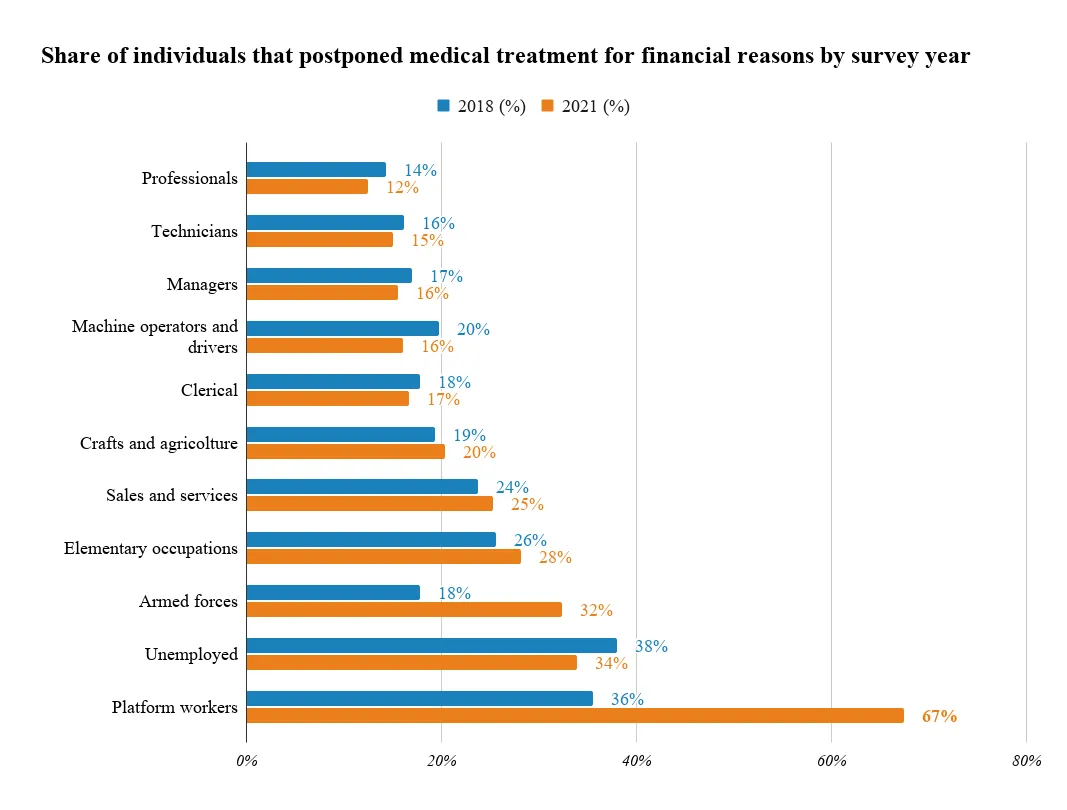
Figure 2. Share of individuals who postponed medical treatment (including dental care) in the previous year because of financial constraints, by occupational category and survey year. Source: Authors’ elaboration of INAPP PLUS 2018 and 2021 survey data, with sample weights applied.
Our analysis provides novel quantitative evidence on the precarious nature of platform work in Italy. In line with previous work, our results reveal substantial heterogeneity among platform workers: “high” and “low” vulnerability segments coexist, with the low-vulnerability segment typically using platform work to supplement its income, while the high-vulnerability segment depends on it. Importantly, however, the relative weight of these segments shifted markedly towards more vulnerable profiles after the Covid-19 pandemic. Compared with other workers in non-standard employment, those relying on digital platforms appear to face the most precarious conditions, particularly in terms of unstable contractual arrangements and economic vulnerability.
These conditions worsened following the Covid-19 pandemic, which, among other developments, coincided with the expansion of the digital economy. Beyond the well-documented determinants of precarity, such as gender, financial strain, and employment instability, our analysis also identifies family organisation as a distinctive feature of platform work. Workers who depend on platform income often carry significant caregiving responsibilities, including childcare and support for relatives or acquaintances with reduced autonomy.
This evidence yields several policy implications. First, platform work needs to be systematically monitored to support policies aimed at tackling the precarious conditions these workers face, as well as at preventing misclassification (workers classified as self-employed to minimise employers’ obligations), piecework, and exploitation. Improved data collection, including greater use of administrative data, is crucial to understanding how many platform workers there are, what type of tasks they carry out and, most importantly, under what contractual, employment, and income conditions.
Second, we have shown that digital platforms may disproportionately rely on marginalised workers, including those facing underemployment, declining job quality, or insufficient earnings from standard employment. This points to the importance of strengthening social protection systems that cover both unemployed individuals and workers in non-standard employment. Such measures could reduce the likelihood that vulnerable groups enter the platform economy out of necessity, only to find themselves trapped in even more precarious conditions.
Third, platform work cannot be considered a suitable option for those who struggle to enter the labour market because of caregiving responsibilities. Instead, it is crucial to strengthen policies that promote a healthy work-life balance and provide targeted support for carers, rather than leaving them reliant on precarious forms of employment that offer only limited and uncertain income.
Fourth, the conditions faced by platform workers reflect the broader trend of labour precarisation that has characterised Italy and the rest of Europe for more than two decades. On top of recognising platform workers’ employment status, policies should therefore strengthen workers’ rights more broadly and reduce the risks that push people towards insecure employment in the first place. This means restoring the centrality of stable and well-paid employment relationships while strengthening the social protection system, including effective support covering both non-standard forms of employment and unemployment.
Finally, we believe that our analysis may underestimate the extent of vulnerability among platform workers. Survey-based data are likely to under-represent the most vulnerable segments of the platform workforce, particularly migrants, who may be excluded from official national surveys because they are not formally resident or lack the language skills required to participate. This potential under-representation may result in an underestimation of both the scale and the intensity of vulnerability within the platform workforce.




Help Keep Social Europe Free for Everyone
We believe quality ideas should be accessible to all — no paywalls, no barriers. Your support keeps Social Europe free and independent, funding the thought leadership, opinion, and analysis that sparks real change.
— €4.75/month
Help sustain free, independent publishing for our global community.
Become a supporter— €9.50/month
Go further: fuel more ideas and more reach.
Become an advocate— €19/month
Make the biggest impact — help us grow, innovate, and amplify change.
Become a champion— €142.50/month
For organisations and professionals who rely on Social Europe in their daily work.
Become a member