KEY INSIGHTS
- Four-party consensus: Austria’s National Council banned head coverings for girls under 14 in December 2025 with the support of the ÖVP, SPÖ, NEOS, and FPÖ, over the objections of the Greens.
- A real problem, the wrong tool: Coercion around girls’ clothing exists in some Muslim communities, but replacing the authority of the family with the authority of the state does not make a child freer.
- Islamic institutions must look inward: Legal challenges to the ban are legitimate, yet Muslim bodies should confront coercion before a court case forces the debate.
- Two fear rooms: Far-right and Islamist media select real events into mirror-image stories that never speak to each other, and algorithms amplify both.
- Sequence matters: Dialogue, education, and multilingual communication should precede coercive legislation, so that law is the end of the road rather than its beginning.
At the start of the 2026/27 school year, a 12-year-old Muslim girl will enter school in Austria knowing that the law no longer allows her to wear a headscarf there. The state says its purpose is not to fight her religion but to protect her freedom and her right to grow up without religious or social pressure. At home, or through her phone, she may hear a different story: that the state is targeting her faith and her identity. Meanwhile, an Austrian voter may hear rhetoric linking Islam to migration, failed integration, and the changing identity of the country.
Between these narratives stands a child whose clothing has become the battlefield of a conflict far larger than herself. Austria’s new law is a test case for a broader question: what happens when integration policy fails to build a shared space for dialogue and then manages the consequences through legislation?
In December 2025, Austria’s National Council approved an amendment to the school law prohibiting girls under 14 from wearing a head covering at school that “covers the head according to Islamic traditions”. The measure was backed by the Austrian People’s Party (ÖVP), the Social Democratic Party (SPÖ), NEOS, and the Freedom Party (FPÖ), while the Greens opposed it. The government frames the restriction in the language of child protection, girls’ autonomy, and “child-appropriate development”. That makes it harder to read the ban simply as another far-right attack on Islam.
There is a real issue behind the political dispute. In some Muslim environments, conservative pressures exist around girls’ clothing, gender relations, and religious practice. Political Islam and religious fundamentalism have also occupied a disproportionate share of the religious discourse addressed to Muslims in Europe. Denying these realities does not protect Muslims from racism. It hands genuine social problems to the far right while allowing fundamentalist currents to monopolise the definition of Muslim identity.
Acknowledging the problem does not make prohibition the solution. If a child is forced to wear a headscarf, the state has a legitimate duty to protect her ability to choose. Yet if the state itself compels her to remove it, an uncomfortable question follows: has she become freer, or has the authority of the family simply been replaced by the authority of the state?
Islamic Institutions Must Also Look Inward
Traditional Islamic jurisprudence generally ties religious obligation to puberty rather than to modern European concepts of adulthood or religious maturity. A pupil may therefore count as religiously accountable within a classical framework while still being treated, correctly, as a child by a European legal and educational system. This tension cannot be resolved by ignoring it.
Austria’s Islamic Religious Community (IGGÖ) has opposed the ban on constitutional and fundamental-rights grounds. A first challenge was dismissed in June 2026 as premature, and new complaints are being prepared now that the ban is in force. Such a legal defence is legitimate, not least because Austria’s Constitutional Court struck down an earlier primary-school headscarf ban in 2020 on grounds of equality and religious neutrality.
But a legal defence does not answer the social question. Why does a seven- or nine-year-old girl wear a headscarf? Is it her own wish, imitation of her mother, family preference, community pressure, or some combination of these? The answer differs from child to child.
Muslim institutions have every right to challenge legislation that singles out an Islamic symbol. Society also has a right to ask what those institutions have done to confront coercion before the issue reached parliament. A more confident European Islam should not wait for a court case before discussing children’s headscarves, fasting, gender expectations, and the relationship between classical jurisprudence and modern childhood.
Two Fear Rooms
Integration does not take place only in schools, workplaces, and public institutions. It also takes place through screens. Many migrants consume news and commentary in Arabic, Turkish, Bosnian, Persian, and other languages alongside the language of their country of residence. This creates a hybrid information space in which competing narratives reach the same person.
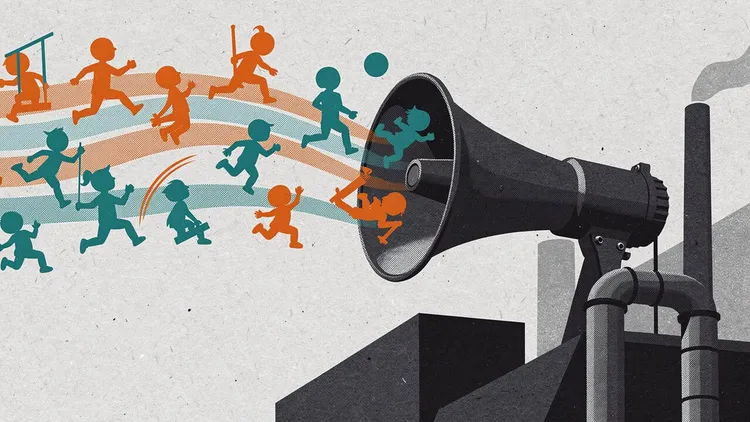
In Europe’s populist media ecosystem, Muslims appear again and again in connection with migration, crime, terrorism, political Islam, and failed integration. In parts of the Arabic, Turkish, or Islamist media, a mirror image emerges: Europe does not want Muslims; the West is fighting Islam; restrictions on religious practice prove a broader hostile project. Neither side always needs to invent facts. Selecting the facts that confirm the fears of its own audience can be enough. Algorithms do the rest.
An Islamist social-media feed can gather unrelated incidents from across Europe into a single story: “The West is at war with Islam.” A far-right feed can assemble crimes, headscarves, demonstrations, and terrorist attacks into another: “Islam is threatening Europe.” Both narratives may contain real events. Their distortion lies in what they select and what they omit. The result is two fear rooms that do not speak to one another.
Integration Requires Communication
Europe has public and international media institutions broadcasting in Arabic and other languages—Deutsche Welle Arabic, BBC Arabic, and France 24 Arabic among them—yet these capacities have rarely been treated systematically as part of the infrastructure of integration. What is needed is not government propaganda but a permanent space in which migrants can hear serious discussion, in languages they understand, about children’s and women’s rights, secularism, state neutrality, political Islam, and parental authority.
Communication must also work in the opposite direction. European audiences need to understand why a Muslim may feel anxiety when the state decides which visible expressions of religion are acceptable, and why religiosity or social conservatism does not automatically mean Islamism or hostility to democracy. Leaving this space to foreign media, Islamist preachers, partisan influencers, and far-right platforms means leaving part of integration policy to the algorithm.
A serious integration policy must be capable of saying two things at once: anti-Muslim discrimination is real, and so are Islamic fundamentalism, political Islam, and coercive conservative practices. Confronting one does not justify ignoring the other. Migrants have responsibilities: respecting the law, learning the language, and understanding the society in which they live. Islamic institutions must confront coercion, fundamentalism, and conspiracy narratives. The media bear responsibility for the economies of fear they help to create.
But the state remains the strongest actor. Governments command schools, law, public media, research institutions, and social policy. They cannot leave integration for years to party competition, religious organisations, media markets, and social-media algorithms, and then conclude that migrants have failed to integrate. Integration is public policy. It must be designed, funded, and evaluated.
Dialogue is not a magic formula. Conversation alone cannot resolve every conflict involving religion, migration, gender, and identity. Law may sometimes be necessary. The argument is about sequence. Education, social work, internal religious debate, and communication should precede coercive legislation wherever possible. Before prohibition, there should be dialogue. The law does provide for conversations with pupils and parents before fines are imposed. But dialogue conducted within an enforcement process is not a substitute for the broader social and educational dialogue that should precede prohibition itself. Before the headscarf becomes an electoral slogan, a Syrian, Turkish, or Afghan mother should be able to hear, in a language she understands, a serious discussion about her daughter’s rights—and to explain her own concerns in return.
Otherwise, prohibition risks turning a negotiable social conflict into an identity war that benefits the most uncompromising actors: the populist who says Islam cannot integrate into Europe and the Islamist who says Europe will never accept Muslims. Austria’s headscarf dispute therefore reveals something larger than the headscarf itself. When society fails to build dialogue, law becomes its substitute. And the price is ultimately paid by the child caught between them.

Help Keep Social Europe Free for Everyone
We believe quality ideas should be accessible to all — no paywalls, no barriers. Your support keeps Social Europe free and independent, funding the thought leadership, opinion, and analysis that sparks real change.
— €4.75/month
Help sustain free, independent publishing for our global community.
Become a supporter— €9.50/month
Go further: fuel more ideas and more reach.
Become an advocate— €19/month
Make the biggest impact — help us grow, innovate, and amplify change.
Become a champion— €142.50/month
For organisations and professionals who rely on Social Europe in their daily work.
Become a member