The United States famously began as a nation skeptical of governance. Its earliest iterations of government were marked by the colonial fight for independence over taxes (“no taxation without representation”) which gave birth to the Second Amendment, the right to bear arms, so citizens might defend themselves against government tyranny in the future.
Today, the United States showcases a wide spectrum of governance approaches thanks to its federalist structure, with each of the fifty states governing rather independently. Many of these states remain wary of taxes and government interference. Crossing state lines can determine whether one has access to reproductive rights, encounters stricter or looser zoning laws, or faces the presence or absence of book bans. As the country has struggled over time to balance the individual’s much-cherished freedom and liberty with collective action dilemmas, the tides of liberalism have pushed for “social democratic” governance approaches, with a more prominent role for the state vis-à-vis its citizens in addressing concerns such as healthcare and housing.
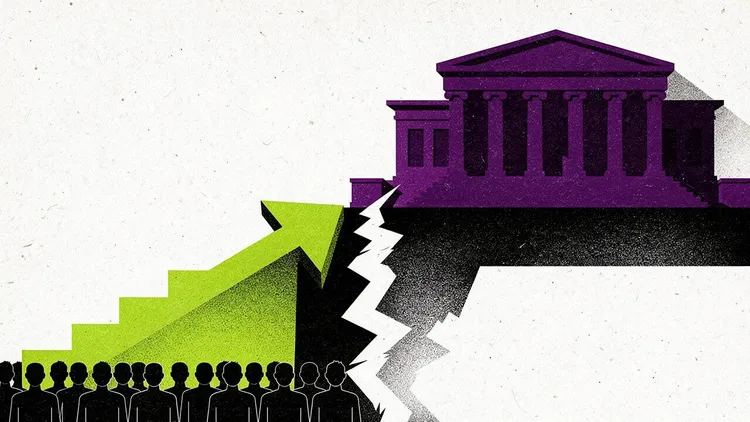
Now, with a sharp, revolutionary wind sweeping through the United States under Donald Trump, his administration is attempting to transform the frustrated voter’s perception of state inertia by creating the appearance of making “progress”. His administration pursues this goal by, paradoxically, abolishing the very policies and agencies that were originally established to make progress possible. While these efforts may not actually address underlying issues—and might even aggravate them—in the eye of the beholder, Donald Trump is undeniably making “progress” in the liberal sense of “change”.
The conservative blueprint for transformation
The Heritage Foundation’s Project 2025 represents a comprehensive blueprint that envisions concrete, conservative ideals for nearly every aspect of American life and a heavily restricted role for government. It advocates for centralizing power in the executive branch, with the federal government focusing on issues such as defense, law enforcement, and national sovereignty, while withdrawing from welfare programs and limiting the regulatory power of government agencies—or simply dismantling them entirely. Overall, the plan intends to shift more power to states, localities, and private actors.
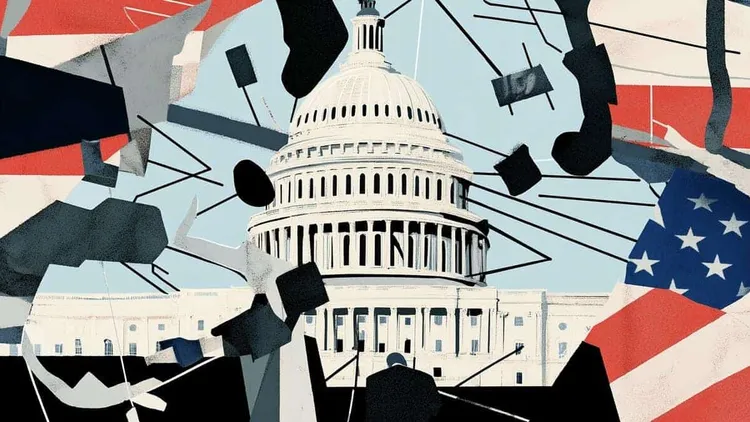
Many of these changes are already being advanced through arguably unconstitutional means, with the Supreme Court and federal courts doing little to halt this agenda’s implementation. This monumental shift in the role of government comes as the concept of the state has increasingly morphed into a synonym for “the ruling elite” for many citizens—an elite perceived as out of touch with the average person’s quotidian concerns. The state and its bureaucracy have seemingly solidified into a rigid structure viewed as incapable of addressing twenty-first-century concerns at a practical level and unresponsive to the majority’s needs.
The idea that the state must become a problem solver again forms the premise of Ezra Klein and Derek Thompson’s book Abundance. In a time when progressive voices on governance have been scarce, Abundance made a temporary splash. The short book outlines ideas for a prosperous American society driven by renewable energy and flush with housing and building opportunities. It was the first liberal blueprint for state modernization to emerge since Democrats began grappling with their devastating loss on the 2024 election battlefield.
The book asserts that government has become overly rigid due to red tape and bureaucratic inertia, and must work to augment the supply of critical services while making them more accessible and affordable. Untangling regulations from permitting and zoning laws, and reforming bureaucracy to fuel innovation, lie at the heart of the conversation. Abundance initiated a serious debate about how liberals have lost adaptability to everyday concerns through overregulation, yet it also sparked backlash. The ideas did not go far enough for many on the progressive fringes of the Democratic Party. One could argue that Abundance was, at best, a surface-level outline of the issues the United States faces. It offers very few tangible solutions and, most importantly, no quick, efficient, or short-term remedies to address the status quo before irrevocable damage is inflicted by the Trump administration and other conservative forces.
The paralysis of progressive perfectionism
Democracy cares about its people, which is why we consult all stakeholders before taking any step forward. But what happens when everyone’s input on every step of a plan interferes in ways that prevent change from progressing—even if that change isn’t strictly progressive? Is liberalism today no longer capable of moving forward because it insists on progressive change at all costs?
In the vacuum that classical liberalism is creating by defaulting on its original promise of achieving change, populism is prospering, sacrificing long-term, sustainable structural solutions for short-term, symbolic measures. A new strain of thought about the role of the state must emerge: one that can address structural issues while also navigating conflicting opinions, concerns, and interests more efficiently. To prevent its own demise, it might need to make decisions not necessarily by taking everyone’s stakes into equal account, but by focusing more squarely on the needs of the majority.
Democracy and liberalism have grown up hand in hand. Now, however, liberalism seems to threaten democracy’s very existence. In the United States, we are watching them fight it out, with the rule of the majority—democracy—leaving liberalism weakened and at risk. This conflict poses a fundamental question for progressive governance worldwide: can liberal principles survive when democratic majorities demand their abandonment? The answer may determine not just America’s future, but the trajectory of democratic societies everywhere.

Help Keep Social Europe Free for Everyone
We believe quality ideas should be accessible to all — no paywalls, no barriers. Your support keeps Social Europe free and independent, funding the thought leadership, opinion, and analysis that sparks real change.
— €4.75/month
Help sustain free, independent publishing for our global community.
Become a supporter— €9.50/month
Go further: fuel more ideas and more reach.
Become an advocate— €19/month
Make the biggest impact — help us grow, innovate, and amplify change.
Become a champion— €142.50/month
For organisations and professionals who rely on Social Europe in their daily work.
Become a member