Political ideologies often rest on an apparently self-evident basic norm that appears immune to critical scrutiny. In classical liberalism—and in its more extreme offspring, libertarianism—the basic norm of freedom often remains little more than a political feeling. Reflections on what freedom actually ought to mean have long come from rival traditions of thought.
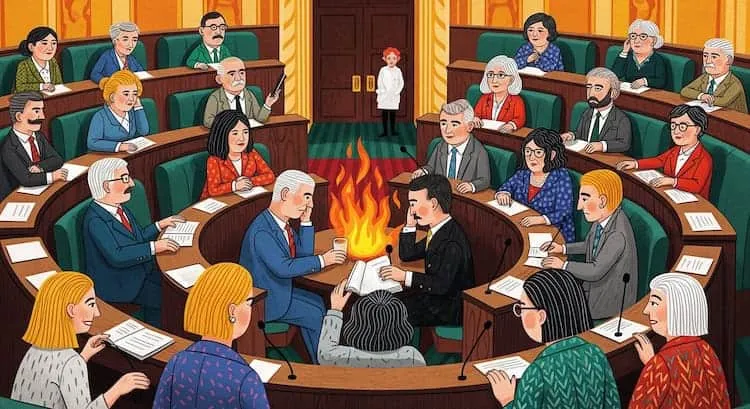
All the more vehemently do libertarians flood the discourse with ungrounded, emotional slogans about said freedom. Right-wing voices from the Murdoch press, the new tech oligarchs, as well as “crypto bros” on podcasts peddle a particularly vulgar form of libertarianism. What they celebrate is, paradoxically, a loyalty to domination and the powers that be. By casting freedom and order as irreconcilable opposites, freedom becomes not a collective aim but a privilege enjoyed only by the few.
In their narrative, the state appears as the great opponent of freedom, as the power that prevents our autonomy—that is, our self-legislation. But are rules and restrictions really hostile to freedom? Does freedom necessarily stand in conflict with order?
A power to limit power
The question of the legitimation of the state and the manifestation of freedom could be called the fundamental question of political theory. Why should the state exist? Why should it act? Thomas Hobbes, in his famous Leviathan, brilliantly flipped this question around: what legitimates the state of nature? Life there, he argued, is solitary, poor, nasty, brutish, and short. To call such a life free or self-determined would be an absurd relativism that mistakes chaos for liberty.
To portray the state as freedom’s enemy may make sense in a dictatorship. In a democracy, however, this reduces itself to an ideology of voluntary submission to the powers that be. Power in the democratic state is seen as mere repression; what goes unacknowledged are the structures that, in the sense of the res publica, order freedom—labour protections, human rights, and the rule of law, for example. There is no absolute contradiction between freedom and order. The democratic state is not the adversary of liberty but its precondition: the institutional attempt to make freedom possible for all citizens, not merely those with economic or social power.
Yet libertarians rarely object to other institutions that constrain individual freedom: employers who dictate working conditions, families that enforce traditional hierarchies, social norms that police behaviour, and markets that determine life chances. The sociologist Niklas Luhmann once described the environment as the universal limiter of freedom. What lies outside the individual—whether market, nature, or state—defines the range of the possible. If we genuinely care about freedom, then all such constraints must be subject to scrutiny.
Without a critical view of employer power over employees, of patriarchal power within families, of social norms and market forces, libertarianism ends up paradoxically demanding liberation only from the one constrainer capable of checking all the others: the democratic state. The state functions as a meta-constraint. It forbids, ideally, the father to beat his child and the employer to exploit his workers. The outcome of such regulation is not less but more freedom—something libertarians are perfectly aware of when it comes to protecting their own property rights.
In a democracy, the state acts as a power to limit power. This meta-power undertakes the necessary planning and organisation of freedom. To forbid the powerful from exercising a freedom that comes at others’ expense is not a restriction of liberty, but its essential condition. As the French anarchist Pierre-Joseph Proudhon eloquently put it: “Freedom is the creation of an order without domination.” Libertarianism, by contrast, aims for precisely the opposite: domination without order.
The freedom of the other
The libertarian disdain for democracy, voiced explicitly by figures such as Peter Thiel, reveals the movement’s true colours. Their argument is that order in the interest of the many deprives the powerful few of their freedom to rule. Instead of mass emancipation, freedom becomes the reward of a social-Darwinist competition—the exclusive resource of the winners. In the end shall stand the rule of the prime movers propagated by authors such as Ayn Rand—those “first movers” she declares to be the righteous elite: entrepreneurs, geniuses, pioneers who supposedly bear the progress of the world solely through their strength and brilliance.
In Rand’s worldview, these prime movers are the source of all wealth and civilisation, while the rest of humanity is relegated to the role of “parasites.” This fairy tale of the economic superman who is meant to shoulder and rule the world is, at its core, nothing more than an economised version of the divine right of kings—the god-given right of rulers dressed up in market rhetoric.
For libertarians, freedom means that one may spread antisemitism and racism on X, thereby exposing entire communities to new threats and old hatreds. The freedom and right of Jews to protection from harassment is sacrificed on the altar of the freedom to threaten and discriminate. This reveals something fundamental that the libertarian denies: freedom is intrinsically contradictory.
Freedom simultaneously means the right to do whatever you want and the right to non-interference from others. One person’s freedom to act constantly collides with another’s freedom from intrusion. Philosopher Isaiah Berlin described this as the crucial distinction between “freedom to” and “freedom from.” Freedom, in this sense, is always interdependent, and therefore always political—it requires negotiation, compromise, and institutional mediation.
In libertarian discourse, however, freedom is imagined as an absolute, apolitical condition. This overlooks the fact that freedom is essentially a scarce social good—a resource conflict that must be managed. Not everyone can be free in the same way, at the same time, in the same space. In a dictatorship, the ruler may be completely free precisely because his subjects are not. A genuinely free order is thus one in which no one’s liberty rests on the unfreedom of others—an order in which the freedom of the other matters as much as one’s own.
Consider traffic as a mundane but revealing example. Libertarians frame speed limits, traffic rules, and increasing bike lanes as a clash between freedom and order. In reality, however, it is a clash between the driver’s freedom and the pedestrian’s, or the cyclist’s. It is a question about the allocation of the finite space of the road and the distribution of risk among different users. As Friedrich Ebert wisely put it: “Every freedom that several people share requires an order.” Freedom designed only for the few requires none—it simply becomes the arbitrary exercise of power.
The road to serfdom is not order but domination masquerading as liberty. What libertarians call freedom should be more accurately understood as the ideological superstructure meant to aid the restoration of the dominance of the powerful few. Right-wing thought, at its core, disguises history as nature, presenting contingent power relations as inevitable facts of life. The notion that freedom is a state of nature confuses “is” with “ought”—a classic naturalistic fallacy.
Freedom does not arise qua natura; it must be constructed through deliberate political action. To define it as the opposite of order is to fundamentally misunderstand it. To regard the zebra in the lion’s jaws as free is libertarianism’s central stupidity—a wilful blindness to the reality that unchecked power creates not liberty but predation.
To take freedom seriously means to acknowledge that it has to be organised and negotiated politically, that a free order requires the careful balancing of competing freedoms. Freedom must accomplish nothing less than emancipation from domination, exploitation, and structural oppression. This is not a limitation of liberty but its fullest expression—a freedom that extends beyond the privileged few to encompass all members of society. The alternative offered by libertarianism is not freedom at all, but merely the ancient tyranny of the strong over the weak, dressed up in the language of liberation.

Help Keep Social Europe Free for Everyone
We believe quality ideas should be accessible to all — no paywalls, no barriers. Your support keeps Social Europe free and independent, funding the thought leadership, opinion, and analysis that sparks real change.
— €4.75/month
Help sustain free, independent publishing for our global community.
Become a supporter— €9.50/month
Go further: fuel more ideas and more reach.
Become an advocate— €19/month
Make the biggest impact — help us grow, innovate, and amplify change.
Become a champion— €142.50/month
For organisations and professionals who rely on Social Europe in their daily work.
Become a member