
Skip to content

Social Europe

  • Videos
  • Podcast
  • eBooks
  • Newsletter
  • Membership

Avatar photoJustus Seuferle

Justus Seuferle is a political scientist who works for the European Institutions. He writes in a personal capacity.
A large crowd of diverse people with a prominent figure casting a shadow against a bright yellow background.

Domination Without Order: How Libertarianism Betrays the Freedom of the Other

Justus Seuferle

The libertarian promise of freedom masks a darker reality: absolute liberation for the few means domination for the many.
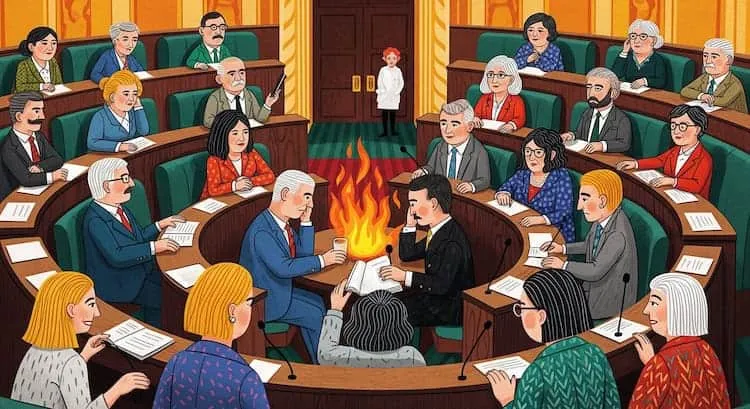
Why Real Democracy Needs Conflict, Not Consensus

Justus Seuferle

Real democracy thrives on disagreement—unity without conflict often masks power and silences necessary political struggle.

The Reactionary Revolution: How a New Conservatism Rejects the Old Order

Justus Seuferle

A new breed of conservative has emerged, one that paradoxically seeks radical change by yearning for a mythologised past.

How the Right Hijacked the Working Class for Culture Wars

Justus Seuferle

The alliance between reactionary forces and the working class is not built on shared economic interests but on a manufactured sense of cultural identity.

S&D Group in the European Parliament advertisement

Health

🇪🇺 Building a Resilient, Equitable EU Health Union: The S&D Blueprint


From securing pharmaceutical autonomy and guaranteeing universal access to care (the European Health Guarantee) to combatting non-communicable diseases and closing the Gender Health Gap. Read the S&D Group in the European Parliament Position Paper demanding that health becomes a priority across all EU policies.

READ THE POSITION PAPER

ETUI advertisement

HESA Magazine Cover

Revisiting worker representation on boards

Board-level employee representation (BLER) has repeatedly resurfaced in times of crisis — from the 2008 financial crash to the Covid-19 pandemic — as a response to mismanagement and democratic erosion. Yet codetermination remains unevenly spread across the EU and underdeveloped within EU industrial relations. This ETUI volume revisits worker representation on company boards by shifting the focus beyond the usual German-centred lens and exploring debates, practices and social partners’ positions in ten often-overlooked EU Member States, to assess the prospects for such an institution to thrive in national social policy.

READ HERE

Eurofound advertisement

Mental Health
Eurofound Talks: Europe's productivity paradox

This episode of the Eurofound Talks podcast looks at why Europe has experienced a more profound slowdown in growth compared to other developed regions, and why greater labour input and higher human capital has not translated into higher output per worker. Mary McCaughey and John Hurley also discuss whether Europe can, and should, look to compete with countries such as the United States and China in the race to harness artificial intelligence.
LISTEN HERE

Foundation for European Progressive Studies Advertisement

Progressive Post Issues

With the volatile start to 2026, what insights can progressives learn from 2025? The 7th edition of the Progressive Yearbook is out now!
In this edition of the Progressive Yearbook, we offer analyses of the EU’s domestic issues—ranging from defense and digital autonomy to what remains of the previous Commission’s Green Deal—as well as global questions such as international trade, tariffs, and the emerging new world order.

READ THE PROGRESSIVE YEARBOOK

Hans Böckler Stiftung Advertisement

WSI Report

WSI Minimum Wage Report 2025

The trend towards significant nominal minimum wage increases is continuing this year. In view of falling inflation rates, this translates into a sizeable increase in purchasing power for minimum wage earners in most European countries. Most EU countries are now following the reference values for adequate minimum wages enshrined in the European Minimum Wage Directive, which are 60% of the median wage or 50% of the average wage.

DOWNLOAD THE REPORT

S&D Group in the European Parliament advertisement

Cohesion Policy

S&D Position Paper on Cohesion Policy post-2027: a resilient future for European territorial equity

Cohesion Policy seeks to foster balanced development and reduce economic, social, and territorial disparities, focusing on rural areas, regions in industrial transition, and those with severe or permanent natural or demographic disadvantages, including outermost, sparsely populated, island, cross-border, and mountain regions.

READ THE PAPER HERE

Our Mission

People

Article Submission

Advertisements

Membership

Politics Archive

Economy Archive

Society Archive

RSS Feed

Legal Disclosure

Privacy Policy

Copyright

Social Europe ISSN 2628-7641

Copyright Social Europe Publishing & Consulting GmbH 2026
  • Videos
  • Podcast
  • eBooks
  • Newsletter
  • Membership