KEY INSIGHTS
- The real constraint is capital, not labour: For two decades capital has been cheap and abundant and corporate profits strong, yet investment, productivity and wages have stalled — the binding brake on growth is how capital is allocated, not the price of labour.
- Firms now lend more than they build: Europe’s non-financial corporate sector saves more than it invests and, since 2009, has been a net lender to the rest of the economy — a striking inversion of its historic role as a borrower and producer.
- Reinvestment has collapsed: For every euro of profit Europe’s non-financial corporations earn, the share reinvested in new productive capacity, net of depreciation, more than halved, falling from 18.9 per cent in 2000 to just 7.4 per cent in 2024.
- Profitable firms still cut jobs: More than two-thirds of the companies studied announced restructuring, putting 2.7 million jobs at risk, and nearly 80 per cent of those announcements came from firms that booked a profit that same year — cuts made to lift returns, not to stem losses.
- Financialisation is a choice, not fate: It is the product of corporate-governance rules, tax codes, state-aid regimes and fiscal rules, so binding conditions on public support, risk-and-reward-sharing public investment and long-term governance can reverse it.
Throughout the developed world, you hear the same anxious story. From Brussels to Washington, political and business leaders warn that our economies have grown uncompetitive because wages are too high, and regulation too burdensome. Make labor cheaper and deregulate, we are told, and private investment will abound.
This diagnosis may sound like common sense to some. But we now have ample evidence and real-world experience to know that it is dead wrong. In a new study for the European Trade Union Confederation, my colleagues and I followed the money to test this hypothesis, analyzing the financial records of Europe’s 300 largest publicly listed non-financial corporations over the last 25 years. Our findings should trouble policymakers both in Europe and beyond. For two decades, capital has been abundant and cheap, and corporate profits strong; yet investment, productivity, and wages have stalled. The binding constraint on growth has not been the price of labor, but the allocation of capital.
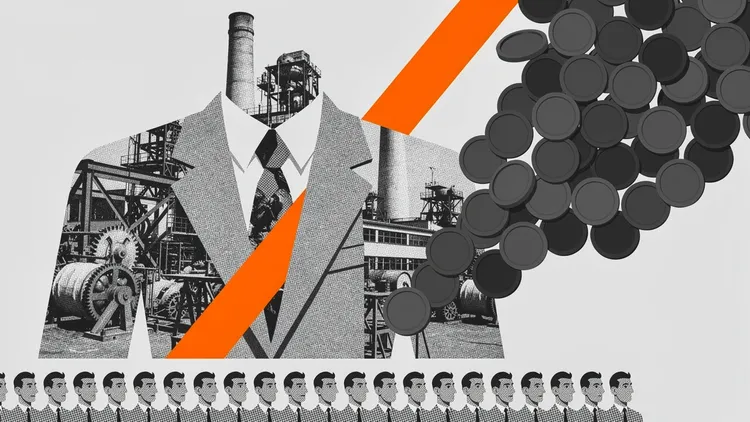
Our study details how large firms maintain healthy profit margins for their shareholders even as real operations are squeezed. Companies increasingly earn their keep as financial actors—collecting interest on bonds or treasuries, receiving dividends, and lending to their own customers—rather than as producers. As a result, shareholder payouts have grown faster than the profits that fund them. Not only does the non-financial corporate sector in Europe now save more than it invests, but since 2009, it has been a net lender to the rest of the economy—a striking inversion of its historic role.
When the profits of Europe’s largest firms are increasingly routed into share buybacks, dividends, and financial assets rather than into production and innovation, the result is a mounting social cost of misdirected capital. As the returns on productive capital fall, it becomes more attractive to put each additional euro into financial assets than toward a new factory or laboratory. Across the firms we studied, the capital stock is in net depletion; and across Europe’s non-financial corporate sector, net capital formation has more than halved as a percentage of GDP since 2000, from 3.7% to 1.6%. For every euro of profit Europe’s non-financial corporations earned, the share reinvested—net of depreciation—in new productive capacity more than halved, falling from 18.9% in 2000 to just 7.4% in 2024.
Workers have paid for this continued financial accumulation. Labor’s share of income in the real economy (excluding finance, insurance, real estate, and the public sector) is lower today than it was in 2000, and it is still declining in several major European countries. More than two-thirds of the companies we examined had announced restructuring events—putting 2.7 million European jobs at risk—and nearly 80% of those announcements came from firms that booked a profit the same year.
The implication is that jobs were cut not as a response to losses, but as a tactic for lifting returns. Over the past quarter-century, profits grew almost twice as fast as wages in the non-financial corporate sector, and shareholder payouts grew even faster. The gains from two decades of profit growth have flowed to capital, not to the workers who produced it.
This problem is hardly unique to Europe. It reflects the logic of financialization that has taken hold globally. But this process rests on a mistaken theory of value that cannot distinguish between creating value and extracting it. As I show in The Value of Everything, the economics discipline has forgotten the difference between profits earned by producing and rents captured by owning. Until we correct for this fatal flaw, the risks of innovation will continue to be borne collectively—by taxpayers, publicly-funded research, and workers—while the rewards are captured ever more narrowly.
None of this is inevitable. Financialization is a policy outcome, reflecting choices that were shaped by corporate-governance rules, tax codes, state-aid regimes, and fiscal rules. The task for government is not just to make capital cheaper or more abundant (cheap capital does not become productive investment on its own). It is to change the terms on which capital is deployed and shared. That requires binding conditions on public support; public investment that shares in both risk and reward, rather than merely de-risking private returns; and corporate governance oriented toward the long term rather than the next quarter.
These ingredients form the core of what I’ve called a modern, mission-oriented industrial strategy. The key is not to pick winners, but to pick the willing—shaping investment flows through bold public missions, and forging well-designed, symbiotic public-private partnerships that steer growth toward real social and environmental value. NASA did not discourage innovation when it included “no-excess-profit” clauses in the procurement contracts that got us to the moon and back in 1969. On the contrary, it created a solutions-oriented system that both solved real problems (what the astronauts would wear and eat, and how they would go to the toilet) and fostered growth on Earth.
Similar collaborations are required for climate change, which raises questions about what we eat, how we move, and which materials we use to build. Across all these challenges, workers belong at the center, not the margins. As Damon Silvers and I argued during the 2023 US autoworkers’ strike, a green transition that does not also deliver good jobs will lack the political support it needs to succeed. Workers and unions are not an afterthought; they must be part of the institutional infrastructure that governs the economy, which is why we need a new social contract between business, labor, and the state.
I believe the argument for a new economics is making headway. In my new book, The Common Good Economy, I develop a compass that can help navigate the process. We must move from merely correcting market failures toward resetting the objective—what Aristotle called the telos of the polis. The “what” and the “how” both matter. Only by paying as much attention to the relationships between capital and labor, public and private, and the state and civil society can we begin to transform our economies. Competitiveness and justice are not opposing goals. The real choice is between an economy that rewards extraction and one that builds the shared foundations of lasting prosperity.
Help Keep Social Europe Free for Everyone
We believe quality ideas should be accessible to all — no paywalls, no barriers. Your support keeps Social Europe free and independent, funding the thought leadership, opinion, and analysis that sparks real change.
— €4.75/month
Help sustain free, independent publishing for our global community.
Become a supporter— €9.50/month
Go further: fuel more ideas and more reach.
Become an advocate— €19/month
Make the biggest impact — help us grow, innovate, and amplify change.
Become a champion— €142.50/month
For organisations and professionals who rely on Social Europe in their daily work.
Become a member