KEY INSIGHTS
- Seven lean years: Germany faces its seventh year of stagnation, with growth in 2026 forecast at just 0.5 per cent.
- A pension bet on Sweden: A new mandatory 2 per cent salary contribution to a state pension fund will dampen growth long before it pays off decades later.
- Tax cuts that barely register: The 2026 income tax reduction is worth only about a quarter of a per cent of GDP, much of it merely offsetting inflation.
- Investment is the real weakness: Falling corporate investment, not labour costs, is the core problem — yet the programme sets no quantitative targets.
- No strategy for transformation: Germany still lacks a comprehensive plan for the innovation its industry urgently needs.
The German economy is now in its seventh year of stagnation. The picture looks worse still once you examine the components of gross domestic product: investment is on a continuous downward trend, while the only significant positive contribution comes from government consumption. Many had hoped that the loosening of the debt brake in March 2025 — which had de facto prohibited the debt financing of public investment — would be the game changer. Yet forecasts for 2026 point to meagre growth of only 0.5 per cent.
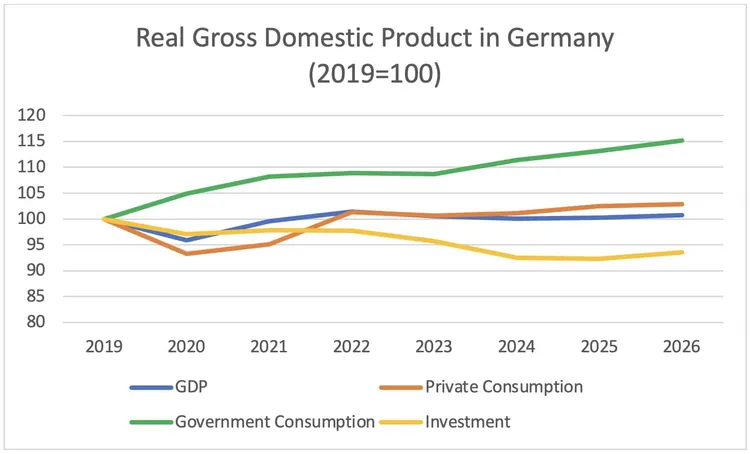
Source: Destatis and the German Council of Economic Experts
There are many reasons for this dismal performance. The sequence of global shocks — Covid, the war in Ukraine, Trump’s tariff war and, this year, the Iran war — has hit Germany, with its focus on exports and industry, harder than other EU countries. At the same time, its automotive sector has come under attack from the “China shock 2.0”, unable to match Chinese technologies in electric batteries and digitalisation.
In recent weeks, the German government — a coalition between the Social Democrats and the conservative CDU/CSU — has tried to turn things around, announcing fundamental reforms of the social security systems and a package of measures to stimulate the economy, the Programme for Upswing and Employment.
“We want to get Germany back on track, and it is now clear that this is possible,” declared Chancellor Friedrich Merz on 2 July, presenting a 34-point “programme for growth and employment”.
A Pension Reform for the 2040s
An important factor behind the Chancellor’s upbeat mood was the set of recommendations made by a Pension Commission (Alterssicherungskommission), installed by the government in December 2025, in which I participated. The commission’s 13 members agreed unanimously on a package of 33 recommendations. Conceptually, the most important is the introduction of a mandatory contribution of 2 per cent of salaries to a government-run pension fund, as practised in Sweden. Other recommendations include raising the retirement age from 67 in 2031 to 67½ in 2041, and cutting the benefit of two-year early retirement for workers with 45 contribution years.
But while the pension scheme is a central pillar of a social market economy, the commission’s recommendations will mainly take effect in the 2030s and 2040s, when pensioners can benefit from the returns on their capital investments. In the nearer term, however, the mandatory payments to build up the capital stock will dampen economic activity — already burdened by higher social security contributions, especially in 2028. The Macroeconomic Policy Institute (IMK) estimates that, in the five years following the increase in contributions, GDP will be reduced by one percentage point and about 250,000 jobs will be lost. Unfortunately, this saving will do nothing to help finance German firms: the proceeds of the forced saving are to be invested largely abroad, in order to generate high returns.
A Programme Short on Investment
But will the Programme for Upswing and Employment deliver the hoped-for turnaround? The most direct impact could come from a cut in income tax, which mainly benefits families with children. At the same time, as a small gesture towards greater social justice, the top marginal rate was raised from 45 to 47 per cent. The overall tax reduction in 2026 amounts to 10 billion euro — about a quarter of a per cent of GDP. Moreover, much of the cut simply compensates for higher inflation. Taken together, the reductions for 2027 and 2028 will not even offset the so-called “cold progression”.
A hotly debated measure is the plan to abolish sick notes issued by telephone. As a result, sick workers will need to submit a certificate of incapacity for work from the first day of illness. This will be difficult to implement in practice, since it is already hard to secure a timely appointment with a physician in Germany. One can debate whether the country’s sickness rate is excessively high, but this measure will certainly not boost the economy. If anything, it will add to the very bureaucratic burdens that are regarded as one of the main obstacles to growth — and that the programme itself promises to reduce: “We are reducing the bureaucratic burden on citizens and businesses, boosting competitiveness and ensuring a socially balanced approach.”
A typical neoclassical growth recipe is the abolition of protection against dismissal for high earners, those on salaries above 170,000 euro. As the number of employees affected is rather small — about 300,000 people — the impact will also be limited. And one might ask whether the atmosphere within companies will change in a productive way if managers must fear instant dismissal whenever they disagree with their boss.
As the chart shows, the main weakness of the German economy is the decline in corporate investment. This is all the more troubling because global competition demands a fundamental technological transformation in Germany, towards innovative business models.
The programme explicitly acknowledges this need: “We will consistently promote future-oriented sectors, including the automotive sector, the chemical and pharmaceutical industries, clean tech, the circular economy, mechanical engineering, battery cell and semiconductor production, and the entire field of artificial intelligence.” Yet it offers no quantitative commitment to match the rhetoric. In the 2027 budget of the special fund for infrastructure and climate neutrality (Sondervermögen), the appropriation for research and development amounts to a mere 1.7 billion euro. That does not stop the finance ministry from advertising it as a 60 per cent increase on the even more inadequate 1.1 billion euro allocated in 2026.
Overall, it is not clear how the reforms and the Programme for Upswing and Employment will fundamentally contribute to a turnaround in the German economy — and, above all, to its urgently needed technological transformation. The lack of clear incentives for investment reflects a broader absence of any comprehensive strategy for innovation and transformation in Germany.
Unfortunately, for the mainstream of German economists this absence of a strategic approach does not seem to be a major problem. Clemens Fuest, the head of the ifo Institute, for instance, evaluated the programme mainly by criticising the fact that the tax burden on companies and government subsidies will not be reduced.
Higher government spending on defence and infrastructure might generate some growth in the coming years. But the German economy continues to move ahead without a clear vision of its future. Market-oriented economists still believe this is the right thing to do. Yet do the seven meagre years now behind us not demonstrate clearly enough that, in the stormy waters of the global economy, ships do not steer themselves?

Help Keep Social Europe Free for Everyone
We believe quality ideas should be accessible to all — no paywalls, no barriers. Your support keeps Social Europe free and independent, funding the thought leadership, opinion, and analysis that sparks real change.
— €4.75/month
Help sustain free, independent publishing for our global community.
Become a supporter— €9.50/month
Go further: fuel more ideas and more reach.
Become an advocate— €19/month
Make the biggest impact — help us grow, innovate, and amplify change.
Become a champion— €142.50/month
For organisations and professionals who rely on Social Europe in their daily work.
Become a member