KEY INSIGHTS
- Hikes arrived too late to matter: Policy rates in the US, UK, Eurozone, Sweden and Canada were raised only as inflation neared its peak during 2021-23, and the standard 1.5-to-2-year transmission lag meant they could not have driven inflation down.
- It was the fuel cycle, not the central banks: Fuel-price inflation led headline inflation by six to 18 months in 2021-23, both on the way up and on the way down.
- Rate policy is the wrong tool for a supply shock: Hikes do not stop wars or pandemics, and forcing a recession to suppress demand carries social costs that outweigh any benefit.
- A subsidy to banks dressed as monetary policy: Remunerating reserves transferred €332.64 billion to euro-area banks between 2023 and May 2026, boosting profits and lending — the opposite of the intended effect.
- About to do it again: Faced with a new energy shock from the war in Iran, the Eurozone and the US are preparing another round of hikes that the 2021-23 record shows will not work.
The inflation that central banks are once again preparing to fight is, to a considerable degree, the fallout from Donald Trump’s war in Iran. The US strikes that began in late February sent oil surging past $100 a barrel, and that energy shock has rippled through the economy to push inflation to its highest level in nearly three years.
As central banks signal that they are ready to raise interest rates in response, it is natural to ask how effective interest-rate policy really was at extinguishing inflation during the previous major episode, that of 2021-23 — an episode that, like today’s, owed more to a supply-side energy shock than to runaway demand.
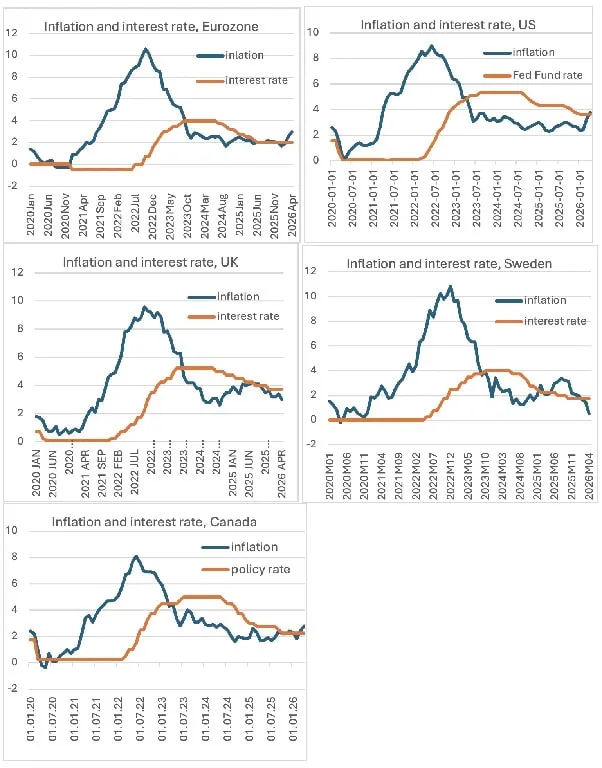
The starting point is five charts showing inflation alongside policy rates in five economies — the US, the UK, the Eurozone, Sweden and Canada — since 2020 (see Figure 1). The policy rates are those under the direct control of the central banks. Two observations stand out.
First, inflation accelerated very fast, climbing from practically zero at the end of 2020 to a peak close to 10 per cent in the second half of 2022. After the peak, the decline was equally fast: in most countries, inflation returned to the proximity of 2 per cent within one to two years.
Second, all central banks were strikingly slow to raise rates. They typically waited more than a year after inflation crossed the 2 per cent bar before tightening. With the exception of the UK, rates were lifted only when inflation had almost reached its peak. The European Central Bank (ECB), for example, raised its policy rate from -0.5 per cent to zero in July 2022, by which time inflation had already reached 8.9 per cent. The underlying rationale at these central banks was that inflation would prove temporary. That turned out to be correct.
But here is the key point. A mass of empirical work shows that the lag between interest-rate changes and their effects on inflation is long. It typically exceeds one year. The estimates are uncertain, but most converge on a delay of 1.5 to two years before a rate hike feeds through to prices. This is why Milton Friedman concluded as long ago as the 1960s that the lags between monetary policy and its effects on output and inflation are “long and variable”.
The charts show that central banks raised rates from low to high in roughly 1.5 years. In other words, during the very window in which they were tightening, those rate hikes could not yet have affected inflation. Yet that is precisely when inflation declined sharply. The fast falls in inflation were therefore unrelated to the rate decisions of the central banks. They must have been driven by another mechanism — the cost-push channel triggered by movements in fuel prices.
Figure 1: Inflation and interest rates in various countries
Source: National central banks.
The second exhibit (see Figure 2) plots the same inflation rates against fuel-price inflation — the change in fuel prices over the previous 12 months, a variable constructed by the International Monetary Fund (IMF). The scales differ sharply: fluctuations in fuel prices (right-hand axis) are more than ten times larger than fluctuations in the price level (left-hand axis).
The pattern is unmistakable. Movements in fuel inflation precede inflation by six to 18 months. At the end of 2020, fuel prices began to surge, and with a delay of six months to a year and a half, headline inflation followed. Similarly, the sharp decline in inflation from mid-2022 is preceded by an equally sharp drop in fuel inflation occurring one to one and a half years earlier.
All of this raises the question of why interest-rate policy was so ineffective during the 2021-23 surge. The first reason is the origin of the shock itself: this was a supply-side episode, with energy prices driven up by the war in Ukraine on top of the supply disruptions of the pandemic.
Central banks struggle to fight cost-push inflation. Raising rates does little to reduce fuel prices. Those prices are typically the product of exogenous shocks — pandemics and wars — and a rate hike neither ends the pandemic nor stops the war. A central bank can, of course, raise rates so far that it engineers a deep recession, cutting output, incomes and therefore the demand for oil. But it is far from clear that this is a good strategy. Oil shocks tend to fade. At some point the oil-price level stabilises or falls, the rate of change in oil prices drops to zero or turns negative, and headline inflation comes down with it — as it did in 2023-24. Pushing the economy into recession to deal with the inflationary consequences of a supply shock looks especially unattractive once one weighs the economic and social costs. As a rule, the best a central bank can do with a supply-driven inflation is to sweat it out, taking care to remain neutral so as to not stimulate demand.
Figure 2: Inflation and fuel-price inflation
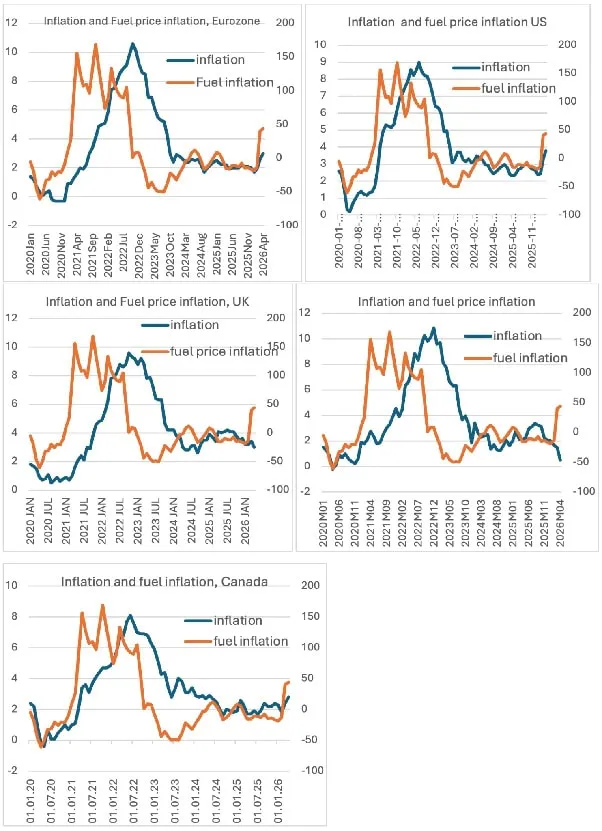
Source: Fuel prices — International Monetary Fund. Inflation — various national central banks.
The objections to using interest rates do not hold when inflation springs from a positive demand shock. Sometimes a boom has been excessive and has produced inflation. Raising rates then attacks the root cause and is genuinely effective in reducing aggregate demand and the inflationary pressures it generates.
A second reason for the ineffectiveness of the 2021-23 rate hikes is of the central banks’ own making. Their current operating procedure is to raise the policy rate by increasing the rate of remuneration paid on the reserves that banks hold at the central bank. When central banks raise rates to fight inflation, they therefore transfer large sums of money to commercial banks. Table 1 shows the scale of these transfers in the Eurozone from 2023 to May 2026.
These transfers swelled banks’ profits. They accounted for more than 50 per cent of total bank profits in the Eurozone during 2023-25. The resulting strengthening of equity positions increased banks’ incentive to extend credit. So even as the central banks were aiming to reduce bank lending by raising rates, the very mechanics of those hikes pushed banks to lend more, offsetting the stated objective. That is an operating procedure which undermines the effectiveness of monetary policy.
Table 1: Yearly interest transfers to banks in the euro area (€ billion)

Source: ECB and authors’ calculations.
The conclusion is uncomfortable but hard to avoid. The interest-rate policies pursued by the major central banks during 2021-23 had close to zero effect on inflation. They came at a high cost. They led to vast transfers to banks, raised bank profits, and produced large losses on central-bank balance sheets — losses that in turn forced central banks to stop remitting profits to their national treasuries, because there were none left. It is difficult to imagine a set of policies with so few benefits and such high costs.
It is striking that central banks continue to deploy an instrument — the interest rate — to fight inflations produced by supply shocks, when the instrument has been shown to be ineffective against them and to produce large economic and budgetary costs. And yet a new round of hikes is in the making in the Eurozone and in the US, this time to confront a renewed surge in inflation that is plainly the result of a supply shock: the energy-price spike driven by the war in Iran. Once again, the central banks appear ready to reach for an instrument that will not work, and will impose great costs in the doing.

Help Keep Social Europe Free for Everyone
We believe quality ideas should be accessible to all — no paywalls, no barriers. Your support keeps Social Europe free and independent, funding the thought leadership, opinion, and analysis that sparks real change.
— €4.75/month
Help sustain free, independent publishing for our global community.
Become a supporter— €9.50/month
Go further: fuel more ideas and more reach.
Become an advocate— €19/month
Make the biggest impact — help us grow, innovate, and amplify change.
Become a champion— €142.50/month
For organisations and professionals who rely on Social Europe in their daily work.
Become a member