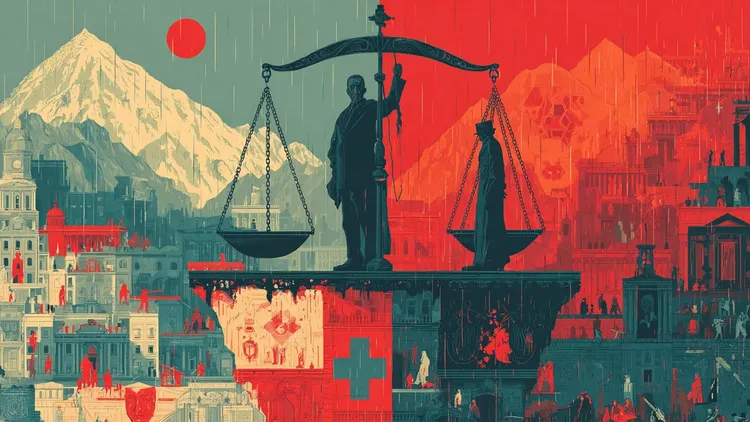
Uruguay has sustained a robust statist profile since the early twentieth century. The government led by José Batlle y Ordóñez, which initiated the era known as Batllismo, was characterised by the strengthening of state institutions and, between 1904 and 1916, the consolidation of a process that reinforced the national state whilst creating several public authorities. This state-building process was closely linked to the separation of church and state and the establishment of a secular order—a phenomenon unique in the region at that time.
During that same period, the first foundations of the welfare state were established, which brought crucial labour reforms such as the Eight Hours Act (1915) and the Weekly Rest Act (1920). This legislation was complemented by social rights including those granted by the Divorce Act (1907), the mandatory character of primary education, and access to social security, marking the course of Batllist reformism with its profoundly egalitarian vocation.
Data from the 2024 Latinobarómetro study demonstrate that Uruguay maintains high levels of trust in the government, the state, political parties and parliament, whilst showing low levels of trust in the church—reaffirming the secular identity and institutional tradition of the country.
The Uruguayan Constitution institutes a democratic, republican, presidential, bicameral and unitary system. It also establishes a social state governed by the rule of law, widely recognising and guaranteeing civil and political rights alongside a comprehensive set of economic, social and cultural rights that manifest the country’s egalitarian vocation. Among these are the rights to work, education, health, social security and housing, thus configuring a constitutional framework that positions the state as guarantor of the well-being and social protection of its population.
The consensus on public provision
Regarding the role of the state, there exists a certain consensus about the need for it not only to perform a regulatory function but also to serve as the provider of basic and essential services. This agreement is maintained not only by the progressive end of the political spectrum but is also embraced by right-wing actors. Even former president Luis Lacalle Pou, torchbearer of the centre-right political forces, has publicly declared his acknowledgement of the state as guarantor and regulator.
Uruguayan public companies address the population’s fundamental rights whilst serving as important national revenue collection entities. Three enterprises in particular hold state monopolies in the administration of basic services: OSE (drinking water and sanitation), UTE (electricity) and ANCAP (fuels). Despite attempts to privatise public companies, which were widely common across the region during the 1990s, Uruguay held a referendum on public enterprises in 1992, through which citizens decided to prohibit the privatisation of these services, thus consolidating the role of the state as guarantor of public goods.
With regard to telecommunications, Uruguay owns a national company, ANTEL, which operates in a competitive market but maintains the monopoly of telecommunications infrastructure, especially in optical fibre coverage. Thanks to considerable public investment in this area, Uruguay stands out, ranking first in Latin America and the Caribbean—and highly at a global level—for the widespread access of homes to internet connectivity. This achievement became an important pillar for Plan Ceibal, the digital literacy programme in primary education.
The public banking institutions—such as the Banco de la República Oriental del Uruguay (BROU), the Banco Hipotecario del Uruguay (BHU) and the Banco de Seguros del Estado (BSE)—compete with the private finance system but maintain wide-ranging influence within the national market, reaffirming the weight of the public sector in the Uruguayan economy.
Public education represents another distinctive feature of the country. Uruguay has been offering free, secular and mandatory education since the end of the nineteenth century, a foundational milestone in building the modern state. Throughout the twentieth century, mandatory education was gradually institutionalised and nowadays encompasses primary and basic secondary education, guaranteeing approximately ten years of effective access to classrooms. Along those lines, the Universidad de la República (Udelar) hosts the largest number of enrolled students compared to private universities in the country, reflecting the policy of providing broad access to higher education implemented in recent decades.
Emerging fractures in the social contract
As far as national problems linked to the state are concerned, at least two open public debates have become evident. On the one hand, as the study “El país de los consensos” (The Land of Consensus) points out, all sectors of the political system agree that drug trafficking and organised crime represent one of the main challenges facing the country. The soaring level of violence in some suburbs of the capital and in other parts of the country, represented by an increasing number of homicides linked to gang disputes, alongside high incarceration rates—among the highest in the region—reflect the extent of the problem. Similarly, the increase in the number of homeless people has turned into a central social concern, especially for progressive sectors of society.
Uruguay also faces alarming levels of poverty among children and youth. This reveals a deep social divide which, combined with the steady decline in birth rates across the entire population, triggers several alerts regarding the demographic and social future of the country. Although the need to tackle this issue represents another political consensus, no effective approaches have been implemented so far.
Gender-based violence, too, is one of the problems that have challenged the idea that Uruguayan democracy is a shining example for everyone to follow. The rates of violence against women, youth and children, which have been increasing lately, expose the weakness of the justice and protection system. Yet the prominent position this issue occupies on the public agenda has not translated into an adequate response either.
One of the most relevant debates on redistribution in Uruguay in recent years is called the “one per cent debate”. This approach, originally brought forward by the trade union movement, pushed the need to establish a fairer tax policy onto the public agenda to ensure an increase in the tax contributions of the richest one per cent of the population, and proposed a redistribution strategy to reduce the income gap. Although part of the Frente Amplio (Broad Front, the left-wing political coalition the current president belongs to) included this approach in their programme, it has not been among the priorities of the current government.
Attempts made by different governments to push state reforms have been sporadic and focused more on strong discourse rather than on concrete measures. Indeed, the government agendas of the first decades of the twenty-first century included reforms aimed at making the state faster and more efficient, but changes in this context became visible only in specific areas of public administration, such as tax offices.
The current background of the debate on this topic is the perception that Uruguay is an “expensive country”, where the cost of living is high, and this high cost is directly linked to the high tax burden and the relatively low level of informality in the economy. With that in mind, it is only natural that the discussion about the public provision of goods and services is based on criticism asserting that, considering the high cost of living in Uruguay, these services should be of higher quality.
For more than a century, the Uruguayan state has been a democratic reference in the region and a pillar of cohesion, equality and social trust. Nowadays, social tensions and new forms of exclusion require a new phase of reforms that combine the effectiveness of the state with its historical commitment to social justice. Renewing the state does not mean reducing it, but reimagining it in response to global and regional challenges: the need for new development models, for coordinated answers to drug trafficking and organised crime, and for public policies capable of overcoming territorial borders to strengthen democracy and social cohesion.



Help Keep Social Europe Free for Everyone
We believe quality ideas should be accessible to all — no paywalls, no barriers. Your support keeps Social Europe free and independent, funding the thought leadership, opinion, and analysis that sparks real change.
— €4.75/month
Help sustain free, independent publishing for our global community.
Become a supporter— €9.50/month
Go further: fuel more ideas and more reach.
Become an advocate— €19/month
Make the biggest impact — help us grow, innovate, and amplify change.
Become a champion— €142.50/month
For organisations and professionals who rely on Social Europe in their daily work.
Become a member