Since the 1990s, Jürgen Habermas’s public interventions have embodied a European conscience whose influence and prestige extend far beyond Germany. From that period onward, his writings have no longer been solely those of the leading figure of the Frankfurt School, renowned for his theory of communicative action. Less pessimistic than his predecessors Adorno and Horkheimer, who scrutinised the latent totalitarian dimensions of modern societies, Habermas has become a philosopher committed to the construction of Europe—a commitment that has been overtly political since the Maastricht Treaty. In this way, he aligns himself with advocates of a supranational European Union in service of a cosmopolitan democratic project and the stabilisation of international relations shaken by the resurgence of nationalisms and war, particularly in the Balkans at that time.
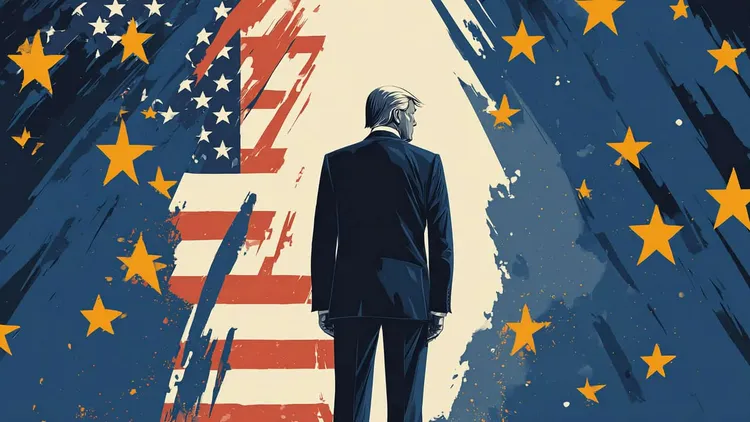
Habermas’s public address in Munich on 19 November 2024 thus stands apart from the commonplace media commentary devoted to shifts in global equilibria following Donald Trump’s renewed victory in the presidential election. The German intellectual incorporates into his analysis the evolution of American politics over several decades. Within this trajectory, he identifies the rise of a Republican current embodied by Newt Gingrich—well before the emergence of the Tea Party or MAGA—as a milestone no less significant than Trump’s own elections. George W. Bush’s political course in the aftermath of 11 September 2001 and the weaknesses of Barack Obama’s foreign policy feature similarly. Yet although subtle in method, the analysis revives a negative representation of the United States typical of the European left in the 1970s, especially during Richard Nixon’s presidency.
Habermas’s analysis nevertheless resists the simplistic terms of the current revival of anti-imperialist rhetoric evident among European left-wing circles. On this point, the German intellectual acknowledges the multipolar evolution of international relations and the constraints posed by Xi Jinping’s new Chinese doctrine for the United States, Asia, and Europe alike. His argument remains original and nuanced when he advocates, from a European perspective, the complementarity of strengthening the political unification initiated at Maastricht and preserving the transatlantic alliance. Likewise, he refrains from endorsing the thesis of some kind of holy alliance between MAGA Republicanism and European “right-wing populists.”
The nuance tends to evaporate, however, when addressing the political character of Donald Trump’s presidency. Here, Habermas’s discourse converges with a pessimistic, even catastrophist critique of the future of American democracy—one that invokes isolated events such as the assault on the Capitol or the mobilisation of the National Guard without analysing or contextualising them. In this respect, this portion of his address echoes the concerns of other observers less renowned than him in Europe, such as Theda Skocpol, Daniel Ziblatt or Arthur Goldhammer.
The limits of Habermasian fatalism
One initial feature of Habermas’s fatalism lies in underestimating one of the principal determinants of contemporary American reality: the forthcoming midterm elections. Regardless of the acknowledged vehemence of his public political discourse or the Caesarist aspirations of a minority of his supporters, the American president does not challenge the electoral process within a multiparty system. Recent results in Florida and New York suggest that alternation between the two traditional parties remains plausible, given that institutions are intact and civil society continues to be divided along historical cleavages. Similarly, American debate does not call into question the system’s foundation in the separation of three powers—an equilibrium that defines liberalism—but rather entails a juridical interrogation of the terms of that equilibrium.
A second feature consists in overlooking the fact that Donald Trump’s ability to assemble an arithmetic national majority, as well as majorities within numerous electoral segments, is not characteristic of the Republican Party as a whole. The president’s capacity for synthesis and embodiment contrasts with the profound divisions of an organisation that encompasses advocates of social spending and protectionist orientation; proponents of a new industrial and international modernity; supporters of a strengthened federal executive; and those favouring greater autonomy for the federated states. The unity of the GOP and its electoral future are tested by the temptation to broaden representation of an affluent electorate through inclusion of citizens responsive to a conservative labourism centred on employment, purchasing power, and the use of borders to counter immigration, Asian imports, and drug smuggling. This process bears similarities to the aggiornamento of right-wing forces in several European countries, including within the Strasbourg Parliament.
Finally, while Habermas does not echo the Spanish left’s calls for resistance to economic and military imperialism, his presentation obscures the undeniable contribution of the American administration to the pacification of international relations in various regions of the world. At the very moment Habermas delivered his Munich address, the United States was articulating its foreign policy orientations in terms of an updating of the Monroe Doctrine—that is, within a national political tradition rather than through an “illiberal” rupture. The first application of this revived Monroe Doctrine in Venezuela does not challenge this interpretation: Nicolás Maduro’s capture may not catalyse the democratisation of the regime, but the American gamble should at least put an end to the dislocation of the country and restore the national economy.
In other words, Habermas fails to give due consideration to the historical nature of American debates, which have never contested democracy or the republic but have instead sought to rebalance these two ancient notions within a federal framework.
Rather than resorting to the concepts of populism or illiberalism—poorly constructed from borrowings from 20th-century political science, if not from Joseph de Maistre—Europe requires a more empirical and serene approach to American realities, as well as to those of Russia or China. Failing this, the old continent will remain prey to the fears it harbours and to ideologies belonging to its own past. By accepting instead to confront these American realities, and the global fading of Kantian dreams dear to Habermas, the EU member states might succeed in rebuilding the strong and balanced Atlantic alliance needed to guarantee a lasting peace with Russia, fair trade with China, the containment of Iran, and the security of maritime routes near Greenland—among other pressing items on the agenda.

Help Keep Social Europe Free for Everyone
We believe quality ideas should be accessible to all — no paywalls, no barriers. Your support keeps Social Europe free and independent, funding the thought leadership, opinion, and analysis that sparks real change.
— €4.75/month
Help sustain free, independent publishing for our global community.
Become a supporter— €9.50/month
Go further: fuel more ideas and more reach.
Become an advocate— €19/month
Make the biggest impact — help us grow, innovate, and amplify change.
Become a champion— €142.50/month
For organisations and professionals who rely on Social Europe in their daily work.
Become a member