Social Europe

politics, economy and employment & labour

  • Projects
    • Corporate Taxation in a Globalised Era
    • US Election 2020
    • The Transformation of Work
    • The Coronavirus Crisis and the Welfare State
    • Just Transition
    • Artificial intelligence, work and society
    • What is inequality?
    • Europe 2025
    • The Crisis Of Globalisation
  • Audiovisual
    • Audio Podcast
    • Video Podcasts
    • Social Europe Talk Videos
  • Publications
    • Books
    • Dossiers
    • Occasional Papers
    • Research Essays
    • Brexit Paper Series
  • Shop
  • Membership
  • Ads
  • Newsletter

Whose is the European Green Deal?

by Albena Azmanova on 11th March 2020 @AAzmanova

TwitterFacebookLinkedIn

The challenges of social and environmental injustice are as intense as ever. But which social forces can act as the agents of change?

social justice climate protests
Albena Azmanova

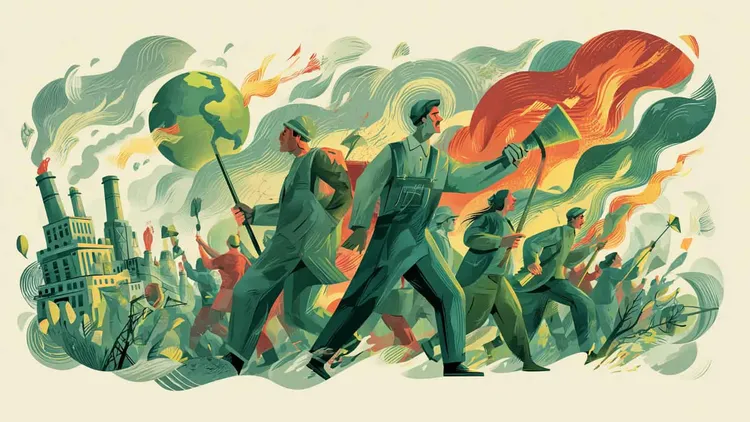
Every idea is only as powerful as the social forces behind it. The idea of environmental justice is at the height of its political fame—the European Green Deal is the flagship policy of the new EU administration. Yet who are the collective social forces behind it? The exalted Fridays for Future youth marches might be the catalyst in bringing the green idea to its current prominence, but they do not constitute a social force of the type labour has provided in advancing the ideals of socialism.

Two peculiarities of social protest are currently preventing the emergence of an agent of change through a broad mobilisation of social forces against the most deleterious effects of capitalism, including the destruction of the natural environment. The first is that lines of social conflict have proliferated into a network of antagonisms: the western working class against the global working class, poor versus rich, owners of competitive industries versus those of noncompetitive ones, holders of stable employment contracts versus perpetual job-seekers. This networked antagonism blocks the emergence of a distinct revolutionary subject with a coherent ideology around which a counter-capitalist hegemony could germinate. A peculiarity of our times is that the capital-labour dynamics of conflict have been replaced by a capital-labour alliance in support of the growth-and-redistribution agenda that has proven to be so deleterious for the environment.

Coalition difficult

The second obstacle concerns the way in which the social-justice and environmental-justice agendas have been politicised. Until recently, the former was articulated, politically, in terms of impoverishment (cost-of-living concerns), inequality and exclusion. The latter was addressed by social movements as a matter of capitalism’s harmful effects. Opposition arose against the pursuit of profit and the production-consumption nexus, for which capitalism has relied on the rampant extraction of natural resources. Politically, such concerns for a long time remained framed as ‘lifestyle issues’, while social justice was presented as a more urgent, ‘bread-and-butter’ issue. That is why it has been difficult to forge a broad coalition in support of fighting poverty and inequality, on the one hand, and saving the environment, on the other: with limited national budgets, electorates prioritised the bread-and-butter concerns over those of lifestyle.

Make your email inbox interesting again!

"Social Europe publishes thought-provoking articles on the big political and economic issues of our time analysed from a European viewpoint. Indispensable reading!"

Polly Toynbee

Columnist for The Guardian

Thank you very much for your interest! Now please check your email to confirm your subscription.

There was an error submitting your subscription. Please try again.

Powered by ConvertKit

The conflict between the two agendas has altered. It has become clear both that global warming is accelerating and that governments are not doing what is necessary to address the emergency. Very few of the 197 signatories of the 2016 international Paris agreement for action against climate change have adopted national climate action plans ambitious enough to meet their pledges. This has altered the manner in which climate justice is politicised. The youth-climate marches that have been taking place across the globe in 2019 and currently have reframed the environment as an ‘essentials of life’ issue, linking it to the aggravation of poverty and a general threat to human life. This has increased the political significance of the environmental agenda. Positioning it on the same plane as issues of economic and social justice enables an alignment between the two agendas, which is a source of hope.

However, whatever commitments to pursuing prosperity for all, as well as to mitigating climate change, might be emerging, the conflict between the agenda of economic justice and that of environmental justice cannot be resolved in the current economic context of limited public funds, as both investment in new technologies and raising the standard of living are costly political objectives. In order to overcome this conflict and allow for policy action, a common denominator must bridge environmental concerns and issues of poverty alleviation. An over-arching concern (what the philosophers Ernesto Laclau and Chantal Mouffe have called ‘a chain of equivalence’) needs to emerge, linking the multiple struggles for emancipation into a common will. Moreover, such a logic equivalence needs to be powerful enough to subvert the existing capital-labour alliance that draws its livelihood from destroying the environment into an alliance to protect the environment.

Overarching discontent

Such a logic is available. It is located in the overarching discontent of the multitude with the tangible effects of the competitive pressures of contemporary capitalism. The destabilisation of sources of livelihood and the increased competitive pressure on almost all preceded the financial crisis of 2008, and the situation has not improved with the post-crisis recovery. Our age is not that of a precarious class, but of a precarious multitude. Surveys indicate that a growing number of people across the capital-labour divide are frustrated with the intensified performance pressures and employment uncertainty that globally integrated capitalism generates. This resentment of job-related pressures combines with unprecedentedly broad awareness that the way we produce and live our lives is toxic for the environment and increases the risks of life-threatening natural disasters.

This allows us to discern a trajectory of change behind the thicket of seemingly disparate grievances and beyond the networked antagonism that pervades global capitalism. The spreading dynamic of social precariousness that afflicts almost all people, irrespective of their income, gender and professional occupation, enables the formation of a very broad alliance of forces who share the desire (rather than a latent, unarticulated interest) to alter significantly the economic and political parameters of their societies. This suggests that the possibility for a radical, if not revolutionary, change is now more obtainable than ever. All we need to do is overcome our nostalgic infatuation with the growth-and-redistribution agenda that crowned the postwar welfare state and focus on fighting economic insecurity. This is the only way to make social justice compatible with environmental justice. 

Excerpted from Capitalism on Edge: How Fighting Precarity Can Achieve Radical Change Without Crisis or Utopia Copyright (c) 2020 Columbia University Press. Used by arrangement with the publisher. All rights reserved.

TwitterFacebookLinkedIn
Home ・ Whose is the European Green Deal?

Filed Under: Politics

About Albena Azmanova

Albena Azmanova is associate professor in political and social thought at the University of Kent’s Brussels School of International Studies. Her most recent book is Capitalism on Edge: How Fighting Precarity can Achieve Radical Change without Crisis or Utopia (Columbia University Press, 2020).

Partner Ads

Most Recent Posts

Thomas Piketty,capital Capital and ideology: interview with Thomas Piketty Thomas Piketty
pushbacks Border pushbacks: it’s time for impunity to end Hope Barker
gig workers Gig workers’ rights and their strategic litigation Aude Cefaliello and Nicola Countouris
European values,EU values,fundamental values European values: making reputational damage stick Michele Bellini and Francesco Saraceno
centre left,representation gap,dissatisfaction with democracy Closing the representation gap Sheri Berman

Most Popular Posts

sovereignty Brexit and the misunderstanding of sovereignty Peter Verovšek
globalisation of labour,deglobalisation The first global event in the history of humankind Branko Milanovic
centre-left, Democratic Party The Biden victory and the future of the centre-left EJ Dionne Jr
eurozone recovery, recovery package, Financial Stability Review, BEAST Light in the tunnel or oncoming train? Adam Tooze
Brexit deal, no deal Barrelling towards the ‘Brexit’ cliff edge Paul Mason

Other Social Europe Publications

Whither Social Rights in (Post-)Brexit Europe?
Year 30: Germany’s Second Chance
Artificial intelligence
Social Europe Volume Three
Social Europe – A Manifesto

Social Europe Publishing book

The Brexit endgame is upon us: deal or no deal, the transition period will end on January 1st. With a pandemic raging, for those countries most affected by Brexit the end of the transition could not come at a worse time. Yet, might the UK's withdrawal be a blessing in disguise? With its biggest veto player gone, might the European Pillar of Social Rights take centre stage? This book brings together leading experts in European politics and policy to examine social citizenship rights across the European continent in the wake of Brexit. Will member states see an enhanced social Europe or a race to the bottom?

'This book correctly emphasises the need to place the future of social rights in Europe front and centre in the post-Brexit debate, to move on from the economistic bias that has obscured our vision of a progressive social Europe.' Michael D Higgins, president of Ireland


MORE INFO

Hans Böckler Stiftung Advertisement

The macroeconomic effects of the EU recovery and resilience facility

This policy brief analyses the macroeconomic effects of the EU's Recovery and Resilience Facility (RRF). We present the basics of the RRF and then use the macroeconometric multi-country model NiGEM to analyse the facility's macroeconomic effects. The simulations show, first, that if the funds are in fact used to finance additional public investment (as intended), public capital stocks throughout the EU will increase markedly during the time of the RRF. Secondly, in some especially hard-hit southern European countries, the RRF would offset a significant share of the output lost during the pandemic. Thirdly, as gains in GDP due to the RRF will be much stronger in (poorer) southern and eastern European countries, the RRF has the potential to reduce economic divergence. Finally, and in direct consequence of the increased GDP, the RRF will lead to lower public debt ratios—between 2.0 and 4.4 percentage points below baseline for southern European countries in 2023.


FREE DOWNLOAD

ETUI advertisement

Benchmarking Working Europe 2020

A virus is haunting Europe. This year’s 20th anniversary issue of our flagship publication Benchmarking Working Europe brings to a growing audience of trade unionists, industrial relations specialists and policy-makers a warning: besides SARS-CoV-2, ‘austerity’ is the other nefarious agent from which workers, and Europe as a whole, need to be protected in the months and years ahead. Just as the scientific community appears on the verge of producing one or more effective and affordable vaccines that could generate widespread immunity against SARS-CoV-2, however, policy-makers, at both national and European levels, are now approaching this challenging juncture in a way that departs from the austerity-driven responses deployed a decade ago, in the aftermath of the previous crisis. It is particularly apt for the 20th anniversary issue of Benchmarking, a publication that has allowed the ETUI and the ETUC to contribute to key European debates, to set out our case for a socially responsive and ecologically sustainable road out of the Covid-19 crisis.


FREE DOWNLOAD

Eurofound advertisement

Industrial relations: developments 2015-2019

Eurofound has monitored and analysed developments in industrial relations systems at EU level and in EU member states for over 40 years. This new flagship report provides an overview of developments in industrial relations and social dialogue in the years immediately prior to the Covid-19 outbreak. Findings are placed in the context of the key developments in EU policy affecting employment, working conditions and social policy, and linked to the work done by social partners—as well as public authorities—at European and national levels.


CLICK FOR MORE INFO

Foundation for European Progressive Studies Advertisement

Read FEPS Covid Response Papers

In this moment, more than ever, policy-making requires support and ideas to design further responses that can meet the scale of the problem. FEPS contributes to this reflection with policy ideas, analysis of the different proposals and open reflections with the new FEPS Covid Response Papers series and the FEPS Covid Response Webinars. The latest FEPS Covid Response Paper by the Nobel laureate Joseph Stiglitz, 'Recovering from the pandemic: an appraisal of lessons learned', provides an overview of the failures and successes in dealing with Covid-19 and its economic aftermath. Among the authors: Lodewijk Asscher, László Andor, Estrella Durá, Daniela Gabor, Amandine Crespy, Alberto Botta, Francesco Corti, and many more.


CLICK HERE

About Social Europe

Our Mission

Article Submission

Legal Disclosure

Privacy Policy

Copyright

Social Europe ISSN 2628-7641

Find Social Europe Content

Search Social Europe

Project Archive

Politics Archive

Economy Archive

Society Archive

Ecology Archive

.EU Web Awards