KEY INSIGHTS
- A persistent gender gap: Girls’ care-career expectations rose from 38 to 43 per cent between 2000 and 2022, boys’ from 10 to 15, leaving the gap at roughly 28 points.
- Professional or nothing: In many countries over 90 per cent of care-minded teenagers expect professional or managerial jobs, while eldercare and personal care barely register.
- Healthcare up, teaching down: Girls’ teaching expectations collapsed in Portugal, France, and Denmark while healthcare rose, a shift driven by girls rather than boys.
- Rewards matter: National pay levels and the age of academic tracking show modest associations with expectations, suggesting job quality shapes plans alongside preferences.
- Policy must widen its aim: Europe needs to make the whole hierarchy of caring occupations credible, not simply attract more young people to “care”.
Europe’s care workforce faces a demographic challenge. According to the European Commission’s 2022 European Care Strategy, more than 1.6 million additional long-term care workers will be needed across the EU by 2050 simply to maintain existing levels of care coverage. Low pay, difficult working conditions, and high turnover already trouble social services. But another important question deserves asking: which caring occupations do young people actually imagine entering? In other words, a complete picture requires more than an understanding of the stress, burnout, and attrition of today’s care workers: it also needs information on the pool of young adults who plan to enter care fields at all.
Our recent study in the International Journal of Comparative Sociology follows the occupational expectations of more than one million 15-year-olds across 30 countries of the Organisation for Economic Co-operation and Development (OECD) over five rounds of the Programme for International Student Assessment (PISA), from 2000 to 2022. Many teenagers, particularly girls, expect to pursue caring careers. But the data also reveal an important mismatch: young women overwhelmingly envisage professional, credentialed work rather than the support-level jobs on which daily care provision also depends. The result is a potential divergence between the care careers young people value and the occupations in which European societies most need workers.
Across the 30 countries, the share of girls expecting a care-related career rose from 38 per cent in 2000 to 43 per cent in 2022. In other words, care work as a whole is surprisingly popular among young women. The corresponding figure for boys increased from 10 per cent to 15 per cent. The gender gap therefore remained at approximately 28 percentage points, even as overall interest grew.
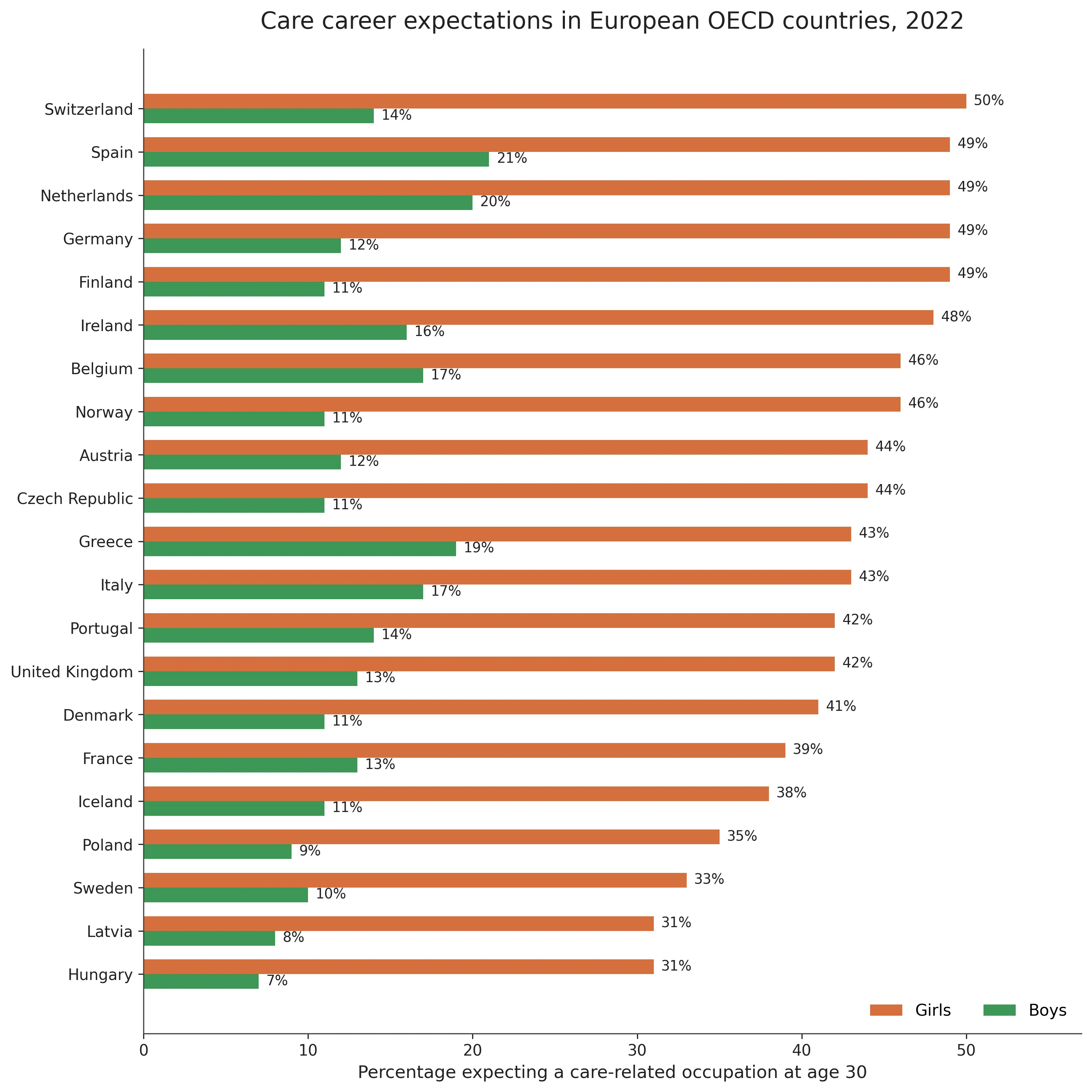
European countries, however, do not all look alike. In 2022, 49 per cent of girls in Finland, Germany, the Netherlands, and Spain expected care careers, compared with 33 per cent in Sweden and 31 per cent in Hungary and Latvia. Among boys, expectations ranged from seven per cent in Hungary to 21 per cent in Spain. Figure 1 illustrates this variation.
That variation does not map neatly onto conventional distinctions between welfare states. Although broad similarities with the United States are apparent, as discussed in our earlier study in Socius, European countries follow distinctive trajectories rather than a single common pattern.
Persistent differences between boys and girls remain important across all these contexts. Expectations of caring work are already strongly gendered by the age of 15, long before employers begin recruiting.
The Care Hierarchy Appears Long Before Employment
The most striking result concerns the occupations within care work. Adolescents who anticipate care careers overwhelmingly expect professional or managerial positions. Physicians, nurses, psychologists, and teachers loom far larger in their plans than personal care, eldercare, or other support roles requiring fewer formal credentials.
In many countries, over 90 per cent of teenagers expecting a care career envisaged a professional or managerial occupation. This pattern was evident from 2000 onwards. For teenagers, care work appears to be an attractive career option primarily when it involves highly skilled, credentialed professional employment. Hands-on personal care, including the everyday work of looking after older people and people with disabilities, is almost entirely absent from their occupational expectations.
Professional and support occupations differ in qualifications, pay, security, authority, and opportunities for progression. These distinctions help explain why caring work can appear attractive in principle while particular caring jobs barely enter young people’s occupational expectations. PISA does not measure their motivations directly, so the evidence cannot tell us exactly how teenagers weigh these considerations. It does show the pronounced occupational hierarchy embedded in their plans.
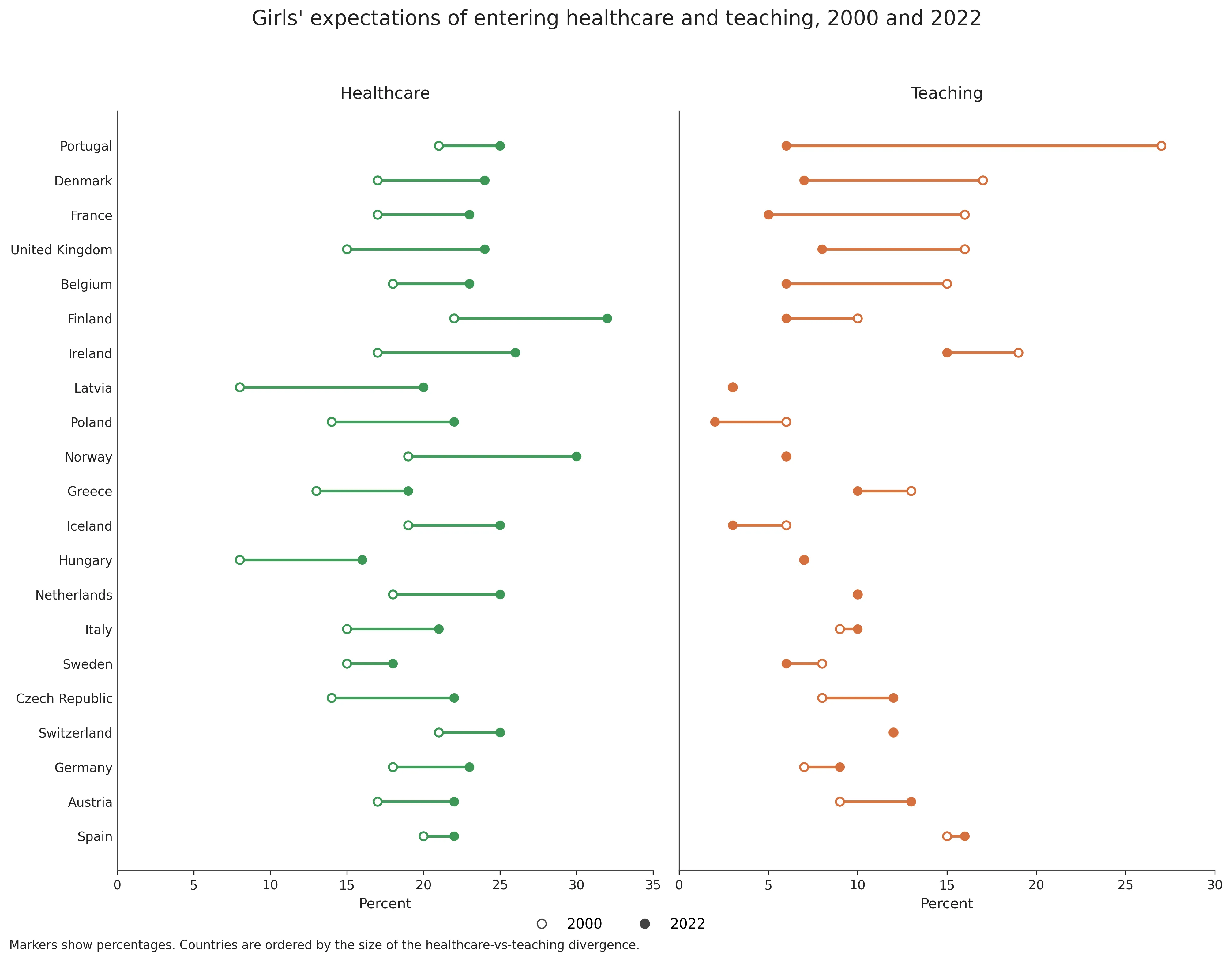
We also observe significant differences between two relatively credentialed domains of care: healthcare and teaching. Across much of Europe, girls increasingly expect healthcare careers, while teaching has stagnated or declined.
In Portugal, the proportion of girls expecting to teach fell from 27 per cent in 2000 to six per cent in 2022. The corresponding decline was from 16 per cent to five per cent in France and from 17 per cent to seven per cent in Denmark. Healthcare expectations increased over the same period. Finland illustrates the divergence: girls’ healthcare expectations rose from 22 per cent to 32 per cent, while teaching declined from 10 per cent to six per cent.
There are exceptions. In Germany and Czechia, girls’ expectations of teaching increased modestly. Figure 2 shows both the more widespread divergence and this cross-national variation. The narrowing gender gap in teaching largely reflects declining interest among girls rather than growing interest among boys.
Healthcare also draws more strongly on educational advantage. Across our models, higher achievement and more advantaged family backgrounds were associated with greater interest in healthcare but showed much weaker associations with teaching. Care careers are therefore differentiated both by gender and by the educational and social resources young people bring to their plans.
What This Means for European Care Policy
The European Care Strategy recognises the need to improve pay, working conditions, skills, and recruitment. In 2025, European social partners also agreed a framework intended to improve recruitment and retention in social services. These initiatives acknowledge that workforce shortages are tied to the quality of care jobs, not merely to the number of potential applicants.
Our analysis found modest associations between occupational expectations and national features such as remuneration and the age at which students are separated into academic and vocational pathways. These observational relationships should not be read as evidence that a particular reform would directly change teenagers’ plans. They do suggest that the opportunities and rewards attached to occupations deserve attention alongside individual preferences.
Nor should expectations at 15 be mistaken for eventual employment. Teenagers may revise their plans, and many more aspire to professional careers than the labour market can accommodate. Nevertheless, expectations offer an early view of which occupations seem desirable and attainable.
Europe’s challenge is consequently broader than encouraging more young people to consider “care”. Many already do, but in highly selective ways. Making personal care, eldercare, disability support, and teaching credible and sustainable careers will require stronger rewards, decent conditions, recognised skills, and real possibilities for advancement. A future care workforce depends on making the entire hierarchy of caring occupations worth considering.


Help Keep Social Europe Free for Everyone
We believe quality ideas should be accessible to all — no paywalls, no barriers. Your support keeps Social Europe free and independent, funding the thought leadership, opinion, and analysis that sparks real change.
— €4.75/month
Help sustain free, independent publishing for our global community.
Become a supporter— €9.50/month
Go further: fuel more ideas and more reach.
Become an advocate— €19/month
Make the biggest impact — help us grow, innovate, and amplify change.
Become a champion— €142.50/month
For organisations and professionals who rely on Social Europe in their daily work.
Become a member