KEY INSIGHTS
- Novices gain most: AI assistance raised customer-support productivity by 15 per cent overall and by around 30 per cent for less-experienced and less-skilled agents.
- Education gap shrinks: In a randomised experiment, access to AI closed roughly three-quarters of the productivity gap between more- and less-educated workers.
- Entry-level evidence is mixed: US payroll data hint at a hiring slowdown for young workers in AI-exposed jobs, while studies from Denmark and Australia find little evidence that AI is to blame.
- Capital takes the prize: Automation raises the return to wealth, and concentrated ownership of frontier models could turn a handful of providers into toll roads across the economy.
- A global divide looms: Cheap machine expertise threatens the service-export model of countries such as India and the Philippines.
Artificial intelligence could make society more productive and narrow wage gaps between workers. Yet it might still end up making society more unequal.
Take the example of a customer support officer, two months into the job, who has to help a small business owner with a technical problem. The officer needs to diagnose what has gone wrong, understand the software, and explain the solution clearly.
In front of the customer support officer sits an AI assistant that has learned from millions of previous conversations, including the responses of the firm’s best workers. It suggests questions to ask and ways to explain the answer.
Stanford’s Erik Brynjolfsson and his co-authors studied what happened when more than 5,000 customer-support agents were given access to such a tool. Across the workforce, productivity rose by 15 per cent. Among less-skilled and less-experienced workers, the number of problems resolved per hour rose by around 30 per cent.
With AI assistance, an agent who had been in the job for two months performed about as well as an unassisted agent with more than six months’ experience.
This compression of productivity differences is something economists have rarely seen before. In the past, a pretty solid economic rule of thumb held that new technologies tended to favour people who already had more education or expertise.
But generative AI might be different. It may prove especially valuable to novices, rather than causing them to fall behind. In this sense, we can think of AI as a tool that allows junior workers to catch up with senior colleagues who have more education or experience in the workplace.
AI Narrows the Education Gap
A randomised experiment provides further evidence. The University of Nottingham’s Guillermo Cruces and his colleagues gave nearly 1,200 adults a workplace-style business problem, randomising whether they had access to AI. Among people working without AI, those with more education outperformed those with less education by a substantial margin. With AI, that gap was roughly three-quarters smaller, leaving only about a quarter of the original difference. Generative AI thus substantially narrowed the education-based productivity gap on this task, though it did not eliminate it.
Others have worried that AI will lead to mass lay-offs, particularly among entry-level workers. Yet the evidence is mixed. Work by the Stanford Digital Economy Lab finds hints of a US hiring slowdown for young workers in highly AI-exposed occupations. But other research suggests that the US youth hiring slowdown might be caused mostly by working from home, which makes it harder to supervise and train new hires, rather than by the uptake of AI.
Evidence from other countries also casts doubt on AI as the main culprit. Research by Anders Humlum and Emilie Vestergaard in Denmark finds that the fall in early-career employment in AI-exposed occupations is not driven by the firms that actually adopt AI chatbots. A report by the Department of Employment and Workplace Relations found that Australian entry-level employment outcomes have mostly held up.
The labour market studies suggest that AI may compress productivity differences among workers, potentially narrowing wage gaps too. The junior accountant catches up with the senior accountant. The average programmer moves closer to the star programmer. The wage premium attached to education and experience might fall, and junior hiring could remain solid.
If those productivity gains translate into relatively larger pay rises for less-experienced workers, wage inequality could fall. Yet total income inequality could still rise if AI widens the gap between wage-earners and capital-earners.
When AI performs a task that a worker used to perform, part of production moves from labour to capital. This means that the gap between labour income and capital income could widen, even as pay packets become more equal.
The Gains Flow to Capital
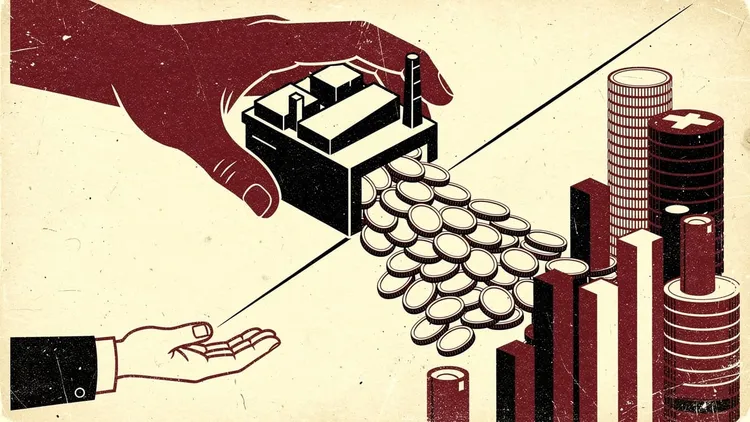
The London School of Economics’ Benjamin Moll and his colleagues develop a model in which automation raises the return to productive wealth. Those gains accrue disproportionately to households that already own more capital. Higher returns compound over time.
Previous technological revolutions often involved businesses buying their own capital equipment. Factories purchased electrical machinery, while offices filled with computers. By contrast, many businesses now access AI through services provided by a small number of external companies.
If every bank, law firm, retailer, and manufacturer relies on a small number of upstream AI systems, then the model provider begins to resemble a toll road sitting across a growing share of the economy.
The share of AI gains that accrue to capital will be higher if ownership of the frontier models is highly concentrated and these megafirms earn large economic rents. At that level, competition will be limited by the vast resources required to build a frontier model: a combination of chips, training data, and talent that has seen the major hyperscalers invest around three-quarters of a trillion dollars this year alone. It will be difficult for new entrants to cross such an expensive moat.
AI could also increase global inequality. For decades, countries such as the Philippines and India have built export industries around relatively abundant educated labour. AI changes that comparative advantage. A call-centre interaction that was once handled by a person in Manila or Mumbai can increasingly be performed by software running in a data centre.
AI substantially lowers the price of certain forms of expertise. That is good news for a worker gaining access to expertise, but it could be a problem for developing countries with substantial services-sector exports. Illustrating this problem, Amazon’s Mechanical Turk platform, through which hundreds of thousands of workers were paid to carry out online tasks, closed down on 30 September 2026.
AI may prove unusual among technologies: helping less-experienced workers catch up with their more-skilled colleagues while delivering the largest financial rewards to those who own the technology. Whether that happens will depend partly on how competitive AI markets become, and on how governments distribute the gains from economic growth.
Artificial intelligence could make the economy more productive and society less equal. We would be wise to mind the gap.
Help Keep Social Europe Free for Everyone
We believe quality ideas should be accessible to all — no paywalls, no barriers. Your support keeps Social Europe free and independent, funding the thought leadership, opinion, and analysis that sparks real change.
— €4.75/month
Help sustain free, independent publishing for our global community.
Become a supporter— €9.50/month
Go further: fuel more ideas and more reach.
Become an advocate— €19/month
Make the biggest impact — help us grow, innovate, and amplify change.
Become a champion— €142.50/month
For organisations and professionals who rely on Social Europe in their daily work.
Become a member