KEY INSIGHTS
- Agitation reprogrammes people: Followers of far-right movements are not merely seduced; years of exposure to enemy stereotypes and collective outrage remake their character.
- Cruelty must be displayed: Kristi Noem’s shooting of her dog and her staged visit to a Salvadoran detention camp show atrocity performed as political theatre.
- Fascism spreads by contagion: Research shows right-wing worldviews travel through networks like infections, with recruiters, educators, flamers, motivators, and micro-influencers each playing a part.
- The authoritarian character is a result, not a cause: Contrary to classic theory, fanaticism can be the product of enthusiasm for an agitator rather than its precondition.
- Fascism is a mood before it is an ideology: Anger, resentment, and the longing for redemption circulate until the fanatic looks normal and the normal person looks suspect.
Leo Löwenthal, a central figure of the Frankfurt School, made a profound observation late in life about authoritarian-populist agitation. In exile in the United States, he had written a groundbreaking study of the subject in the late 1940s, False Prophets (published in English as Prophets of Deceit). Decades later, in 1981, he noted that the distinctive feature of this agitation is “that it turns psychoanalysis on its head”.
Unlike psychoanalysts, who strive to heal neuroses, psychotic disorders, and the lingering effects of trauma in individuals, far-right agitation does the exact opposite. It makes “people neurotic and psychotic and ultimately completely dependent on their so-called leaders”. It fuels anger and bitterness, seeking to transform its followers into thoroughly paranoid individuals. This agitation fosters a cult of harshness, a delight in meanness, and destructive fantasies involving cruelties that followers wish to inflict on those they deem responsible for their misfortunes. Ultimately, it intensifies “murderous, aggressive, and destructive impulses”.
Within this propagandistic barrage of emotional manipulation, followers are not merely “seduced”. People fundamentally change when they succumb to such agitation; they undergo a form of brainwashing and reprogramming. The transformation recalls Galy Gay in Bertolt Brecht’s famous play Man Is Man, in which experiments explore how individuals — and their attitudes — can be moulded at will.
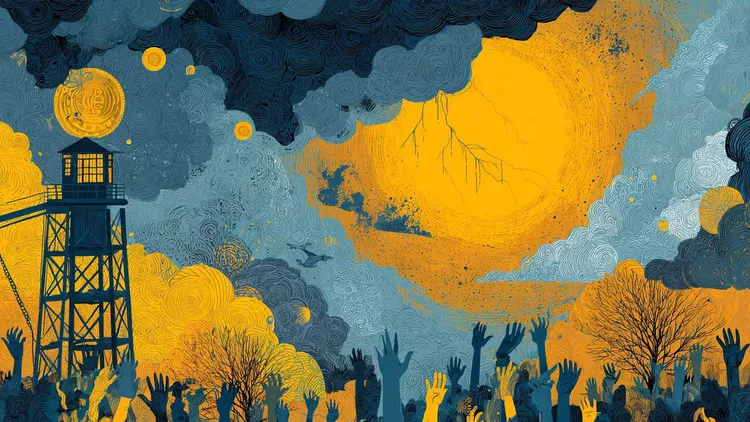
One is not born a fanatic; one is made into one. Gradually, and then suddenly, fascist agitation fabricates character types. These are years of acclimatisation — to a certain tone of voice, to the excitement, to the constant repetition of the same enemy stereotypes, to the pleasure of sharing in collective outrage, to the feeling of being part of a besieged community. Anyone caught up in the maelstrom of agitation soon perceives every slight as a moral justification for retaliation. These are formative years of inhumanity.
This is the era in which we now find ourselves once again.
Traditional analyses of fascism and theories about the “authoritarian personality” primarily examine which powerful social groups have an interest in authoritarian rule. Some convincingly describe how frustration, fears of economic decline, and a loss of trust in traditional labour parties make people susceptible to right-wing agitation. There has also been extensive and detailed research into the authoritarian personality traits of those particularly susceptible to right-wing worldviews. But very little research has been done on how people change when entire societies are swept up in a wave of coldness, and why they gradually begin to derive pleasure from a cult of harshness as it takes hold.
The Cult of Harshness on Display
One morning, Kristi Noem decided to shoot her dog. The pet was only 14 months old, disobedient, and defied all attempts at training. Instead of retrieving pheasants, she preyed on the neighbour’s chickens. In such cases, Noem explained, ruthlessness must prevail. Sentimentality has no place here. No mercy — that was the ostentatious message. By recounting the episode in her memoir, Noem, then governor of South Dakota, endeared herself not only to her supporters but also to Donald Trump, paving the way for higher office.
Later, as United States Secretary of Homeland Security, she posed theatrically in front of a detention camp in El Salvador to which migrants had been deported. With their heads shaved, they formed the backdrop to Noem’s staged performance. The message: atrocities must not only be committed; they must be publicly displayed. On social media, a whipped-up mob celebrated Noem’s actions. It was only when the paramilitary forces of federal agents under her command began shooting ordinary citizens and peaceful protesters that Noem became a liability to the administration and was removed from office.
The followers are co-productively entangled in this dynamic, which yields individuals consumed by a thirst for revenge and hostility, incited to join an (online) mob. This crowd of followers perceives every transgression by their leaders — and every transgression of previously fixed civilisational boundaries — as an act of liberation.
Theodor W. Adorno and his academic colleagues had already placed the “potentially fascist individual” at the centre of their research in their famous studies on authority and the family, as well as “on the authoritarian character”. Their primary concern, however, was with people socialised in authoritarian families, schools, and the strict hierarchies of the military during the First World War. The character traits of these authoritarian types included conventionalism, subservience, authoritarian aggression towards dissenters or those who deviated from conformism, superstition and stereotyping, a fixation on power and posturing, destructiveness, and cynicism. While these traits persist, a particular type of socialisation is now more dominant in right-wing movements — one that Adorno and his colleagues had already observed: the “crank”, the “rebel”.
Sigmund Freud, for his part, prophetically described in his Group Psychology and the Analysis of the Ego the changes an individual undergoes when joining a crowd, a “collective soul”. Drive inhibition ceases, a “diminishment of conscience” sets in, and “emotional contagion” and the “herd instinct” take effect. Ultimately, in False Prophets, Löwenthal describes a dynamic that reads like a chronicle of the present day. The agitator styles himself as a saviour; he not only wades through the malaise of social conditions but downright relishes it. He piles fabricated horrors onto real ones to justify any resistance. He speaks in a boorish manner — obscene and brimming with a lust for violence — but, according to Löwenthal, it is precisely “his bad manners that serve as a guarantee of his sincerity”. Anyone caught in the tunnel vision of such agitation sees nothing but crime, murder, manslaughter, and threats — even in the best-ordered communities in history. They develop a veritable paranoid delusion and live in a pseudo-reality.
Not only do contemporary social science and social-psychological theories provide ample evidence of the dynamics of de-civilisation; more granular research does as well. US scholars have recently studied the pathways through which fascist worldviews spread and noted that “objective” factors — such as economic decline, peripheral location, and high unemployment — offer little explanation. Instead, right-wing worldviews spread like “infections” through networks in regions where people have strong exposure to right-wing ideology. The more frequently people are exposed to slogans and collective reinforcement within these networks, the stronger the authoritarian dynamic becomes. Social researchers have found that even opponents of the far right become more xenophobic when constantly exposed to numerous xenophobic posters during an election campaign.
Other studies show that this “self-poisoning of the soul” is even more effective when an online ecosystem of agitation with distributed roles emerges. There are the “recruiters”, who coolly try to get people to sign petitions; then the “educators”, who spell out right-wing lines of argument in a seemingly logical manner; furthermore, the “flamers”, who spread toxic, inflammatory content; then the “motivators”, who reinforce a group identity (“We, the ordinary people, stand together against the elites and our enemies”); and finally the “micro-influencers”, who carry aspects of far-right worldviews into moderate circles and their friend groups.
Even in psychiatric research, researchers are grappling with this problem, as more and more people with psychotic disorders who also hold a far-right worldview are being admitted to hospitals. Not all far-right extremists are mentally ill, but many mentally ill people today are far-right extremists. The link between “psychopathology and extremist violence” has long been established, according to one research paper, but it has recently begun to make the work of doctors in hospitals quite difficult in practical terms.
The mass-psychological dynamics of these processes trigger an undeniable self-radicalisation within social circles, where far-right parties are only one factor. Feedback loops with an increasingly paranoid following and the pathologies of social-media propaganda are additional causes. Even the agitators themselves are, to some extent, merely pawns in this complex — like sorcerer’s apprentices who can no longer control their own creation.
The Return of the F-Word
Recently, a debate has arisen over whether “fascism” is a more appropriate term than euphemisms like “populism”. “Yes, it is fascism,” asserts Jason Stanley, a US scholar of fascism. Oliver Nachtwey and Carolin Amlinger speak of “democratic fascism”, arguing that these emotional worlds exist “as a fascist fantasy within democracy”. The philologist Jan Philipp Reemtsma, in turn, recently asked what is actually gained by using the “F-word”: “I need to examine the phenomenon, not talk about what to call it.” Others have disagreed, arguing that it is not about a phrase but about the analytically accurate assessment of this brutalisation, dehumanisation, and violence, as well as the societal endorsement and peculiar lust for destruction.
Contrary to the assumptions of the classic studies, an “authoritarian character” may not be a prerequisite for being swept up by an agitator at all, “but rather the result of this enthusiasm”, as the social psychologist Sebastian Winter has argued. The subject enamoured with resentment, much like the agitator, tends towards a strikingly theatrical “affective fury”, in the phrase of the psychoanalyst and social psychologist Hans-Jürgen Wirth — an exaggeration of tone and volume, a powerful surge of emotion that stems from the significance of fascism’s politics of emotion. Its fundamental emotional motifs are anger, hatred, vindictiveness, disgust, envy, resentment, bitterness, sarcasm, cynicism, destructiveness, and a refusal to empathise.
What characterises fascism? A cult of the leader, paranoid worldviews, absolute black-and-white thinking, and antagonistic enemy stereotypes — especially of minorities, but also directed against supposed internal enemies. Aggression is relentlessly whipped up. A cult of harshness aligns the fascist right, libertarians, and pseudo-liberals. Maximum negative emotionalisation transforms a following into an agitated and angry mob. The historian Robert O. Paxton once described fascism as a “nebula of attitudes”. It needs no theory because it thrives instead on “mobilizing passions”.
Fascism does not begin with murder; it begins with the pleasure of imagining it. Violence takes root within before it rages outward. At first, people merely laugh at the cruelty; then it is perceived as liberating honesty; and finally, as a necessary consequence in a hostile world. The fascistisation of speech is characterised by intense agitation, pathos, and brutality. The power of propaganda lies in making cruelty appear to be justice. The masses, in turn, give individuals carte blanche to be worse than they would be on their own. The subject is reformatted. The fanatic defends his feelings against the facts.
Seen in this light, fascism is more of a mood that gradually takes hold of and overwhelms one. The emotions of hurt, fear, envy, resentment, and the longing for redemption are contagious. This emotional contagion does not merely flow from agitators to followers but spreads in all directions. Much like synaptic connections in neural networks, these connections are strengthened the more intensively they are used. Emotions, tone of voice, and catchphrases are adopted, escalating into fanaticism. Fascism, then, is less an ideology than a social process. Contagion is no accident; it thrives in environments where emotions circulate like an echo that returns louder and louder, until the fanatic appears normal and the normal person appears suspicious.
This essay is based on Robert Misik’s book Education in Cruelty: The Mass Psychology of the New Fascism (Erziehung zur Grausamkeit. Die Massenpsychologie des neuen Faschismus), published by Suhrkamp Verlag in August 2026.

Help Keep Social Europe Free for Everyone
We believe quality ideas should be accessible to all — no paywalls, no barriers. Your support keeps Social Europe free and independent, funding the thought leadership, opinion, and analysis that sparks real change.
— €4.75/month
Help sustain free, independent publishing for our global community.
Become a supporter— €9.50/month
Go further: fuel more ideas and more reach.
Become an advocate— €19/month
Make the biggest impact — help us grow, innovate, and amplify change.
Become a champion— €142.50/month
For organisations and professionals who rely on Social Europe in their daily work.
Become a member