KEY INSIGHTS
- A shrinking fiscal capacity: Once off-budget instruments such as NextGenerationEU are counted, the EU’s real fiscal capacity falls from 1.43 per cent to 1.28 per cent of gross national income from 2028 onwards.
- Europe underinvests against its rivals: The EU’s net productive investment amounts to around two per cent of GDP, compared with roughly 23 per cent in China and four per cent in the United States.
- Borrow to invest: The authors call for a budget at least 10 per cent larger, a debt-financed successor to NextGenerationEU, and fiscal rules that exempt growth-enhancing investment at national and EU level.
- Spend more wisely: EU funds, above all the €409 billion European Competitiveness Fund, should be tied to conditions on quality jobs, local value creation, training, and collective bargaining.
When the European Commission presented its proposal for the next EU budget, covering 2028 to 2034, it called it a “budget for a stronger Europe”.
Given the scale of what Europe is up against — the twin green and digital transitions, sluggish growth and fiscal strain across member states, a security order upended by Russia’s war against Ukraine, an increasingly unpredictable United States wielding tariffs and transactional pressure, an ascendant China combining state-subsidised overcapacity with growing control over strategic supply chains, and a rules-based trading system under strain from all sides — a stronger Europe is indeed what we need.
However, when we look at the proposed EU budget, a stronger Europe is not what we may get.
The Commission presents the budget as one that will “equip Europe with a long-term investment budget matching its ambitions to be an independent, prosperous, secure and thriving society and economy over the coming decade”. Yet the striking €2 trillion headline figure shrinks considerably once it is put into context.
Relative to the size of the EU economy and in constant prices, the proposed budget differs only marginally from the current Multiannual Financial Framework (MFF), rising from 1.13 per cent of EU gross national income (GNI) to just 1.15 per cent (in 2025 prices). Even that comparison paints an incomplete picture, because it ignores off-budget instruments such as NextGenerationEU (NGEU), which have contributed considerably to financing investment in the current funding period. Once all off-budget instruments are factored in, the picture becomes bleaker still: the EU’s real fiscal capacity is set to fall from 1.43 per cent to 1.28 per cent of GNI from 2028 onwards, largely because NGEU expires in 2026 with no successor in sight.
Meanwhile, some member states are pushing for even deeper cuts. Germany, a traditional advocate of budgetary austerity, has called for cuts of 20 per cent relative to the Commission’s proposal.
The likely result is a substantial shortfall in investment. Even under the Commission’s own proposal, the EU would face an annual private and public investment gap of €300 billion (Koch and Biegon, 2025). And this is a conservative estimate: it captures only the gap related to EU-level investments — cross-border infrastructure, energy grids, coordinated industrial decarbonisation — and excludes crucial fields such as social investment and climate adaptation. Combined with national-level investment needs, the total gap rises to around €1,200 billion. National governments, however, have limited room to fill the gap themselves, constrained as they are by the EU’s fiscal rules (ETUC, 2024).
This is not a budget for a stronger Europe. The proposed MFF, together with strict EU fiscal rules, risks leaving Europe with less, not more, capacity to invest, precisely as investment needs are rising: in the resilient supply chains, technological innovation, and local production needed to reduce dependence on the US and China; in the decarbonisation and digitalisation needed to advance the EU’s economic model; and in the quality jobs and regional development needed for a just transition.
Meanwhile, the US and China are not so much hitting the brakes on debt as shifting into high gear on investment in future technologies and strategic sectors. China currently invests around $5.9 trillion a year — more than 30 per cent of GDP — compared with $5.1 trillion in the US (17 per cent of GDP) and just $3.1 trillion in the EU (16 per cent of GDP). Much of Europe’s investment, moreover, merely replaces ageing assets: its net productive investment amounts to only around two per cent of GDP, compared with roughly 23 per cent in China and four per cent in the US (McKinsey, 2026). For the EU, this is bad news, since net productive investment is widely regarded as an indicator of future growth and productivity.
Net productive investment, 1995-2024
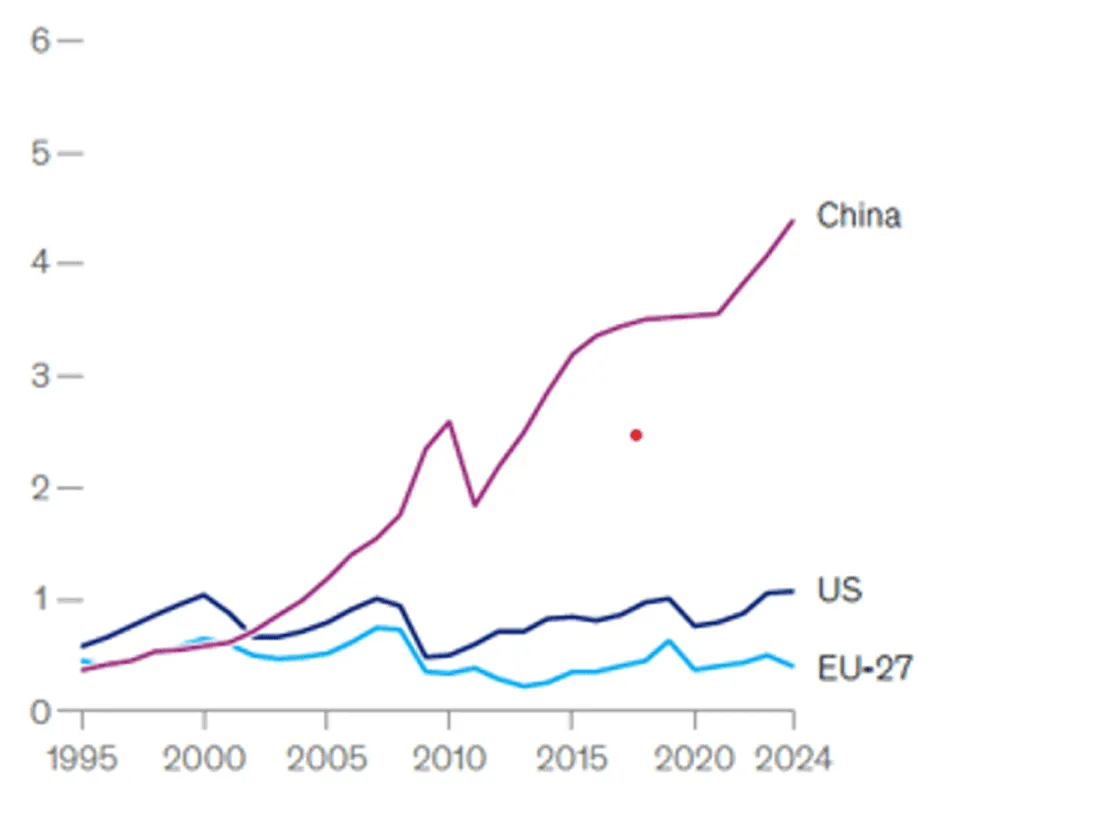
Source: McKinsey 2026
But it need not be this way. The EU should do two things.
The first is fairly obvious. If Europe is investing too little, it needs to start investing more — publicly and privately. Instead of debating a supposedly “excessive” budget proposal, member states should follow the European Parliament’s proposal to increase the budget by at least 10 per cent. This is roughly equivalent to the amount earmarked for repaying NGEU and would restore some room for manoeuvre for productive investment.
It is also time to move beyond the reflexive ideological war over EU debt instruments. NGEU boosted growth, funded green and digital modernisation, and supported millions of young people into education and employment. A successor is therefore worth discussing: a new debt-financed investment programme targeting areas of strategic EU interest and future technologies. Debt financing at EU level makes sense not only to fund urgently needed investment but also for broader fiscal and strategic reasons (Paetz, Rinne, and Watzka, 2026). Common EU borrowing offers a more efficient way to finance large-scale investment while creating a deeper pool of safe European assets. Over time, this could strengthen the euro’s international role, reduce Europe’s reliance on US financial markets and the dollar, and increase the EU’s economic and strategic autonomy.
None of this will unlock its full potential, however, unless the EU also reforms its fiscal rules. Member states should be allowed to finance growth-enhancing public investment through borrowing. The same logic should apply at EU level: debt instruments within the upcoming MFF, such as the proposed Catalyst Europe loans, should likewise be excluded from net expenditure, since they too enable growth-enhancing investment.
More broadly, EU fiscal rules should be designed to support, not constrain, the long-term modernisation of Europe’s public capital stock. The National Escape Clause (NEC) already offers short-term flexibility, allowing member states to increase borrowing temporarily in exceptional crises. The EU originally activated the clause to allow defence investment; recently, it widened the scope to include investment in the energy transition amid repeated global fossil fuel crises. Further use cases, notably the twin transition, are plausible and should be considered.
Yet the EU does not lag behind the US and China only because it invests less: its spending has also been less targeted and less efficient. This is where the second aspect comes in.
While the US Inflation Reduction Act (IRA) ties support to conditions such as quality employment and domestic content, the EU has so far used strategic conditionalities only selectively, without a systematic focus on strengthening the single market, local production, or decent work. Where capital faces no conditions, it tends to follow the path of least resistance and highest returns — which, in a financialised economy, are often financial rather than productive. This is why large chunks of capital in the EU have, over the past two decades, flowed into shareholder payouts, financial assets, and balance-sheet accumulation rather than productive investment, innovation, and employment (UCL, 2026).
As returns are extracted rather than reinvested, the productive base on which future value depends is run down. Reversing this requires clear social conditionalities: obligations to reinvest profits, commitments to local value creation (local content), investment in qualification and training, or the application of collective bargaining. The IRA has shown that such conditionalities can trigger a spike in investment in strategic sectors, with positive effects on employment, wages, and regional development — precisely what the EU needs (Roosevelt Institute, 2026).
For the next EU budget, this means attaching clear conditionalities to EU funds — above all to the planned European Competitiveness Fund, set to disburse €409 billion to companies, to date largely without strings attached. These funds must be tied to securing high-quality jobs in the EU and strengthening European value creation.
Europe needs a joint, forward-looking investment offensive — one that lets the EU seize the moment, take the lead in shaping tomorrow’s industries and jobs, and free itself from its dependence on volatile partners. A stronger Europe is possible — but only if it dares to spend more, breaks with the logic of austerity, and spends what it has more wisely, tying every euro to conditions that serve Europe’s future.


Help Keep Social Europe Free for Everyone
We believe quality ideas should be accessible to all — no paywalls, no barriers. Your support keeps Social Europe free and independent, funding the thought leadership, opinion, and analysis that sparks real change.
— €4.75/month
Help sustain free, independent publishing for our global community.
Become a supporter— €9.50/month
Go further: fuel more ideas and more reach.
Become an advocate— €19/month
Make the biggest impact — help us grow, innovate, and amplify change.
Become a champion— €142.50/month
For organisations and professionals who rely on Social Europe in their daily work.
Become a member