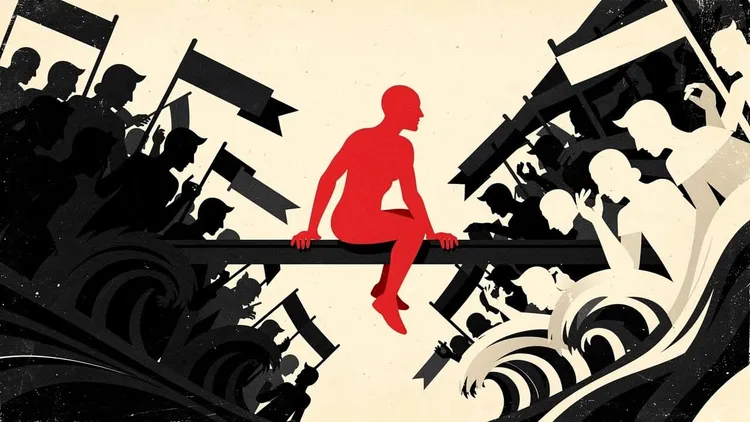
The European left is going through a crisis. In an insightful article, ‘What happened to Europe’s left?’, Jan Rovny explains that the various political defeats of social-democratic parties—in France, Germany, Italy, Holland, the Czech Republic and Greece—stem from shifting their focus to the new middle classes, letting the ‘precariat’ fall for nationalist protectionism. For Rovny, the political sphere is crystallising as a new cleavage between cosmopolitans and traditionalists, where the left, especially social democracy, is gradually being discarded.
Social democracy’s revival must find its source in a new European project. In a crisis, it is better to return to the fundamentals. Historically, socialism and social democracy embodied internationalist values. Unlike extremist parties, European construction is a leftist battle. So, the upcoming European elections could be a good opportunity for the left to reaffirm its values.
Nevertheless, this will only possible by committing to fundamental guiding principles. The first should be that the Party of European Socialists (PES) break definitively with the European People’s Party (EPP). After all, is it not conservativism’s aim to maintain the established order? Many citizens think Europe does not have any impact on their daily life. The ‘grand coalition’ between the EPP and PES contributes towards reinforcing extremism.
Social democrats and socialists, gathered in the PES, must finally break with the conservatives of the EPP. This is the only way to disrupt the European status quo and adopt bold proposals. Even in the event of defeat, the PES will be better off within the parliamentary opposition than in an EPP-dominated commission where its influence is lacking.
Institutional reform
Furthermore, the conservatives reject any global reform of the Institutions. But the European left must put on the table an institutional reform, promoting a real legislative force and effective supervisory power for the European Parliament. Too often, the parliament is reduced to being a mere echo chamber, when it should control the European Commission.
The parliament should obtain greater budgetary and monetary prerogatives. For instance, it could vote on the various economic objectives such as deficit or debt targets. And it could acquire more legitimacy with real European elections: transnational lists should focus on European issues and challenges, refusing to allow the elections to be dominated by national issues.
It is also important to ensure a strong role for the Committee of the Regions and the Economic and Social Committee, to promote a European social dialogue. Finally, the European left should push for once and for all for a proper, full-scale European budget, financed by more efficient taxation and more oriented toward infrastructure investments and regional development.
Fiscal reform
In her recent book, Leftism Reinvented, Stephanie Mudge argues that left-wing parties have given up their duty to protect the poorest, paving the way for extremist parties. If the judgment appears very harsh, left-wing politicians have to take it seriously.
The European left should propose a common fiscal reform. EU member states should harmonise their taxes and define common rates, particularly for corporate taxes. This policy would have two advantages: limiting the dumping effects, still apparent in the single market, and taxing global companies more efficiently.
Indeed, for years, we have seen the rise in power of many big companies, particularly in the digital sector (the infamous GAFA), whose activities are more difficult to locate and thus tax correctly. In the spirit of social justice, we should tax these firms at the European level, according to their number of users in each country. Such common taxation could be extended to limiting the obscene profits of the European soccer industry, for instance.
The benefits of this new European tax should supplement the European Social Fund and the Cohesion Fund to foster the construction of the common European social model. And when it comes to trade agreements, the European left should above all reaffirm its commitment to a strong European industrial base and environmental and social standards, as the only way to impose an efficient and protective European transnationalism.
Social ecology
A crucial goal for the European left will be to convince voters that Europeanisation and globalisation are not necessarily bad things. As Roberto Unger put it, the question should not be ‘how much globalisation?’ but rather ‘what manner of globalisation?’.
If the EU has achieved its main historic goal—bringing sustained peace—it must rise to a new objective: creating a common social model, based on solidarity and common identity. It will be the prerequisite for a Europe which changes people’s lives and ensures solidarity.
The left must play a key role here—first, by promoting an ecologically-minded ideology. Today, it is not possible to be on the left without being ecological. The concept of social ecology establishes that ecological policy must be the starting point for all social policies. Facing global warming, the European left could propose a European environmental treaty, which could represent an ecological counterpart to the Stability and Growth Pact and the Maastricht criteria.
Secondly, the European left, if it wins power, must demonstrate that Europe can bring social progress. A European migration strategy, currently absent, could finally resolve the migratory crisis. A directive currently limits the working week to 48 hours—this ceiling should be further reduced. And those states condemned for abrogations by the European Court of Human Rights should be financially sanctioned by the European Commission, so as to encourage social progress. The EU would then act as a protective shield for its citizens and it would be possible to realise a ‘European dream’, more focused on politics and citizenship.
If the European left succeeds in proposing ambitious ideas for change, it will regain power in the various European countries. Institutional reforms, social and fiscal harmonisation, ecological ambition, social progress—it should take ownership of these concepts in the coming months.
Help Keep Social Europe Free for Everyone
We believe quality ideas should be accessible to all — no paywalls, no barriers. Your support keeps Social Europe free and independent, funding the thought leadership, opinion, and analysis that sparks real change.
— €4.75/month
Help sustain free, independent publishing for our global community.
Become a supporter— €9.50/month
Go further: fuel more ideas and more reach.
Become an advocate— €19/month
Make the biggest impact — help us grow, innovate, and amplify change.
Become a champion— €142.50/month
For organisations and professionals who rely on Social Europe in their daily work.
Become a member