KEY INSIGHTS
- Deficits without discipline: Since the financial crisis the US has not once met Europe’s three per cent deficit criterion, running crisis-level deficits even at something like full employment.
- Rates at worrying levels: Ten- and 30-year Treasury yields have hit around 4.7 and 5.2 per cent, while above-target inflation hems in the Fed’s scope to intervene.
- Europe pays for America’s excess: A euro surge, weaker US import demand, or imported inflation could hit Europe, which has no say over the US decisions that trigger them.
- A safe asset as insurance and investment vehicle: A permanent EU borrowing capacity financed by own resources would fund public investment cheaply and defuse national doom loops.
- The window is open: With China diversifying and Japan exposed, global investors stand ready to hold EU bonds and for Europeans to reverse the €300 billion savings drain.
As my mother is fond of saying, you can have too much of a good thing.
In the US, fiscal deficits have aggressively offset negative shocks (the global financial crisis and the pandemic) and boosted investment in industrial transformation (Joe Biden’s misleadingly titled Inflation Reduction Act).
Meanwhile in Europe, adherence to fiscal orthodoxy, while permitting some shock absorption, has made fiscal policy more restrictive and, notably, has prevented a vigorous expansion of public investment to match declared policy ambitions. At least part of the much-bewailed gap between US and EU economic performance reflects not structural factors, as usually claimed, but rather just a much more expansionary fiscal policy on the other side of the Atlantic.
But America has clearly had way too much of a good thing.
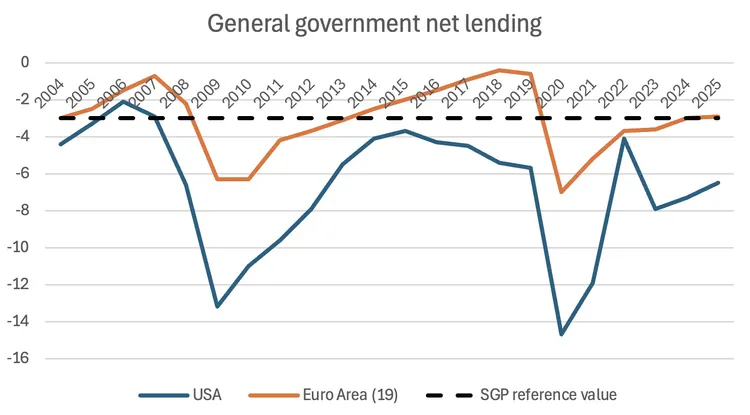
Fiscal Chickens Come Home to Roost
The problem is not the big swings into deficit — here the EU should learn from America — but the persistent failure to rebuild fiscal firepower in good times. Strikingly, since the global financial crisis, the US has not once met Europe’s three per cent deficit criterion! And particularly so in the last three years, when the US has run deficits at the same level as Europe did in the depths of its crisis, despite a quite vigorous recovery and something like full employment.
It is not just the persistent deficits that have driven the recent sharp rise in interest rates; long-end yields on 10- and 30-year Treasuries, decisive for the cost of borrowing for the private sector too, have hit around 4.7 per cent and 5.2 per cent respectively. There are more fundamental and serious concerns about the US policy framework and about the prospects for inflation.
Massive permanent tax cuts in the One Big Beautiful Bill, the costly and inflationary Iran war, inflationary tariffs (revenue from which is now largely being returned to importers rather than filling Treasury coffers), Donald Trump’s attacks on the Federal Reserve, and the weaponisation of the dollar — to mention just the most important — all constitute fiscal chickens coming home to roost. Both domestic actors and the holders of huge volumes of US government bonds abroad are exhibiting a well-justified, fundamental lack of confidence in expected real returns, in US policy, and thus in the value of the assets in their portfolios. (Bond values and interest rates move inversely.) The dollar privilege that enabled the US to run large deficits is crumbling.
The problem is that US Treasuries are the most important financial asset in the world, the bedrock of the global financial system. The market will not necessarily spiral into crisis. But recent tinkering by Scott Bessent’s Treasury has only served to underline fragility rather than build confidence. And with inflation indicators stuck at above-target rates and more inflationary shocks likely in the pipeline — wheat prices, Canada tariffs — the scope for the Fed to step in pre-emptively is limited: there is a huge risk of “fiscal dominance” if the Fed were to underwrite what is clearly a structurally unsustainable fiscal stance, shattering its credibility in the process.
In short, a crisis is not inevitable, but the risk is growing daily, and if the fiscal faeces does hit the fan, it will be sprayed across the Atlantic. Already, European rates are being dragged up by the US hoovering up global capital, also for the AI boom or, more likely, bubble. Looking ahead, some combination of a sharp appreciation of the euro, a further drop in US import demand, and/or a backwash of inflationary pressure is likely, depending on developments in the US and decisions taken there, over which — and this is the key point — Europe has essentially no influence. (If in any doubt on that score, recall that Bessent did not even inform, much less consult, the European Central Bank (ECB) before opting to use euros to prop up the yen as a way of propping up the Treasury market.) The consequences of US fiscal irresponsibility risk being offloaded onto fiscally cautious Europeans, as happened with the sub-prime crisis. The US gets the boost. Europe gets the blast.
Now is the time for counter-action.
Europe’s Moment to Build a Safe Asset
A threat can often be a blessing in disguise. In fact, the growing pressure on the dollar-centred global financial framework in general, and on the US Treasury market in particular, is a huge opportunity that Europe should grasp. The times were never more propitious for Europe to establish a market for EU debt.
The long-standing arguments still hold. There is broad agreement on the need for a massive investment initiative to deepen Europe’s strategic autonomy and sustainability: in renewables, transport and energy infrastructure, in digital technology, security, and “preparedness”. Much of this will need to be public-sector-led and has the character of a European public good. A joint European borrowing capacity is not now — as in the old Eurobond debate of the euro crisis — primarily about bailing out national fiscal positions. Still, it would ensure that public investment could take place across the EU, at low interest rates, even in countries with currently little fiscal space. And by generating a single safe asset, it would help reduce the risk of the national “doom loops” between fiscal authorities and banking systems that wreaked such havoc in the 2010s. It would also enable the ECB to intervene in the bond market when needed, without the tortuous structures and arguments surrounding purchases of national bonds.
What is new is the international context. The dollar system is visibly weakened. International investors are nervous. China has already substantially diversified out of the dollar. Many countries, Japan first and foremost, would dearly like to reduce the vulnerability that comes from massive holdings of US paper. Confronted with the Trump administration, non-euro investors near and far will be willing to hold EU bonds: securities issued by an entity that is renowned, if for nothing else, for its stolidity, and that is trying, as best as is currently possible, to uphold international trade norms. This, in turn, will enable Europe to finance needed investment considerably more cheaply, also by partly reversing the outflow of European savings to the US (around €300 billion a year, according to the Draghi Report). Last but not least, it will help to achieve a smooth transition towards a more multipolar global financial and economic system, one into which, hopefully, countries such as China and India can be integrated.
From a purely economic point of view, it is, of course, a complete absurdity that a body with the global economic weight of the EU lacks its own substantial and permanent treasury market. (The bonds issued under NextGenerationEU (NGEU) have a kind of proof-of-concept function, but NGEU is explicitly conceived as a temporary measure, even if its bonds — which were in high demand — will circulate for many years.) The barrier has always been political and legal. (Some legal ways forward are discussed here.) What is clear is that the framework conditions have never been more favourable. The fact that negotiations on the next seven-year EU budget are under way, and look tortuous, may also prove fortuitous. A borrowing capacity financed by enhanced own resources could be a way to enable the higher EU spending favoured by some countries while avoiding the pressures on national budgets opposed by others.
America’s fiscal travails pose significant risks for Europe. The EU should take out insurance by swiftly establishing an EU safe asset — bonds serviced out of its own resources — even if initially small in volume or outside the treaties. In the longer run, the weakening of the dollar-based system opens up opportunities for Europe to shed its dependence on the US, painfully visible in recent months, and to boost its autonomy on the world stage. Alongside other measures, such as European payments systems, a growing, liquid market for EU bonds is an essential pillar, generating the low-cost financial resources Europe needs to fund the investment required to drive its economic transformation.

Help Keep Social Europe Free for Everyone
We believe quality ideas should be accessible to all — no paywalls, no barriers. Your support keeps Social Europe free and independent, funding the thought leadership, opinion, and analysis that sparks real change.
— €4.75/month
Help sustain free, independent publishing for our global community.
Become a supporter— €9.50/month
Go further: fuel more ideas and more reach.
Become an advocate— €19/month
Make the biggest impact — help us grow, innovate, and amplify change.
Become a champion— €142.50/month
For organisations and professionals who rely on Social Europe in their daily work.
Become a member